CEREMONY
Wedding Traditions Explained: Where They Came From, What's Myth, and What to Keep
An NYC officiant traces where common wedding traditions actually come from, which romantic backstories are myth, and how to keep, cut, or reinvent each one with respect.
A bride stopped me three days before her wedding, half-apologizing, to ask whether she was “allowed” to skip the part where her father walks her down the aisle. She loved her dad. She also paid her own rent, owned her own apartment, and felt strange being handed off like a deed changing hands. So I told her what I tell most couples. Half the rules you think you’re breaking were invented to sell something or settle a dowry, and the other half are younger than your grandmother.
I write and perform ceremonies for couples all over New York, plenty of them intercultural or interfaith, and the question I get more than almost any other is some version of “where does this come from, and are we allowed to do it.” Here are the real answers.
The short version: most of the traditions couples lose sleep over keeping or cutting are Victorian inventions or 20th-century marketing, not ancient law. And the ones with the deepest, most specific cultural roots are usually the ones couples want to borrow without knowing the weight they carry. That gap is the whole game.
Each section below gives you the real origin first and then how I’d handle it in a ceremony.
Why knowing the origin actually changes your wedding
I’m no historian. I’m the person standing in front of you when you say your vows, and my job is to make sure every piece of your ceremony means something to you specifically.
Here’s what I watch happen over and over. A couple keeps a tradition because they assume it’s required, it sits there in the ceremony like a rented chair, and nobody feels anything when it happens. Then I ask why it’s there, they can’t answer, and we either cut it or rebuild it into something they can defend out loud.
So I’m going to walk through the traditions couples ask me about most, tell you where each one actually comes from, flag the romantic backstories that turn out to be myth, and tell you exactly how to keep, cut, or reinvent it.
Where does the white wedding dress really come from?
Almost everyone believes Queen Victoria invented the white wedding dress. She didn’t.
Brides wore white centuries before her. English Princess Philippa wore a white gown lined with ermine and squirrel fur in 1406, and Mary Queen of Scots wore white in 1558 (Wikipedia). What Victoria did in 1840 was make it fashionable, because her wedding was reproduced in newspapers and fashion plates and everyone with aspirations copied it (Smithsonian Magazine).
And the meaning we all assume? Retrofitted, too. White started as a flex about money, not virtue. A white gown could be ruined by a single afternoon of actual work, so wearing one announced that your family belonged to the leisure class. The “white equals purity” reading got projected backwards onto the dress during the Victorian era, and so did the “wear it only once” rule. Victorian brides, Victoria included, commonly restyled and rewore their gowns (JSTOR Daily).
How to hold this one: wear whatever color you want, and skip the guilt about it. If you’re a second-time bride who’s been told white “isn’t for you,” that’s Victorian status anxiety, not a rule. I’ve married women in deep red, in gold, in their mother’s restyled dress, and not one of those ceremonies felt less married.
What’s the real history of the veil?
The veil is the elder statesman here. It beats the white dress by roughly two thousand years.
The Roman bride’s veil, the flammeum, wasn’t white at all. It was flame-colored, a deep saffron yellow that Pliny the Elder compared to egg yolk. It covered the bride head to toe, and the point was almost theatrical. She was meant to look like she was on fire, both to ward off evil spirits and to invoke the flame of Vesta, goddess of hearth and home (Ancient Origins).
So the soft, sentimental object we have now started life as a piece of protective armor.
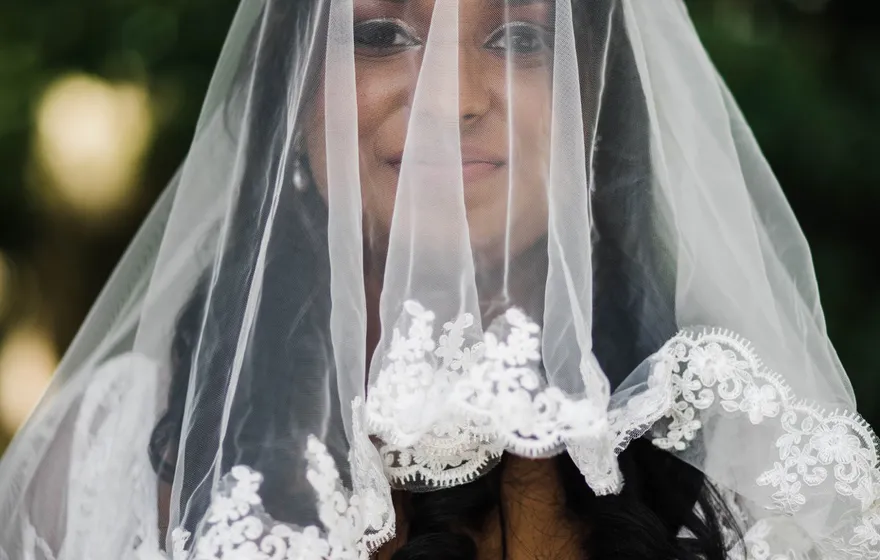
How to hold this one: the veil carries no single fixed meaning, which means you get to assign it one. I’ve had brides wear a grandmother’s veil specifically as the “something old,” and I’ll name that in the ceremony so the room knows whose hands made it. If the lift-the-veil moment feels like a man unwrapping a possession, skip it. Walk in with your face showing, and keep the veil for the photos if you love how it looks.
Something old, something new: what does the rhyme actually mean?
You know the rhyme. You probably don’t know it has a forgotten fifth line.
The full version is “something old, something new, something borrowed, something blue, and a sixpence in her shoe.” It’s a Victorian rhyme from Lancashire, England, first documented in an 1871 issue of St. James’s Magazine (Mental Floss).
The original meanings were superstitious and protective, not sentimental:
- Something old: protection for a future baby
- Something blue: purity and fidelity
- A sixpence in her shoe: prosperity, plus a charm against frustrated former suitors
That warm “carry a piece of your history” reading we use today is a modern softening.
What does breaking the glass mean at a Jewish wedding?
This is the moment everyone waits for. The foot comes down, the glass shatters, the room shouts “Mazel tov.” Most people assume it has always meant one solemn thing. It hasn’t, and that’s the beauty of it.
The earliest reference, in the Talmud (Berakhot 30b-31a), describes a rabbi smashing a cup to sober up guests who’d gotten too merry. It was a check on the joy, a way to put some weight back into the room. The famous association with the destruction of the Temple in Jerusalem didn’t attach until roughly the 14th century (My Jewish Learning).
Today it carries several readings at once: the Temple, the fragility of relationships, the breaking of the tablets at Sinai, a noisy joy. None of them cancels the others out.
How to hold this one: if this is your tradition, you don’t have to pick a single meaning. I’ll often name two or three in the ceremony and let the couple keep whichever one moves them. If it isn’t your tradition, this is not a ritual to borrow for the dramatic crunch. Its weight is religious and communal, and lifting it for spectacle empties it.
Is jumping the broom an African tradition or something else?
Here’s one where the honest answer is “it’s contested,” and a respectful post has to say so.
The story you’ll hear most is that jumping the broom comes straight from Ghana or the Asante people. Historian Tyler D. Parry questions that clean origin. His work argues the ritual shares more with British Isles besom-wedding customs and the cultural exchange between enslaved African Americans and poor white Southerners in the 18th and 19th centuries. Welsh Romani communities had their own besom wedding, “priodas coes ysgub.” The practice came roaring back among African Americans after Alex Haley’s Roots aired in the late 1970s (Wikipedia).
None of that contested history makes it less real, or less yours if it’s yours. For many Black American couples, jumping the broom honors ancestors who were barred from legal marriage and built their own rites anyway. That meaning is earned, and it stands whatever the deepest root turns out to be. If this is your heritage, I’ve written a fuller walkthrough of the ritual in my guide to jumping the broom.
How to hold this one: if this is your heritage, do it and do it proudly, and let your officiant name why it’s there. If it isn’t, this is not a generic “fun jump” to add for energy. Borrowing it without the history flattens the exact thing that gives it power.
What is el lazo, the wedding lasso?
El lazo is one of my favorites to watch, because the symbol is so plain and so good.
After the couple’s vows, the padrinos (the sponsors) drape an oversized rosary around both their shoulders, looping it into a figure-eight. That infinity shape stands for unending, unbreakable union, and the crucifix rests in the center, between the two of them, to signify God’s presence in the marriage. The custom is centuries old and lives in Mexican, Filipino, and Spanish Catholic ceremonies. Many families pass the same lasso down for generations, so the cord around your shoulders may have circled your grandparents too.
How to hold this one: el lazo is explicitly religious and sacramental, so it belongs in Catholic or culturally connected ceremonies. If you love the “bound together as one” image but you’re secular or interfaith, don’t strip the rosary of its faith and keep the prop. Choose handfasting instead, which gives you the same physical binding without borrowing a sacrament. More on that below.
Where does “tying the knot” come from?
People say “tying the knot” without realizing it’s literal.
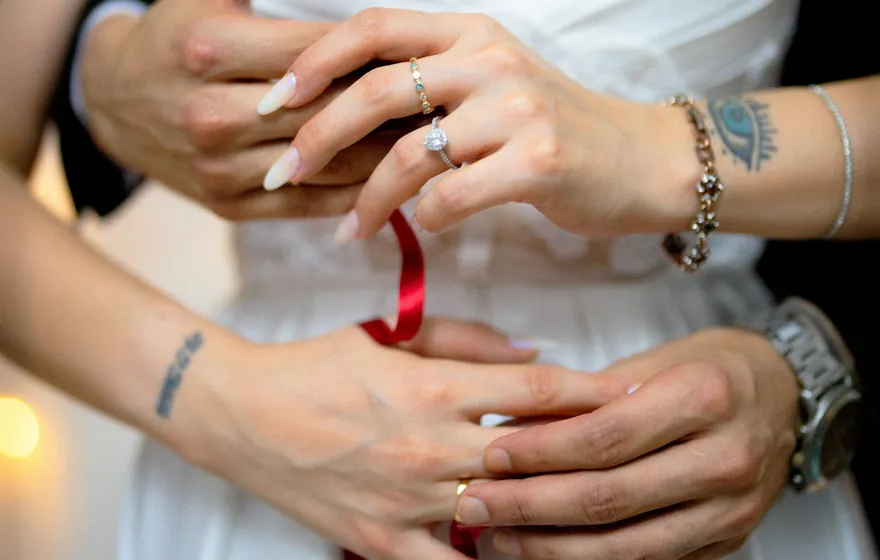
It comes from Celtic handfasting, where the couple’s hands were bound together with cord or ribbon. Under old Irish Brehon law, handfasting was the official marriage ceremony, and it often started as a trial marriage lasting “a year and a day,” after which the couple could continue or part ways (The Wild Geese).
That history is exactly why I recommend handfasting to so many couples. It predates church oversight, it isn’t tied to one religion, and it gives you a physical, visible “we are joined” moment you can adopt honestly without lifting it from a living faith you don’t belong to.
Here’s a full, copy-ready handfasting script you can use as written or adapt. It’s secular, so it works for almost anyone.
Officiant (to the room):
“Long before there were marriage licenses, couples were married by the binding of their hands. The phrase ‘tying the knot’ is not a metaphor. It is this.”
(Couple joins hands, right to right and left to left.)
Officiant:
“These are the hands of your best friend, holding yours on your wedding day, promising to hold them through every ordinary day after.”
(Loosely drape the first cord across their joined hands.)
“With this cord, you are bound to the home you’ll build together.”
(Drape the second cord.)
“With this one, you are bound to the patience you’ll need on the hard days, and the laughter that gets you through them.”
(Gently tie a single loose knot, or loop the cords so they hold.)
Officiant (to the couple):
“This knot is not a trap. You’re not bound because you have to be. You’re bound because you each looked at the whole of this person, and chose them on purpose. Hold on to each other the way you’re holding on right now.”
(Couple may slip their hands free, leaving the cords loosely knotted to keep.)
Officiant:
“Keep these cords. Years from now, when you find them in a drawer, remember the day you tied them, and the people who watched you do it.”
If you want more ways to build a binding or unity moment that’s genuinely yours, I’ve gathered a stack of them in my round-up of unity ceremony ideas, and there’s a fuller walkthrough of the ritual itself in the handfasting guide.
Is the “first look” a real tradition?
The photographed first look, where the couple meets privately before the ceremony and a photographer catches the reaction, feels timeless. It’s barely older than your phone.
The original rule, that the groom shouldn’t see the bride beforehand, came out of arranged-marriage and dowry logic, plus a later superstition that an early glimpse would jinx the union. Part of the real reason was blunt and practical. Keep the couple apart so the groom couldn’t get a good look and back out of the deal (J Morris Flowers).
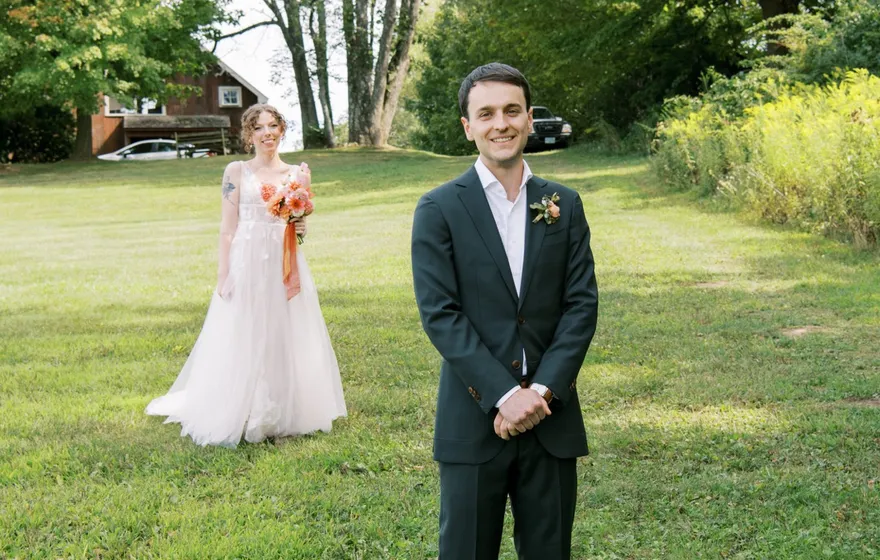
The modern first look flips a superstition rooted in fear into a private, tender moment. It’s a reinvention, and a lovely one.
How to hold this one: do whichever serves you. If you want a quiet moment together before the noise of the day, take the first look with zero guilt about “bad luck,” because the bad-luck rule was about preventing buyer’s remorse, not protecting love. If you want the aisle to be the first time you see each other, keep it. Both are valid, and neither is more traditional than the other in any way that should bind you.
Why does the bride stand on the left?
You’ll hear that the bride stands on the left so the groom’s right hand, his sword hand, stays free to fight off rival suitors, with the best man standing armed and ready to help.
It’s a great story. It comes from marriage-by-capture lore, and it’s the kind of dramatic origin that gets repeated everywhere and is genuinely hard to verify as literal history (The Vintage News). I’d treat it as folklore, not fact.
How to hold this one: stand wherever you like. For two grooms, two brides, or anyone who finds the “captured bride” framing a little grim, side placement is purely about sightlines and photos. I usually set couples so the partner whose family is larger has them in easy view, or simply so the light is good. There’s no rule here worth obeying.
How do you decide which traditions to keep?
This is the part couples actually need, so here’s my working method.
I ask one question of every tradition a couple wants to include. Can you tell me, in a sentence, why it’s in your ceremony? If the answer is “because that’s what you do,” that’s a red flag, not a reason. If the answer is “because that broom belonged to my great-aunt and she raised my mother,” now we have a reason worth saying out loud.
Here’s the whole post in one table, so you can see where each tradition stands.
| Tradition | Real origin |
|---|---|
| White dress | Wealth, not purity |
| Veil | Roman, flame-colored |
| The rhyme | Victorian, 1871 |
| Breaking the glass | Talmud, then Temple |
| Jumping the broom | Contested |
| El lazo | Catholic sacrament |
| Handfasting | Celtic |
| First look | Modern |
| Bride on the left | Folklore |
Every row comes back to the same question about why it’s in your ceremony.
Where each tradition sits also matters. A binding ritual hits differently right after the vows than it does at the start, and the broom belongs at the very end, as a threshold you cross together. If you’re sorting out sequence, my guide to wedding ceremony order walks through where each piece naturally falls.
And if you’re blending two cultures or two faiths, the goal isn’t to cram in every tradition from both sides until the ceremony buckles. It’s to choose the few that carry real weight for each of you and let the officiant name their origins with respect, so your guests understand what they’re watching. I get into the how of that in my piece on interfaith wedding ceremonies.
When you include a borrowed ritual, have your officiant say one plain sentence about where it comes from before it happens:
“This is el lazo, a tradition from Maria’s family in Mexico, and it means their union has no end.”
That single line does two things. It honors the source, and it lets every guest in on the meaning instead of watching a mystery. Silence around a borrowed ritual is what makes it feel like decoration.
Build the ceremony you can defend
Here’s where I’ll be honest about what I do for a living. Most couples come to me sure they have to follow a script handed down from somewhere, and they leave realizing the script was always theirs to write.
If you want to do that work yourself, you can. The whole point of knowing these origins is permission. Keep the white dress because you love it, not because purity demands it. Do the handfasting because the binding moves you, not because a year-and-a-day trial marriage ever applied to you. Choose on purpose.
If you’d rather not start from a blank page, that’s exactly what I built the Couple’s Ceremony Kit for. It gives you the full structure, the wording, and the ritual options laid out so you can pick what fits and skip what doesn’t, without guessing whether you’re “allowed.” It’s the difference between staring at an empty document and editing something that already holds together.
And when a specific heritage is yours to honor, I have written deeper guides to Black wedding traditions, Jamaican, Caribbean, and African wedding traditions, plus what actually happens in a Hindu, Jewish, or Catholic wedding ceremony.
Or start smaller and free. Grab a complete sample ceremony script and read a real one end to end. Seeing where the traditions actually sit in a working ceremony tends to answer half the questions couples bring me before they ever ask them.
Frequently asked questions
Did Queen Victoria invent the white wedding dress?
No. Brides wore white centuries before her, including English Princess Philippa in 1406 and Mary Queen of Scots in 1558. Victoria’s 1840 wedding popularized the look through newspapers and fashion plates, but she didn’t originate it. White originally signaled wealth, a dress you could ruin and afford to wear once, and the “white means purity” meaning was added later in the Victorian era.
Is it disrespectful to include a tradition from a culture that isn’t mine?
It depends on the tradition and how you hold it. Rituals with deep cultural and religious weight, like el lazo, jumping the broom, or breaking the glass, carry meaning that isn’t yours to repurpose casually. If a ritual connects to your partner’s heritage, a faith you both share, or you’ve been genuinely invited into it, including it with understanding is honoring it. When in doubt, ask the family it belongs to, and name its origin out loud in the ceremony.
What does breaking the glass at a Jewish wedding mean?
It holds several meanings at once. The oldest, from the Talmud, was to restore solemnity to a joyful occasion. By the 14th century it became a reminder of the destruction of the Temple in Jerusalem. Couples today also read it as the fragility of relationships, or simply as a joyful, noisy “Mazel tov” moment. All of those readings coexist.
What is the wedding lasso (el lazo) and can non-Catholics use it?
El lazo is an oversized rosary that sponsors (padrinos) drape around the couple’s shoulders after their vows, forming a figure-eight that symbolizes infinite union, with the crucifix resting between them. It’s rooted in Mexican, Filipino, and Spanish Catholic ceremonies and tied to the sacrament of marriage. Because it’s explicitly religious, it’s best kept within Catholic or culturally connected ceremonies. Couples who want the “bound together” symbolism without the religious frame often choose handfasting instead.
Which wedding traditions are okay to skip?
Almost all of them, if you understand what you’re skipping. Many “timeless” customs are recent inventions or were never required: the photographed first look, the “something blue” rhyme, the white dress as a purity statement, the bride standing on the left. My test is simple. If you can’t say out loud why a tradition is in your ceremony, either cut it or rewrite it into something you can.
The Couple’s Ceremony Kit
Walk in with a ceremony that sounds like the two of you
This post covers one part of the ceremony, and the Couple’s Ceremony Kit covers the rest, with five full scripts to start from and the prompts I use to help couples write their vows.
- Five full ceremony scripts in five different styles
- The Story Mine, thirty prompts for writing your vows
- Sixteen unity rituals, with the words and what to gather
- Thirty readings, each with my notes on when it fits
CEREMONY
Caribbean Wedding Traditions Worth Keeping
A couple sat in my office in Crown Heights, both second-generation, one side Guyanese and one side Trinidadian, and the bride said, "We want it to feel Caribbean, but we don't.
READ →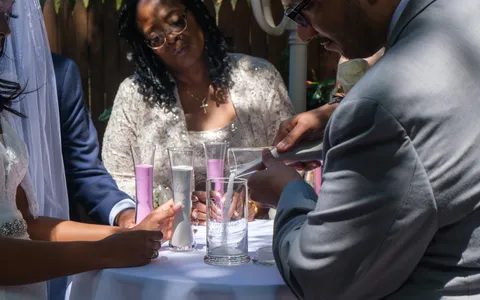
CEREMONY
What Is a Unity Ceremony? The Complete Guide
What a unity ceremony is, where it fits in your wedding, and how to choose the right ritual, from an officiant who's performed them at 300+ weddings.
READ →
CEREMONY
African Wedding Traditions, Explained With Respect
African wedding traditions by people and region: the Akan knocking, the Yoruba engagement, the Igbo kola and wine-carrying, libation, aso ebi and the broom, with how to include one or two without flattening them.
READ →