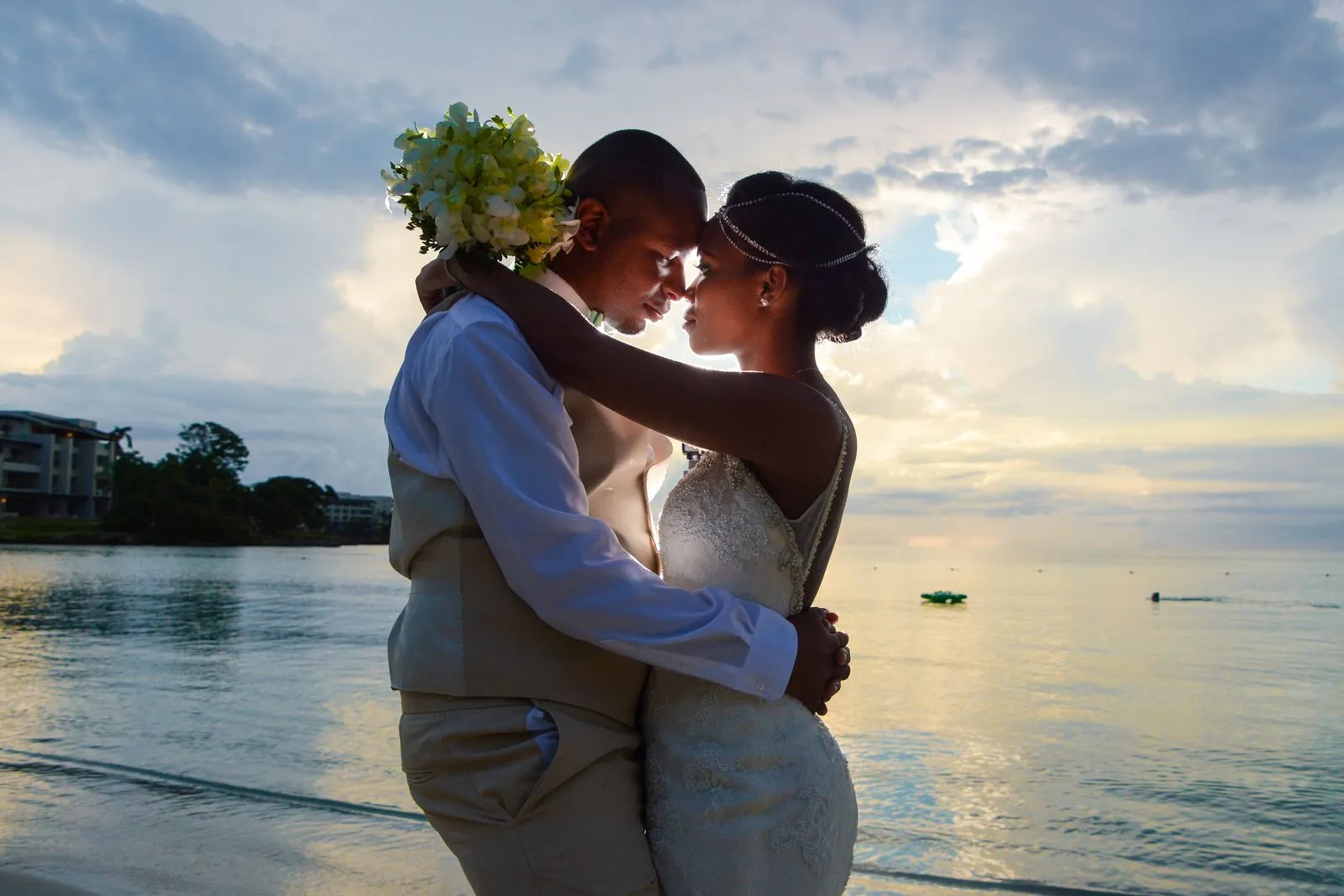
CEREMONY
Caribbean Wedding Traditions Worth Keeping
A Caribbean officiant on the real Caribbean wedding traditions, what's shared vs island-specific, and how to carry them into a US ceremony.
A couple sat in my office in Crown Heights, both second-generation, one side Guyanese and one side Trinidadian, and the bride said, “We want it to feel Caribbean, but we don’t know which Caribbean.” I’ve thought about that line for years, because she said the quiet part out loud, and most couples never do.
I’m Jamaican-born, and I officiate in the city that holds the largest Caribbean community outside the West Indies. For my couples, these traditions don’t live on some faraway island. They live three subway stops away, in a Flatbush banquet hall or a backyard cookout, in the corridor that got officially named “Little Caribbean” in 2017 (Wikipedia). When I write about this, I’m writing about weddings I’m actually standing up in front of, not customs I read about once.
Here’s the thing nobody tells you up front.
Caribbean wedding traditions are not one tradition. They’re a layered inheritance of African, Indian, and European roots, fused together by the islands’ history of colonization, slavery, and indentured labor. That’s why a “Caribbean wedding” looks different in Kingston, Port of Spain, Georgetown, and Port-au-Prince. The shared spine is real. The island-specific rituals are very real too. And for a Caribbean-American couple, the hard part isn’t finding a tradition. It’s choosing which thread of a mixed inheritance to pull.
Let me map it for you, the way I would if we were sitting across a table.
What do Caribbean weddings actually share?
Strip away the island differences and a few things show up almost everywhere.
Black cake is the through-line. Across the English-speaking Caribbean, the wedding cake is a dense, dark, rum-soaked fruit cake (Island Origins Magazine). It descends from British Christmas plum pudding, which island cooks and enslaved Africans adapted with sugarcane rum and “browning,” a burnt sugar that gives the cake its near-black color (Caribbean Heritage Magazine). The dried fruit soaks in alcohol for months, traditionally starting at the engagement. Think about what that means. The cake is a record of how long a couple waited. You’re not eating dessert. You’re eating the time.
Community is the planner. In old-time Jamaican weddings, the work got handed to appointed roles, not just to family. The “wedden godmadda” chose and often sewed the gowns and led the cake parade. The “wedden godfadda” organized the music, the drink, and a decorated “show bread” loaf topped with two birds to stand for love (Jamaica Observer). The whole village had a job. That instinct survives in how Caribbean families still show up to build a wedding together.
Music runs the day, it isn’t background. A steelpan, a tassa band, a sound system, a folk-song circle. The music tells you what’s happening and when. It announces, it cues, it carries the room from one moment to the next.
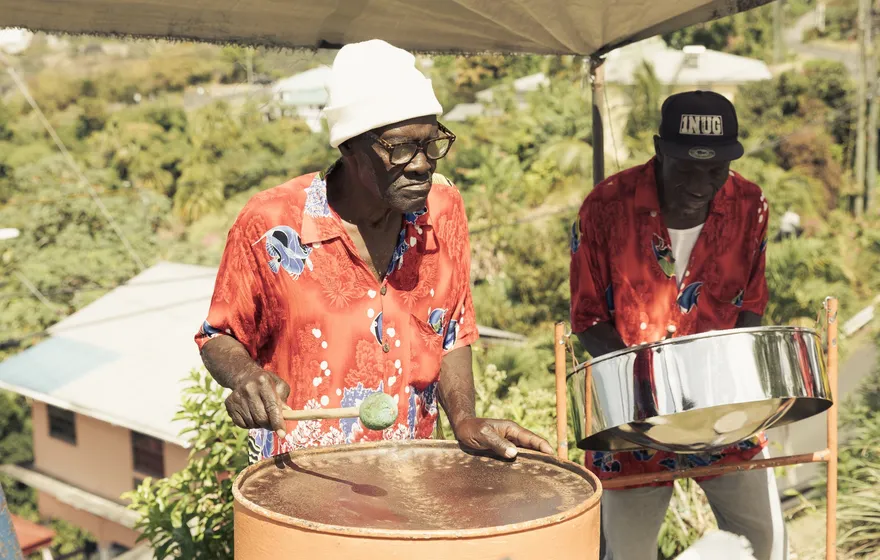
Whichever island your family comes from, those three show up in some form.
Jamaica: the silent cake parade
This is the one I grew up near, and it’s nearly lost, which is exactly why I keep telling couples about it.
In old-time rural Jamaican weddings, married women in white dresses and head-ties carried the black cakes on their heads in a silent procession through the village to the “wedden booth.” The cakes were covered in white lace so the bride wouldn’t see them until the wedding day (Jamaica Observer). Picture it. A line of women moving without a word, balancing the cakes, the whole community watching the marriage arrive.
The rest of the Jamaican pattern is Afro-British. A church ceremony, a reception at the groom’s family home, and food that means business: curry goat, rice and peas, mannish water (the goat-head soup served to keep the men standing).
Trinidad: where three weddings live in one island
Trinidad is the clearest example of that layered inheritance, because a single Trinidadian family can hold African, Indian, Muslim, and Christian wedding cultures at once (WeddingTraditions.org).
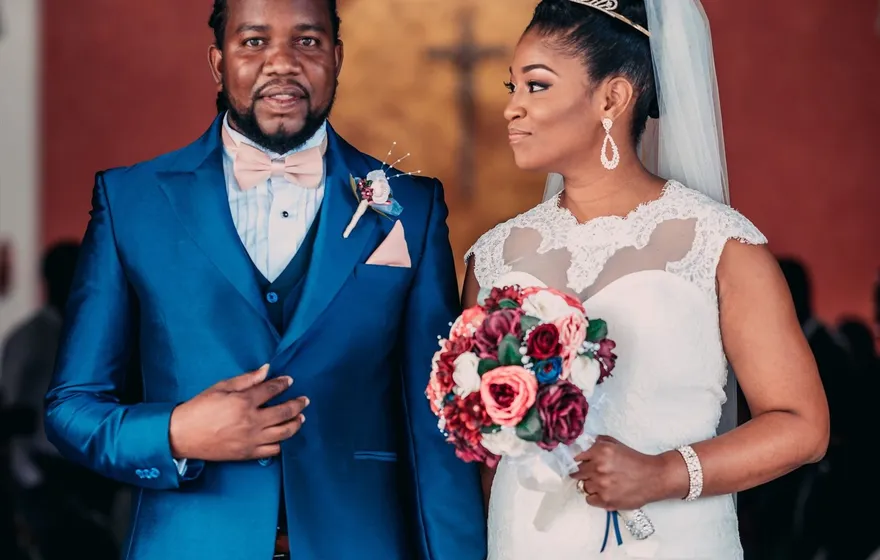
That Indian layer comes from indentured labor. After slavery’s abolition, the British shipped roughly 147,000 indentured Indian laborers to Trinidad, with the first ships arriving in 1838 (Wikipedia). They carried their rites with them, and the Indo-Caribbean wedding is what grew from that.
So a Trinidadian Hindu wedding can run three to four days. There’s a “cooking night,” and a Matikoor, the women’s earth-digging fertility ceremony with folk songs and drumming (WeddingTraditions.org). And then there’s the sound that announces all of it: tassa.
Tassa drumming is the Indo-Caribbean wedding’s announcement system. A tassa band greets the groom’s baraat (his procession) and cues the major moments of the day. It descends from the North Indian dhol-tasha drumming the indentured laborers brought over: the dhol a deep double-headed bass drum, the tasha a kettledrum that rides on top (CICR, University of London). When a tassa band gets going, you feel it in your chest before you see anything. That’s the point. The drums tell a whole street that a wedding is coming.
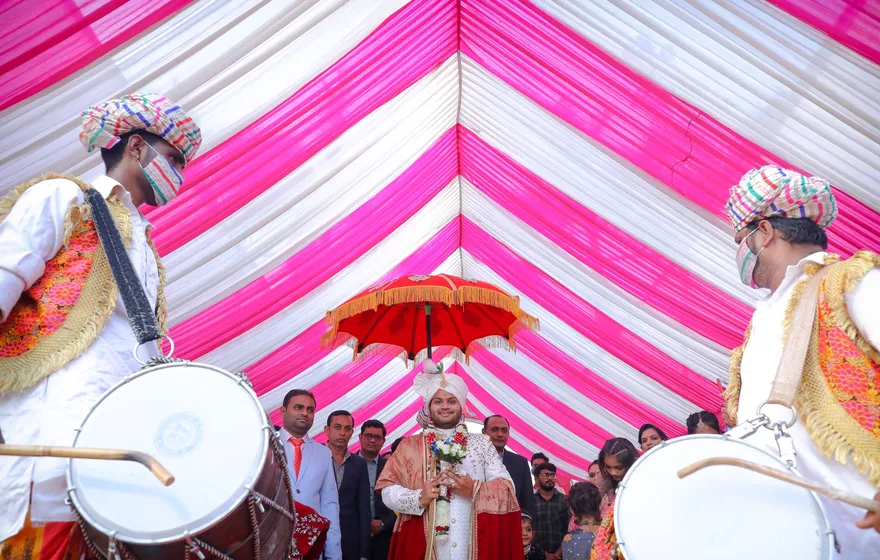
The groom in a Trinidadian baraat gets the same kind of escort, with tassa in place of the dhol.
Haiti: community as the witness
Haitian weddings build anticipation on purpose, and they make the community the literal witness.
The “Annonceuses” are young girls in white who dance and march in to announce the wedding party. Then comes the “Surprise Bride” procession: bridesmaids in white, bridal-style gowns walk in before the real bride, so the room keeps wondering which woman is the bride until she finally appears. It’s a slow, deliberate build, and the whole congregation spends it guessing.
Here’s the part I love most as an officiant. Haitian couples often sign the marriage license on the altar, in front of everyone. The paperwork I usually handle off to the side becomes a public act. The community doesn’t just attend the marriage. It witnesses the signature.
I’ve started borrowing that move for couples of every background, because it takes the dullest legal moment of the day and gives the room something to watch.
Guyana: Queh Queh, kept alive in secret
Guyana carries one of the most moving African survivals in the region, and it deserves to be understood, not just performed.
Queh Queh (also spelled Kweh Kweh) is an African-rooted celebration held the night before the wedding. It runs on call-and-response singing led by a Queh Queh leader, circle dancing with foot-stomping, a rum libation poured to honor the ancestors, and a staged “bride purchase,” where the bride is covered in a white sheet and lifted in a chair (Dem Village).
Now the history, because the history is the whole weight of it. Enslaved Africans held Queh Queh in secret on the eve of the European wedding the colonizers imposed, so they could keep their own marriage rites alive (Dem Village). When a Guyanese family does Queh Queh today, they’re continuing something their ancestors had to hide to keep. That’s not a theme party. That’s an inheritance.
Guyana also took the largest share of indentured Indian labor in the region, roughly 238,000 people transported to British Guiana (Wikipedia), so an Indo-Guyanese wedding carries the same Hindu and Muslim rites you’ll see in Trinidad.
The African roots under all of it
So much of what reads as “Caribbean” is African, adapted under slavery and colonial rule. The libation poured to the ancestors, the circle dancing, the call-and-response song. These aren’t decorative flourishes. They’re West and Central African practice that survived the Middle Passage and the plantation.
A word on jumping the broom, because couples ask me about it constantly. Its origin is genuinely contested, and an honest post should say so. Some historians trace it to West African (Asante and Akan) spiritual use of the broom to sweep away evil. Others argue it reached the Americas through 19th-century Britain (African American Registry). Both can be partly true. What I tell couples is this: do it because it carries meaning in your family, not because someone online told you it’s “the” Black wedding ritual. I broke down the full history and how to do it well in my guide on jumping the broom.
When you include any of these in a US ceremony, name the origin in one sentence before you do it, something like:
“This libation honors our ancestors, a Guyanese custom that survived because it was kept in secret.”
That single line is the difference between heritage and decor, because now your guests know what they’re watching.
How to carry these into a US ceremony
This is the question my couples actually came to me with, so let me answer it plainly.
You don’t fold in five traditions. You pick the one or two threads that are genuinely yours and you carry them with intent. A wedding that performs every island custom it found feels like a museum. A wedding that does one thing, named and meant, feels like home.
Here’s what folds cleanly into a US ceremony timeline:
- Serve a real black cake as your wedding cake, soaked from the engagement if you have the months. Each island leans different: red wine or white rum in Jamaica, cherry brandy in Trinidad and Guyana.
- Open the processional with tassa drummers or a steelpan if your roots are Trinidadian or Indo-Caribbean. Live music as the announcement, the way it’s meant to work.
- Hold a Queh Queh the night before if your family is Guyanese, and let it be its own evening rather than something squeezed into the reception.
- Make the license signing public, Haitian-style. Have me invite the whole room to witness it instead of handling it quietly off to the side.
- Recreate the cake parade in miniature if you’re Jamaican, with family members carrying the cake in.
Placement is where an officiant earns their keep:
| Ritual | Where it goes |
|---|---|
| Tassa procession | The very top |
| Libation | Early on |
| Cake parade | The reception |
| License signing | In full view |
If your island faith is Catholic or Christian and you’re having a civil ceremony, we can hold the spirit of the church rite inside a legally binding civil one. The legal work and the heritage don’t fight each other. It just makes the marriage real to the room too.
If you want to see how a ceremony gets sequenced overall, my wedding ceremony order breakdown shows where each piece sits, and the wedding traditions explained hub covers the rituals from every culture I draw on.
Building your own Caribbean ceremony
I’ll be honest about where most couples get stuck. It isn’t the ritual. It’s the words around it.
You know you want the black cake, the libation, the tassa. What you don’t have is the language that introduces each one so your guests understand it instead of politely clapping at something they can’t read. That language is the whole job. It’s what I write for my couples, and it’s what turns a custom into something everyone in the room understands.
If you’re building your ceremony yourself, my Couple’s Ceremony Kit gives you the full structure plus fill-in-the-blank wording for cultural and unity rituals, so you can drop in a libation or a cake parade and have the exact lines to introduce it with weight. It’s the difference between “and now we’ll do a tradition” and a sentence that tells your grandmother you know exactly where this came from. You can also pull a free sample ceremony script first to see how the wording is built before you commit to anything.
Frequently asked questions
What’s the difference between Jamaican and Trinidadian wedding traditions?
Both share Caribbean black cake and community-led celebration, but the roots differ. Jamaican old-time custom is Afro-British: the silent black-cake parade carried by women in white head-ties, a church ceremony, and a reception with curry goat and mannish water. Trinidad carries a much heavier Indian inheritance from indentured labor, so a Trinidadian Hindu wedding can run three to four days with tassa drumming, a baraat procession, the Matikoor night, and a ceremony under a canopy. Trinidad blends African, Indian, Muslim, and Christian elements, sometimes in one family.
What is Caribbean black cake and why is it the wedding cake?
Black cake is a dense, dark, rum-soaked fruit cake that descends from British Christmas plum pudding, adapted in the islands with sugarcane rum and burnt-sugar browning for its color. The dried fruit soaks in alcohol for months, traditionally starting at the engagement, which is part of why it became a marriage cake. It’s the traditional wedding cake across Jamaica, Trinidad, and Guyana, with each island favoring different liquor (red wine or white rum in Jamaica, cherry brandy in Trinidad and Guyana).
How can a Caribbean-American couple include these traditions in a US wedding?
Pick the thread that’s actually yours and name its origin out loud during the ceremony so it reads as heritage rather than decor. Practical options that fold into a US ceremony: serve a real black cake as the wedding cake, open the processional with tassa drummers or a steelpan if your roots are Trinidadian, hold a Queh Queh the night before if your family is Guyanese, or have the officiant invite the room to witness the license signing, Haitian-style. One or two carried with intent beats a checklist.
What is Queh Queh at a Guyanese wedding?
Queh Queh (also spelled Kweh Kweh) is an African-rooted Guyanese celebration held the night before the wedding. It runs on call-and-response singing led by a Queh Queh leader, circle dancing with foot-stomping, a rum libation poured to honor the ancestors, and a playful staged bride purchase. Enslaved Africans created it to keep their own marriage rites alive in secret when colonizers banned traditional ceremonies, which is part of why it still carries weight today.
What are the African roots of Caribbean wedding traditions?
Many Caribbean wedding customs are African survivals that adapted under slavery and colonial rule. Guyana’s Queh Queh, the libation poured to ancestors, circle dancing, and call-and-response song all trace to West and Central African practice. Jumping the broom is often cited too, though its origin is genuinely contested between West African (Asante and Akan) and 19th-century British sources, so it’s worth naming honestly rather than claiming as settled fact.
The Couple’s Ceremony Kit
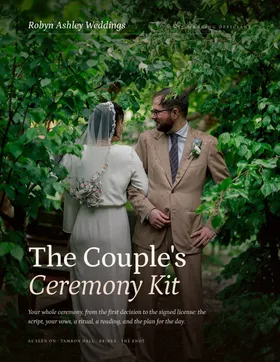
Walk in with a ceremony that sounds like the two of you
This post covers one part of the ceremony, and the Couple’s Ceremony Kit covers the rest, with five full scripts to start from and the prompts I use to help couples write their vows.
- Five full ceremony scripts in five different styles
- The Story Mine, thirty prompts for writing your vows
- Sixteen unity rituals, with the words and what to gather
- Thirty readings, each with my notes on when it fits
CEREMONY
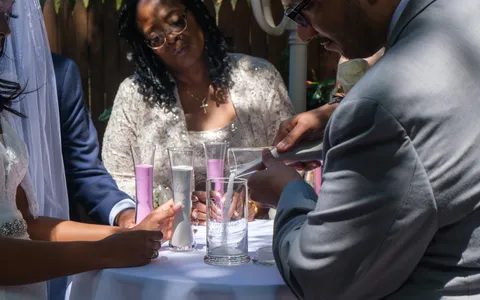
What Is a Unity Ceremony? The Complete Guide
What a unity ceremony is, where it fits in your wedding, and how to choose the right ritual, from an officiant who's performed them at 300+ weddings.
READ →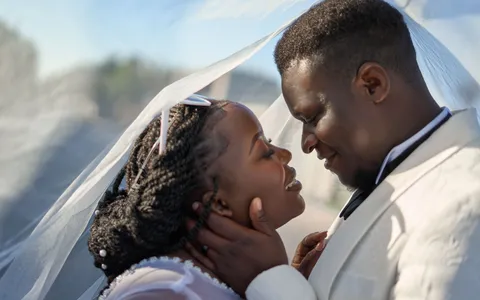
CEREMONY
African Wedding Traditions, Explained With Respect
African wedding traditions by people and region: the Akan knocking, the Yoruba engagement, the Igbo kola and wine-carrying, libation, aso ebi and the broom, with how to include one or two without flattening them.
READ →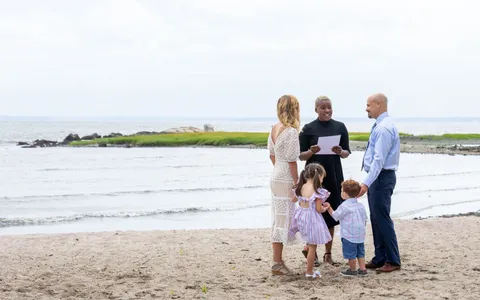
CEREMONY
Ways to Include Family in Your Wedding Ceremony (Matched to Comfort, Not Just Closeness)
A menu of real ways to give parents, grandparents, siblings, and kids a role in your ceremony, matched to comfort level, plus honoring a loved one who's passed and how to keep it from running long.
READ →