PLANNING
Wedding Ceremony Order
The real wedding ceremony order, every part in sequence, what's required vs optional, timing for each, and how to cut a 30-minute ceremony to 10.
I was three feet from a couple in Central Park, mid-ceremony, when the bride leaned in and whispered, “Wait, are we married yet?” They were. They’d been married for about ninety seconds, ever since the declaration of intent. They just didn’t know which part did the legal work, because nobody had walked them through the order before the day.
I get that question more than almost any other, and it’s why this page exists. Most ceremony-order guides hand you a seven-step list and treat it like scripture. I’ve built and delivered the order of service for hundreds of weddings, and the lived truth is looser and more useful than any list.
In most states one spoken moment does the legal work, the declaration of intent, and the pronouncement is the customary close that tells the room it’s done. Everything else, vows included, is structure you arrange around those two anchors. Once you see the order that way, you stop following a template and start directing a room.
Here’s the full sequence, in order, with what each part is, whether you can skip it, and how long it actually runs. Keep this open in another tab while you draft.
CHAPTER 01
What is the full order of a wedding ceremony?
This is the traditional running order, the one most couples and officiants build from:
The traditional order of a wedding ceremony
-
Processional
The wedding party and the couple walk in.
-
Welcome and opening remarks
The officiant greets everyone and frames the day.
-
Readings
A friend or family member reads a passage or poem.
-
Declaration of intent
Legally required
The “Do you take…” / “I do.”
-
Vows
The personal promises you write or recite.
-
Ring exchange
Rings on, with a line each.
-
Unity ritual
Optional
Candle, sand, handfasting.
-
Pronouncement and first kiss
Customary close
“I now pronounce you…”
-
Recessional
Everyone walks back out.
That order matches the standard sequence most planners publish (Minted). What they rarely tell you is which steps you’re allowed to delete, so let’s walk through it the way a director would, not the way a checklist does.
CHAPTER 02
The processional: longer than you think
The processional is the entrance, and it’s the single most underestimated chunk of the whole ceremony. Couples picture a quick walk. In reality it runs 5 to 10 minutes and grows with the size of your wedding party (TheWeddingPlanner.ai).
Picture it from the back. Each pair walks, pauses, finds their spot, and the music has to breathe between entrances. A party of ten people moving one or two at a time eats real minutes. I’ve watched couples budget two minutes for this and then feel rushed all day, because the math was off from the first note.
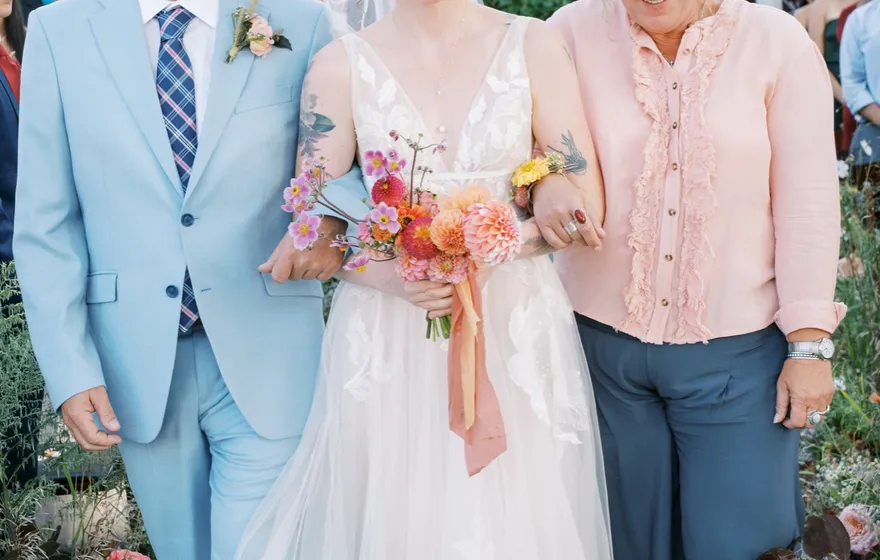
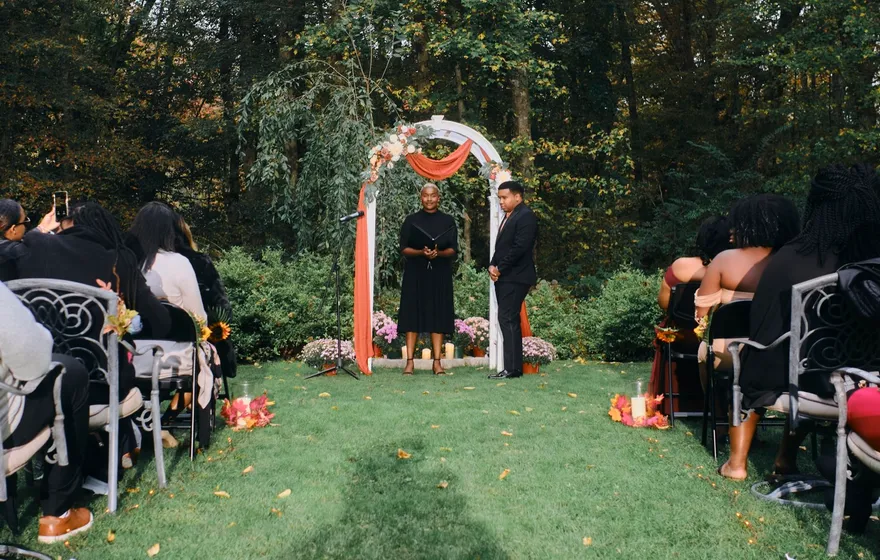
Here’s a staging convention worth knowing: the officiant is first in and last out unless you’ve decided otherwise. I’m already standing at the front when your people start walking, and I’m still there when the recessional clears. That’s what keeps the entrance and the exit from sagging.
If you want the full who-walks-with-whom breakdown, including order, spacing, and song timing, that lives in my guide to the wedding processional order. It’s the one part of the day worth rehearsing out loud.
CHAPTER 03
Welcome and opening remarks: setting the room
Once everyone’s in, I open. This is the 1 to 2 minute welcome where the officiant greets the guests, names what we’re here for, and sets the temperature of the room before anything heavier happens.
Legally, this part is optional. Humanly, it’s the opposite. It’s where the nervous couple finally exhales. A good opening tells the guests how to feel and tells the couple they’re in steady hands.
Keep it tight. Two minutes of warm framing reads as confident. Five minutes of the officiant telling a long story about how they met you reads as the officiant making your wedding about themselves. If you’re writing your own, my walkthrough on how to write a ceremony breaks down what an opening needs to do and what it can leave out.
CHAPTER 04
Readings: optional, and easy to overdo
Readings come after the opening, usually one or two, delivered by a friend or family member. Each one runs about 2 to 3 minutes depending on length.
My honest take: readings are a generous way to involve people, and they’re also the first thing I reach for when a ceremony runs long. Two is a sane ceiling. I’ve sat through ceremonies with four readings where you could feel the back rows checking out by the third.
If you want them but can’t settle on what, I keep a running collection in wedding ceremony readings, sorted by tone, so you can match the passage to the people standing up front. One reading that fits beats three that don’t.
CHAPTER 05
Declaration of intent vs vows: the part people confuse
This is the heart of the order, and it’s the part couples most often blur together, so let me slow down here.
The declaration is the load-bearing wall. The vows are the room you decorate.
The declaration of intent and your vows are two different things. The declaration is the “Do you take…” / “I do” exchange. It’s the spoken consent that legally seals the marriage, and state statutes such as New York’s require it (N.Y. Domestic Relations Law 12). Your vows are the personal promises you write to each other. They carry every ounce of sentiment and zero ounces of legal weight.
That distinction is freeing. Skip your written vows entirely and you’re still fully married, as long as the declaration happens. The declaration is the load-bearing wall. The vows are the room you decorate.
In New York specifically, the bar sits even lower. The law (N.Y. Dom. Rel. Law section 12) requires no particular form or ceremony at all, only that you “solemnly declare” before the officiant and at least one witness that you take each other as spouses (N.Y. Domestic Relations Law 12). No mandated vows, no mandated rings, no required script.
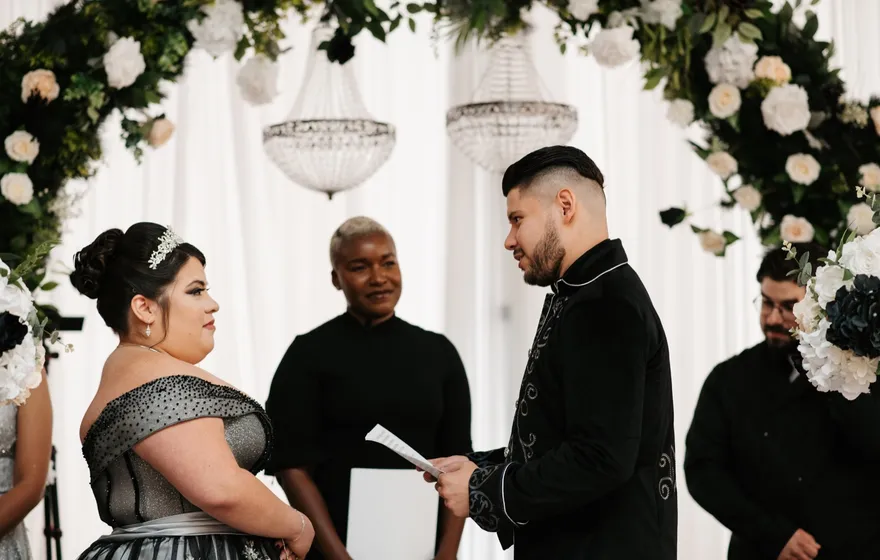
The declaration runs about a minute. Vows run 3 to 5 minutes per person, and that’s the part of the order most likely to swell if you’re not watching it. If you’re writing yours, I have a full method in write wedding vows, and the exact wording for the declaration itself is in my wedding ceremony script.
CHAPTER 06
The ring exchange: about a minute, and optional
Rings go on after the vows. The exchange itself is short, roughly one minute, with a single spoken line as each ring slides on.
Like the vows, the ring exchange is optional and carries no legal weight. Couples are always a little surprised by that. You can be married without a single ring in the room. Most people want the rings because the gesture is lovely, not because the law asks for it.
If you’re including it, the words matter more than the speech about what the circle symbolizes. I’d cut the symbolism monologue before I’d cut a clean, warm line. For the exact phrasing, including secular, religious, and modern versions, see ring exchange wording.
CHAPTER 07
Where the unity ceremony goes in the order
Unity rituals are positional, not fixed, and knowing where each one sits saves you from awkward sequencing.
Most unity rituals (candle, sand, handfasting) go right after the ring exchange and before the pronouncement, when the couple has just made their promises and the room is at its quietest. Handfasting sits in that same slot. Closing rituals are different: breaking the glass and jumping the broom go at the very end, after the pronouncement, because they punctuate the marriage rather than build to it.
One practical warning from experience. If you’re combining a unity candle with a handfasting, light the candle first, then do the binding. Reverse those and you’ve got an open flame next to a cord wrapped around two pairs of wrists, which is exactly the day-of surprise nobody wants.
| Ritual | Where it goes |
|---|---|
| Unity candle, sand, handfasting | Right after the ring exchange, before the pronouncement |
| Breaking the glass, jumping the broom | At the very end, after the pronouncement |
| A unity candle with a handfasting | Light the candle first, then do the binding |
A unity ritual adds 2 to 4 minutes depending on which one. It’s optional, so it’s the first thing to drop if you’re cutting for time. If you do want one and aren’t sure which fits, I’ve laid out the options by personality and setting in unity ceremony ideas.
CHAPTER 08
The pronouncement and first kiss: the customary close
This is the moment the bride in Central Park was waiting for. The pronouncement, where I say “I now pronounce you married,” closes the legal moment the declaration of intent already created. Statutes like New York’s require the couple’s declaration in front of the officiant and a witness, and they don’t prescribe a closing line (N.Y. Domestic Relations Law 12). I still treat the pronouncement as essential, because it tells everyone in the room the marriage is done.
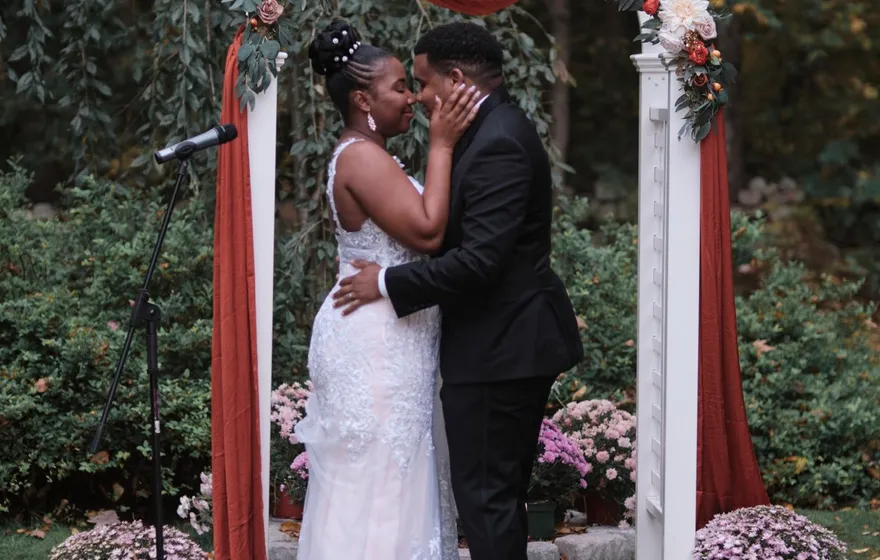
It runs 1 to 2 minutes with the kiss, and it’s the emotional peak, so I deliver it head up, looking at the couple, voice carrying. This is also where I see first-time officiants stumble most. They read the pronouncement head-down off the page during the exact beat the whole room is waiting to cheer. Look up. Say it to them, not to your notes.
CHAPTER 09
The recessional: reverse the processional
The recessional is the exit, and one rule solves it: walk out in reverse order of how you walked in (Minted). The couple leads, then the wedding party pairs off back up the aisle in the opposite sequence from their entrance.
It runs 3 to 5 minutes. Couples skip rehearsing it and then bunch up at the back, so a single pass at the rehearsal earns its keep.
CHAPTER 10
How long is a wedding ceremony, part by part?
Here’s the full timing breakdown in one place, so you can build your own timeline:
| Part | How long | Legally required in most states |
|---|---|---|
| Processional | 5 to 10 minutes | No |
| Welcome and opening remarks | 1 to 2 minutes | No |
| Readings | 2 to 3 minutes each | No |
| Declaration of intent | About 1 minute | Yes |
| Vows | 3 to 5 minutes per person | No |
| Ring exchange | About 1 minute | No |
| Unity ritual | 2 to 4 minutes (optional) | No |
| Pronouncement and first kiss | 1 to 2 minutes | No (customary close) |
| Recessional | 3 to 5 minutes | No |
Add it up and a full version comes to about 25 to 30 minutes, which matches the typical non-religious sweet spot of 20 to 30 minutes (religious ceremonies often run 45 to 60) (TheWeddingPlanner.ai).
CHAPTER 11
How to shorten a wedding ceremony to 10 minutes
This is the question I get from couples staring at a 30-minute draft they secretly find too long. The good news: trimming is easy once you know what’s structural and what’s decorative.
To get down to about 10 minutes, cut in this order:
- Drop the unity ritual. It’s the cleanest 3 to 4 minutes to lose.
- Cut the “what the rings symbolize” speech. Keep the rings, lose the monologue.
- Cap readings at one, or zero. This is where the minutes hide.
- Trim the jokes and banter unless the couple specifically asked for them.
What’s left is the spine: a short welcome, the declaration of intent, the vows, the ring exchange, and the pronouncement. That’s a real, warm, fully legal ceremony in about ten minutes.
And if you need to go even shorter, you can. A bare-bones ceremony, with just the declaration, brief vows, ring exchange, and pronouncement, runs 6 to 8 minutes (American Marriage Ministries). I’ve done elopements that clocked in right there and didn’t feel rushed, because every word still earned its place.
CHAPTER 12
A short, copy-ready ceremony order you can use
Here’s a compact ceremony built on the spine, the kind I’d write for a couple who wants warm but quick. Lift it, swap names, adjust to taste.
Welcome: (officiant, looking at the guests)
“Good evening, everyone. We’re here for Sam and Alex, who decided that out of all the people in all the world, they’d rather do the whole thing together. Let’s get them married.”
Declaration of intent: (officiant, turning to each partner in turn)
“Sam, do you take Alex to be your spouse, to have and to hold, from this day forward?”
(Sam: “I do.”)
“Alex, do you take Sam to be your spouse, to have and to hold, from this day forward?”
(Alex: “I do.”)
Vows: (each partner, in their own words, kept short)
“I promise to keep choosing you. On the easy days, and on the ones where the dishwasher breaks and we’re both tired. You’re my favorite person, and I’m not going anywhere.”
Ring exchange: (as each ring goes on)
“I give you this ring as a sign of everything I just promised.”
Pronouncement: (officiant, head up, voice carrying)
“By the power vested in me, and with the joy of everyone here as witness, I now pronounce you married. Go ahead and kiss.”
(First kiss. Recessional begins.)
That’s the whole structure in under ten minutes, and it’s every bit as binding as a thirty-minute version. If you want a longer one to pull from, with multiple openings, declarations, and pronouncements, I keep a library in wedding ceremony script examples.
CHAPTER 13
Don’t forget the part that isn’t in the order at all
The most-forgotten logistic in any ceremony order is the one that doesn’t happen in front of guests: signing the marriage license. That signature, not the kiss, is what files your marriage with the state.
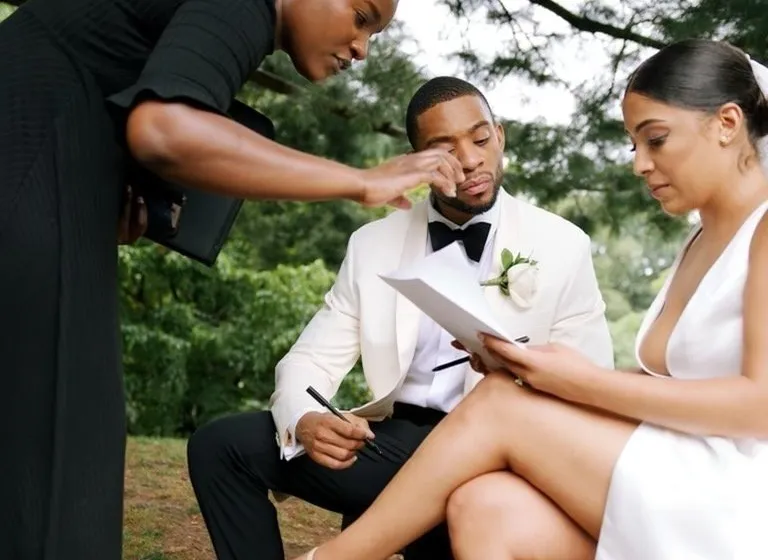
It usually happens right after the recessional, in a quiet corner with the couple, the officiant, and the witness. Build it into your day-of timeline even though it sits outside the spoken order, because a beautiful ceremony with an unsigned license is a party, not a marriage.
CHAPTER 14
Where the Couple’s Ceremony Kit fits
If you’re the one assembling this order, whether you’re writing your own ceremony or briefing a friend who’s officiating, you don’t have to build every part from a blank page.
That’s what I put the Couple’s Ceremony Kit together for. It gives you the full order pre-structured, with fill-in-the-blank scripts for every element here: openings, declarations of intent, vow frames, ring lines, unity options, and pronouncements, all in language that sounds like a person instead of a legal form. You decide what to keep and what to cut, and the timing and sequencing are already handled.
Two companion reads once your order is set: how to turn it into a wedding ceremony program for your guests, and the wedding ceremony mistakes I see most often, so you can sidestep them.
It’s the difference between staring at a list of nine parts and starting from a draft you only have to make yours.
If you want to hear the voice before you commit to anything, grab my sample ceremony script and read one all the way through. It’ll tell you faster than I can whether this is the tone you want for your day.
For the full word-for-word template that every part of this order builds toward, read my complete wedding ceremony script guide.
CHAPTER 15
Frequently asked questions
What is the order of a wedding ceremony?
The traditional running order is: processional, the officiant’s welcome and opening remarks, readings, the declaration of intent (the “I do”), the exchange of vows, the ring exchange, an optional unity ritual, the pronouncement and first kiss, and the recessional. In most states the law requires only the declaration of intent, made in front of your officiant and witnesses. The pronouncement is the customary close. Everything else is yours to keep, move, or cut.
What parts of a wedding ceremony are actually required?
In most states, the one spoken moment the law requires is the declaration of intent, where each person affirms in front of the officiant and witnesses that they take the other as their spouse. The pronouncement, where the officiant declares you married, is how officiants close that moment, and most treat it as essential, but state statutes generally do not require it. In New York, the law requires no particular ceremony at all beyond a solemn declaration before the officiant and at least one witness. Vows, rings, readings, and unity rituals are all optional.
What’s the difference between the declaration of intent and the vows?
The declaration of intent is the “Do you take…” / “I do” exchange. It is the legal moment of consent and is required in many states. Vows are the personal promises you write or recite to each other. They carry sentimental meaning but no legal weight, so you can shorten them or skip them and still be married.
How long is a wedding ceremony?
Non-religious ceremonies usually run 20 to 30 minutes, and religious ceremonies often run 45 to 60. Roughly: processional 5 to 10 minutes, opening remarks 1 to 2, each partner’s vows 3 to 5, ring exchange about a minute, pronouncement and kiss 1 to 2, recessional 3 to 5. The processional almost always takes longer than couples expect.
Where does the unity ceremony go in the order?
Most unity rituals (candle, sand, handfasting) go right after the ring exchange and before the pronouncement. Closing rituals like breaking the glass or jumping the broom go at the very end, after the pronouncement. If you combine a unity candle with handfasting, light the candle first so the binding cord doesn’t catch fire.
Do you have to say vows or exchange rings to be legally married?
No. Personal vows and the ring exchange are both optional and have no legal effect. What makes the marriage legal is the declaration of intent before your authorized officiant and the required witness, plus a signed license returned on time. You can skip rings and written vows entirely and still be fully married.
BOOK YOUR CEREMONY
Need help with your ceremony?
Tell me about your day. I will write back the same week.
AVAILABLE 2026 + 2027
PLANNING
Where to Elope in NYC: Best Spots, Costs & Packages
Last spring I married a couple at Wagner Cove on a Saturday in May, peak season, the lake full of rowboats. They'd braced for chaos. We tucked under that little wooden gazebo, the.
READ →
PLANNING
Wedding Processional Order
At a rehearsal in Central Park last spring, the bride's divorced parents hadn't been in the same room in eleven years. We had ninety seconds of aisle to get through, and the whole.
READ →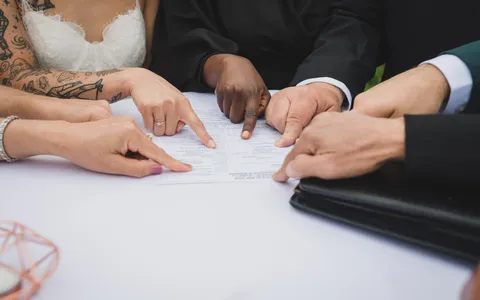
PLANNING
NYC Marriage License: Step-by-Step Guide (2026)
A couple once called me from a hotel lobby an hour before their rooftop ceremony, panicked. They'd picked up their license at 4 PM the day before, and the rooftop slot was 3 PM..
READ →