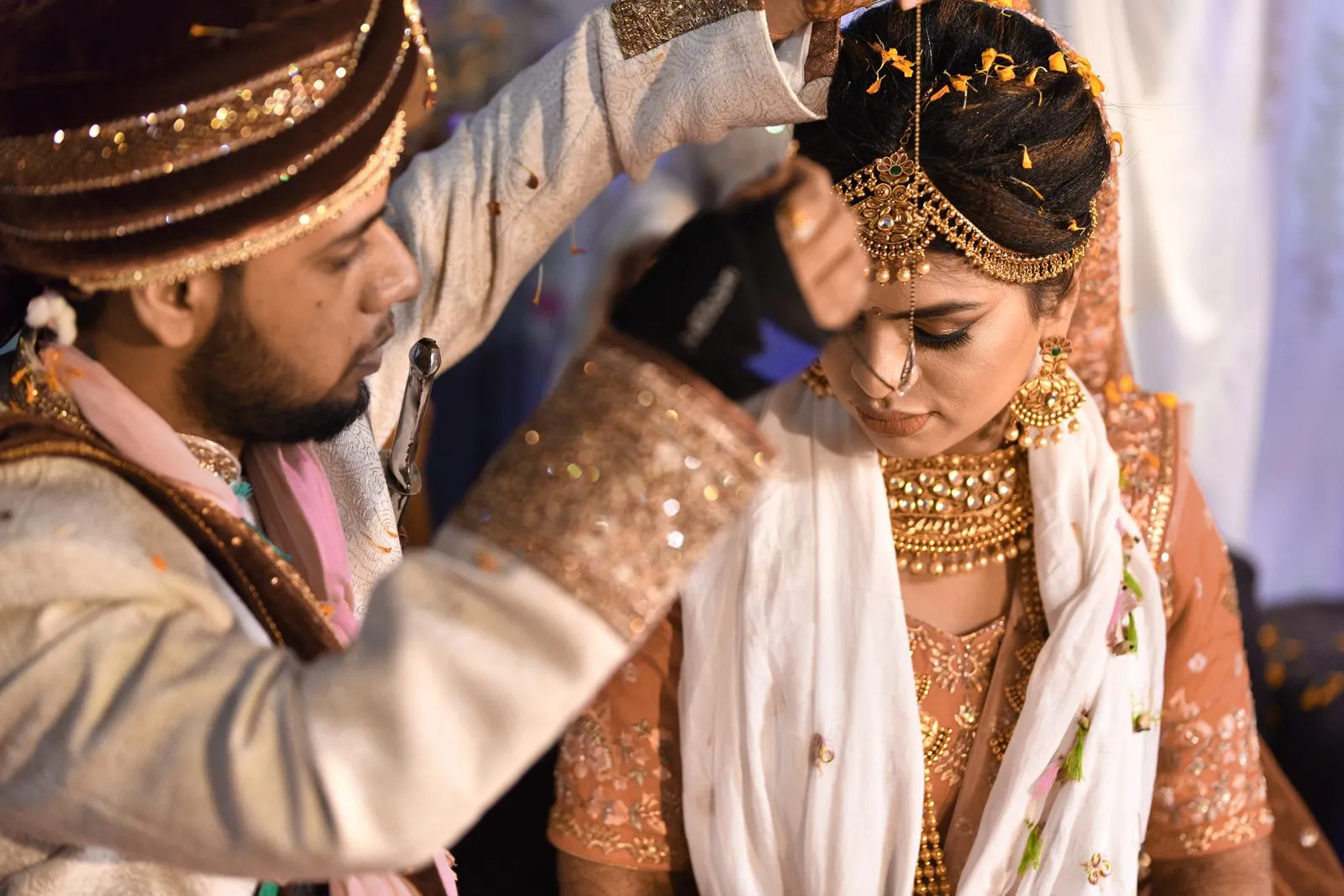
CEREMONY
Hindu Wedding Ceremony, Explained for Guests and Couples
What happens at a Hindu wedding ceremony, in order: the mandap and sacred fire, the seven steps, the mangalsutra and sindoor, how long it runs, and how an interfaith couple can co-lead it with a pandit.
The first time I stood at a mandap, I was the Western half of a co-led ceremony, and I had exactly one job for the next twenty minutes: stay out of the pandit’s way and watch. The couple circled a small fire while their families pressed in close, and when the bride’s mother started crying at the fourth step, I finally got what most ceremony write-ups never tell you. This isn’t a costume version of a wedding. The fire is a witness, and the steps are the marriage itself.
I’ve co-officiated and choreographed enough fusion ceremonies to know my lane here. I’m not a pandit, I don’t perform the Vedic rites, and I’ll tell you plainly when something belongs to a Hindu priest. What I can do is walk you through what actually happens, in order, so a guest can follow along and an interfaith couple can build a ceremony that honors both sides without flattening either one.
Here’s the short version. A Hindu wedding ceremony moves through a set of Sanskrit rites led by a priest at the mandap, building toward the saptapadi, the seven steps around a sacred fire that make the couple married. The full ceremony runs about 90 minutes to three hours, and it usually sits inside a larger two or three day celebration.
What is the mandap, and why does everything happen there?
The mandap is the canopy at the center of the ceremony, usually four pillars holding up a decorated roof. Think of it as a temple built for the day, and the four pillars are often read as the four stages or goals of life. You step onto it the way you’d step into a sacred space, which is why shoes come off.
Inside the mandap sits the agni, the sacred fire, built from ghee and wooden or woolen wicks (Wikipedia). Every vow in the ceremony is spoken toward this fire, because Agni is believed to carry the couple’s promises to the gods. The fire is the official witness, not a decoration.
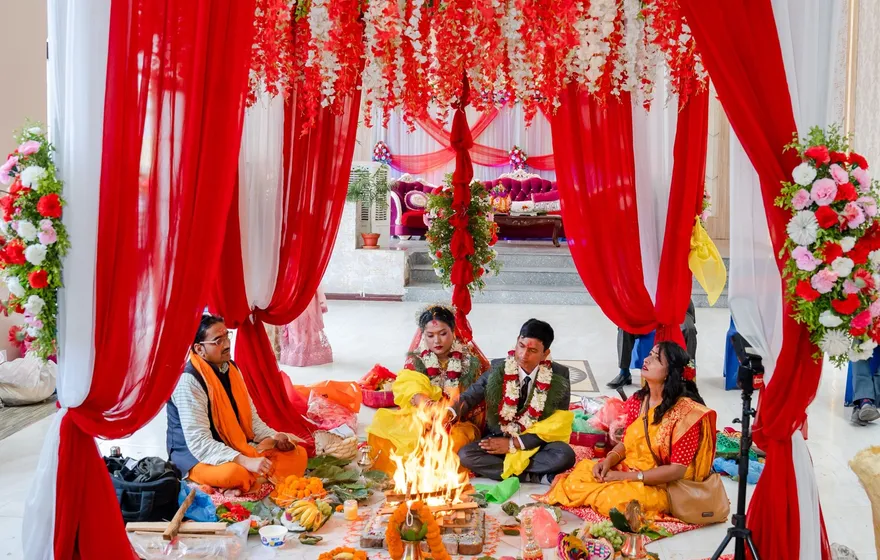
I flag this for couples early, because it’s a practical problem before it’s a spiritual one. An open flame inside a hotel ballroom means a conversation with the venue about fire rules and smoke detectors, sometimes a contained fire bowl, sometimes a designated coordinator standing by. Sort that out months ahead, not the morning of.
What is the order of a Hindu wedding ceremony?
Every region and family does this a little differently, and your pandit’s version is the one that counts. That said, there’s a recognizable spine to the core ceremony (Wikipedia):
The order of a Hindu wedding ceremony
-
Baraat and milni
Before anyone sits down, the groom arrives in a procession, often on a horse, with music and dancing. The two families greet each other.
-
Jaimala (varmala)
The couple exchanges flower garlands. This is the first public “yes.”
-
Ganesh puja
A prayer to Ganesh to clear obstacles before the marriage begins.
-
Kanyadaan
The bride’s father places her hand in the groom’s, traditionally “giving away” the bride.
-
Vivaha-homa
The sacred fire is lit. The ceremony’s center of gravity is now this flame.
-
Panigrahana
The groom takes the bride’s hand and recites Rigvedic mantras.
-
Saptapadi (saat phere)
The seven steps or seven circles around the fire. This is the marriage.
-
Mangalya Dharanam and sindoor
The groom ties the mangalsutra around the bride’s neck and applies sindoor to the part in her hair.
Knowing this order is the single most useful thing for a co-officiant. It tells me exactly where I can slot an English reading, a vow exchange, or a moment for the couple’s friends, without ever cutting into a rite mid-mantra. You build the Western elements into the seams, never on top of the Sanskrit, and if you want the full breakdown of how a ceremony sequences from processional to recessional, see my guide to wedding ceremony order.
What are the seven steps (saptapadi)?
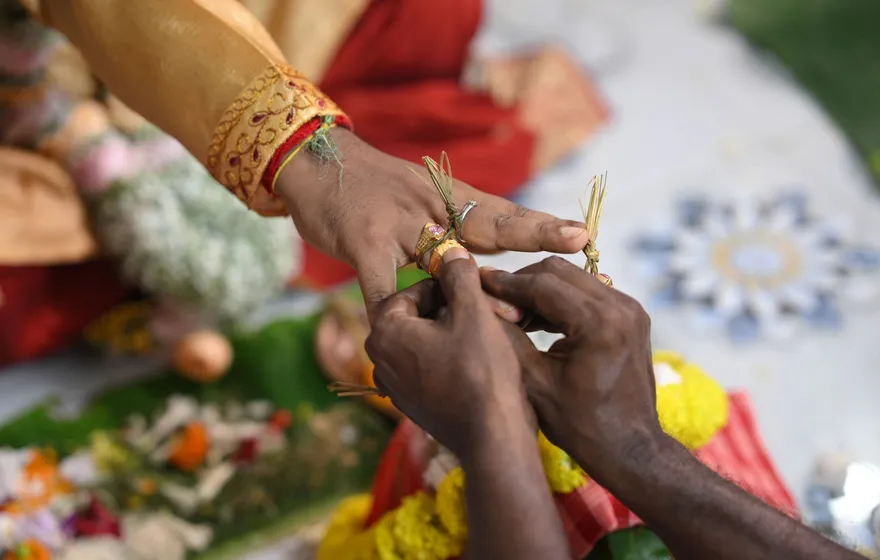
Saptapadi is Sanskrit for “seven steps.” In North Indian tradition, the couple circles the fire seven times, the saat phere. In South Indian tradition, they take seven literal steps, the groom often leading the bride by her little finger (Wikipedia). Either way, each step carries a vow.
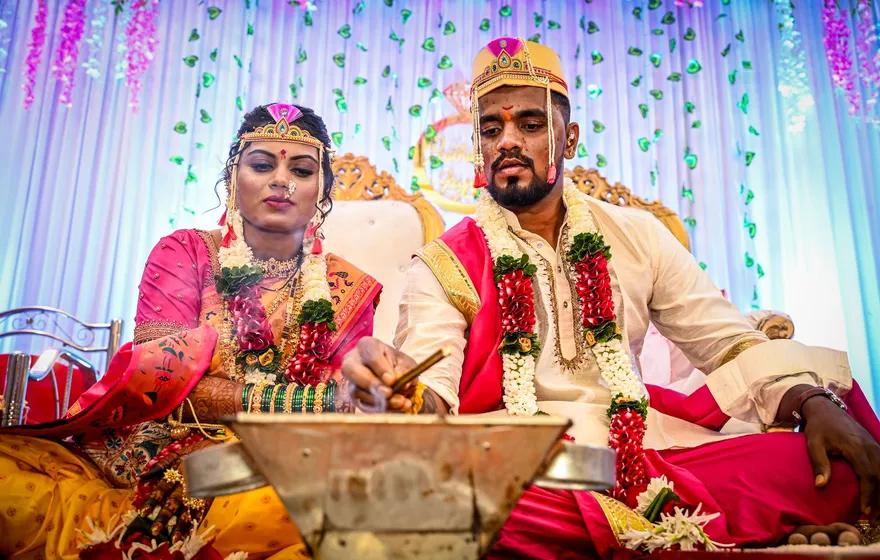
The seven promises cover, roughly:
| Step | The vow |
|---|---|
| 1 | Nourishment and food |
| 2 | Strength |
| 3 | Prosperity |
| 4 | Happiness and shared joy |
| 5 | Family and children |
| 6 | The seasons of life lived together |
| 7 | Lifelong friendship |
That last one gets me every time. After all the cosmic language about prosperity and progeny, the seventh step is simply a vow to be friends.
Here’s why the saptapadi is more than pretty symbolism. Under Section 7(2) of India’s Hindu Marriage Act, 1955, when a couple’s rites include the saptapadi, the marriage “becomes complete and binding when the seventh step is taken” (India Code). The legal instant of marriage is the seventh step around the fire.
The fire is a witness, and the steps are the marriage itself.
Keep that in mind and the whole ceremony reads differently from the guest chairs.
That ruling, Dolly Rani v. Manish Kumar Chanchal, is worth knowing if you’re an interfaith couple wondering whether you can skip the rites and just sign paperwork (Supreme Court Observer). If the Hindu validity of your marriage matters to your family, the steps have to actually happen.
What’s the difference between the mangalsutra, sindoor, and the saptapadi?
People mix these three up constantly, so here’s the clean version. They’re three separate moments doing three separate jobs.
| Moment | What it is |
|---|---|
| Saptapadi | Seven steps, the marriage |
| Mangalsutra | Necklace marking marriage |
| Sindoor | Red vermilion in the part |
The mangalsutra tying is the Mangalya Dharanam, and it often comes right after the seven steps.
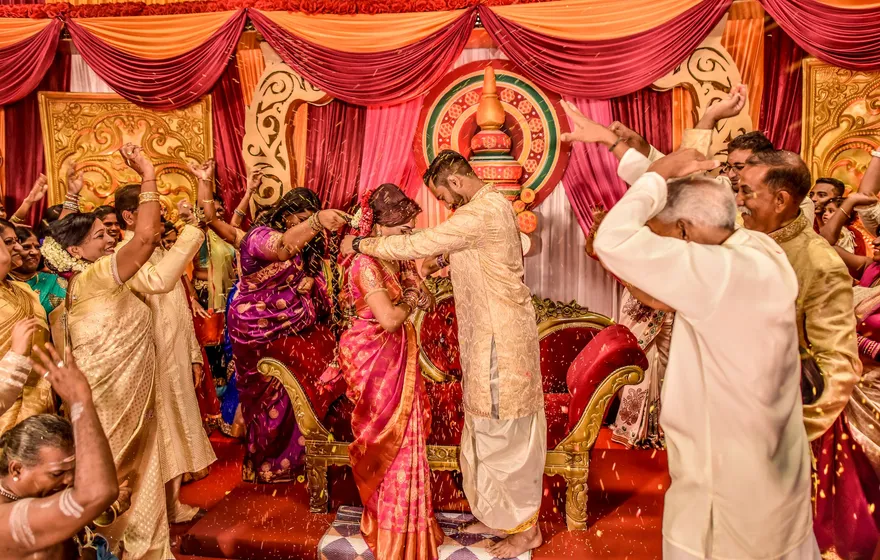
Regional tradition changes which marker carries the weight (Wikipedia):
| Region | Main marker |
|---|---|
| North India | Sindoor, mangalsutra |
| South India | Thaali tying |
| Bengal | Shankha-pola bangles |
If you’re a guest, don’t assume what you saw at one Hindu wedding is “the” tradition. It varies by region, language, and family. For a wider tour of the rituals you’ll meet across cultures, my breakdown of wedding traditions explained covers where these markers come from.
How long is a Hindu wedding ceremony?
The main ceremony itself usually runs about 90 minutes to three hours (Wikipedia). The fire rites take time, and nobody rushes the mantras.
What surprises a lot of first-time guests is that the ceremony is one day inside a much larger celebration, commonly two to three days, sometimes five or more. The mehndi (henna), the sangeet (a music and dance night), and the baraat all happen around the main rites. So when someone asks “how long is a Hindu wedding,” the honest answer is a few hours for the ceremony and often a full weekend for the wedding.
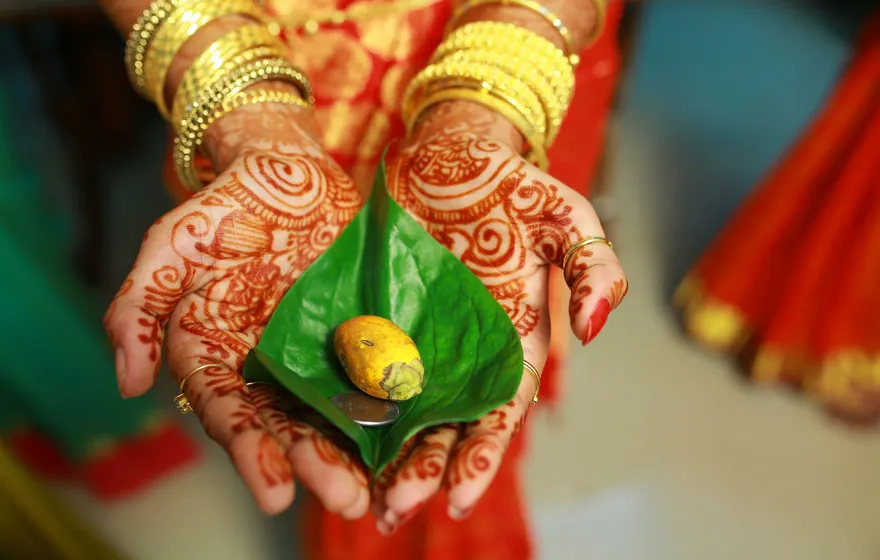
For interfaith couples, this length is actually a planning lever. A lot of them deliberately shorten the Vedic portion with their pandit and pair it with a separate Western vow exchange, so each tradition gets its own uncrowded moment rather than one stretched marathon.
Can a non-Hindu officiant perform a Hindu wedding?
You can’t do it alone, and you wouldn’t want that anyway. The Vedic fire rites, the saptapadi, the kanyadaan, the Sanskrit mantras chanted to Agni, belong to a Hindu priest or pandit. Those rites take training and lineage I don’t have, and I won’t pretend otherwise. I will not personally perform the saptapadi or the kanyadaan. What a Western or interfaith officiant does instead is co-lead alongside the pandit.
When I co-lead, I handle the vows, the readings, the ring exchange if there is one, and the running translation for a mixed-faith room so half your guests aren’t quietly lost. The pandit owns the Sanskrit rites; I own the English connective tissue and the choreography between sections. In practice we stand side by side at the mandap and hand the ceremony back and forth.
There are two common ways to structure this (The Three Tomatoes). One is a single co-led ceremony where the pandit and the second officiant alternate sections. The other is two distinct ceremonies, a Hindu ceremony plus a separate Western vow exchange, often on different days.
| Format | How it runs |
|---|---|
| Co-led | They alternate sections |
| Two ceremonies | Often on two days |
I lean toward the second for couples whose two families have very different expectations, because then nobody feels like a guest at their own half.
For a fuller walk through blending two faiths in one room, including how to brief families who’ve never met the other tradition, read my guide to planning an interfaith wedding ceremony. And if your fusion crosses two religions, my breakdown of how different wedding traditions actually work covers the rites you’ll meet on the other side of the room.
A co-led ceremony bridge you can actually use
Here’s the part nobody writes a script for: the seam. The moment where the pandit’s Sanskrit section ends and the English begins. I wrote this bridge to be spoken by the Western co-officiant right after the saptapadi, so the non-Hindu guests understand what they just watched and the ceremony keeps its dignity. Take it, change the names, make it yours.
Officiant: (stepping forward as the couple completes the seventh step)
“A moment ago, [Name] and [Name] took seven steps together around the fire. For those of us seeing this for the first time, I want you to know what you witnessed.”
“Each step was a promise. To nourish each other. To grow strong together. To build a life of meaning. To share joy. To raise a family, however they choose to define it. To move through every season side by side. And at the seventh step, the simplest promise of all: to be lifelong friends.”
“In this tradition, the marriage is not made by a signature or a certificate. It is made right here, by these seven steps, witnessed by the sacred fire and by every one of you. So I can tell you with certainty: [Name] and [Name] are married.”
Officiant: (turning to the couple)
“Now, in the language and the tradition that also belongs to this family, I’d like to invite you both to speak the vows you’ve written for each other.”
(Couple exchanges personal vows. Ring exchange, if included, follows here. Then hand back to the pandit for the mangalsutra and sindoor, or close, per your order of service.)
That bridge does the real work of a co-led ceremony. It honors the rite that just happened without performing it, and it gives the half of the room that doesn’t speak Sanskrit a way in.
If you want a complete, fill-in-the-blanks ceremony you can adapt for the Western portion of a fusion wedding, I keep a free sample ceremony script you can pull from for the vows, readings, and the closing.
Do you have to include kanyadaan?
You don’t. In March 2024, the Allahabad High Court clarified that kanyadaan, the father giving away the bride, is not a prerequisite for a valid Hindu marriage; only the saptapadi is indispensable (Swarajya).
I bring this up because the “giving away” framing sits uneasily with a lot of modern couples, and some of them assume dropping it breaks the marriage. It doesn’t. I’ve seen couples rework it into a mutual giving, where both partners offer themselves to each other and both sets of parents bless the union, rather than one father handing over a daughter. Your pandit can tell you exactly how to restructure it while keeping the rites that matter intact.
If you want non-religious vows or readings to sit alongside the Vedic portion, my piece on unity ceremony ideas has options that pair cleanly with a fusion ceremony without competing with the fire rites.
What should guests know before attending a Hindu wedding?
A few things make the difference between watching politely and actually being part of it:
- Shoes come off to step onto the mandap. It’s sacred ground. There’s even a playful game, the joota chupai, where the bride’s side “steals” the groom’s shoes.
- Wear color, with a few exceptions. Bright, festive attire is welcome. Avoid red, which is the bride’s color. Avoid white and pure black, both tied to mourning.
- Expect the baraat. The groom often arrives in a loud, dancing procession, sometimes on a horse. Join in if you’re invited; this is celebration, not a quiet processional.
- Cash gifts traditionally end in 1. Think $101 or $501. The extra rupee or dollar is considered auspicious, a number that keeps going rather than rounding off.
- The ceremony is long and you can move. Guests often shift, chat quietly, and step in and out during the fire rites. It’s a living room energy, not a hushed church.
Miss one of these and nobody will mind, but knowing them makes the day much easier to follow.
Who handles the legal paperwork in New York?
For couples marrying in New York City, this is the practical hinge, and it’s separate from the religious rites entirely. To solemnize a marriage in NYC, the officiant must be registered with the City Clerk, and they sign the marriage license. The officiant doesn’t need to be a New York resident (NYC City Clerk).
At a co-led interfaith ceremony, the couple decides who that legal signer is: the pandit, the Western officiant, or whoever is registered. Settle this early. I’ve seen the question come up at the signing table, which is the worst possible moment, and the fix is a five-minute conversation weeks ahead. Make sure the person named on the license is the one who’s actually registered with the City Clerk, and if you want the paperwork sequence start to finish, my NYC marriage license guide lays out every step.
Building the Western half of your fusion ceremony
The pandit handles the Vedic rites. What’s left to you is everything in the Western seams: the vows you say to each other, the readings your friends deliver, the bridge that ties the two traditions together for the whole room. That part is yours to write, and it’s where a fusion ceremony either feels like two stapled-together halves or one whole thing.
That’s exactly what I built The Couple’s Ceremony Kit for. It walks you through writing vows that sound like you, choosing readings that fit a mixed-faith room, and structuring the non-Vedic portion so it sits gracefully beside the fire rites instead of fighting them. It won’t write your saptapadi (that’s your pandit’s work, and rightly so), and it gives you a clean, confident frame for everything around it. For couples planning a fusion ceremony in New York or Westchester, it means you’re working from a plan instead of guessing.
Frequently asked questions
How long does a Hindu wedding ceremony last?
The main ceremony usually runs about 90 minutes to three hours. It’s typically one day inside a larger celebration that can span two to three days, with separate events like the baraat, sangeet, and mehndi. Interfaith couples often shorten the Vedic portion and pair it with a Western vow exchange so each tradition gets its own moment.
What are the seven steps (saptapadi) and why do they matter?
Saptapadi means “seven steps” in Sanskrit. The couple either takes seven steps or circles the sacred fire seven times, with a vow at each step covering nourishment, strength, prosperity, happiness, family, the seasons of life, and lifelong friendship. Under India’s Hindu Marriage Act, when saptapadi is part of the rites, the marriage becomes complete and binding the moment the seventh step is taken.
Can a non-Hindu officiant perform a Hindu wedding ceremony?
The Vedic fire rites traditionally belong to a Hindu priest or pandit, and that’s who should perform them. A Western or interfaith officiant can co-lead, handle the vows, readings, and ring exchange, and explain the rituals to mixed-faith guests, but the sacred Sanskrit rites are the pandit’s lane. In practice the two work side by side at the mandap.
Is kanyadaan required, and can we leave it out?
You can leave it out. The Allahabad High Court clarified in 2024 that kanyadaan is not legally required for a valid Hindu marriage; only the saptapadi is indispensable. Many modern and interfaith couples drop or rework kanyadaan for equality reasons, sometimes using a mutual giving where both partners offer themselves to each other. Confirm the specifics with your pandit.
Who signs the marriage license at an interfaith Hindu wedding in New York?
In New York City, whoever solemnizes the marriage must be registered with the City Clerk, and they sign the license; residency isn’t required. At a co-led interfaith ceremony, the couple decides whether the pandit or the Western officiant is the legal signer. Sort this out in advance so the registered officiant is the one named on the paperwork.
The Couple’s Ceremony Kit
Walk in with a ceremony that sounds like the two of you
This post covers one part of the ceremony, and the Couple’s Ceremony Kit covers the rest, with five full scripts to start from and the prompts I use to help couples write their vows.
- Five full ceremony scripts in five different styles
- The Story Mine, thirty prompts for writing your vows
- Sixteen unity rituals, with the words and what to gather
- Thirty readings, each with my notes on when it fits
CEREMONY
Caribbean Wedding Traditions Worth Keeping
A couple sat in my office in Crown Heights, both second-generation, one side Guyanese and one side Trinidadian, and the bride said, "We want it to feel Caribbean, but we don't.
READ →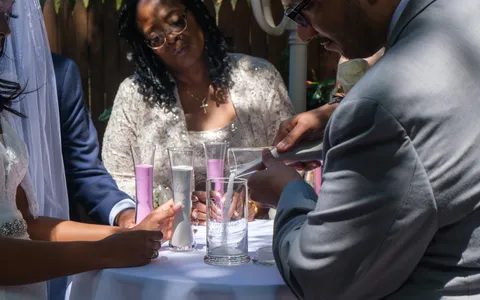
CEREMONY
What Is a Unity Ceremony? The Complete Guide
What a unity ceremony is, where it fits in your wedding, and how to choose the right ritual, from an officiant who's performed them at 300+ weddings.
READ →
CEREMONY
African Wedding Traditions, Explained With Respect
African wedding traditions by people and region: the Akan knocking, the Yoruba engagement, the Igbo kola and wine-carrying, libation, aso ebi and the broom, with how to include one or two without flattening them.
READ →