CEREMONY
African Wedding Traditions, Explained With Respect
African wedding traditions by people and region: the Akan knocking, the Yoruba engagement, the Igbo kola and wine-carrying, libation, aso ebi and the broom, with how to include one or two without flattening them.
A few years ago I stood at the front of a Brooklyn ceremony while the bride’s grandfather poured palm wine onto the floor of a rented loft and called the names of three people who were not in the room. The space went still. I had a script in my hand and I never said a word of it, because the words that mattered were his, in a language I do not speak, for ancestors I never met.
That’s where a lot of advice about African wedding traditions goes wrong. It hands you a checklist. “Add a libation ceremony” sits there next to “first dance song” like it is one more thing to order off a menu. The truth is that these rituals belong to specific families and specific peoples, and my job as the officiant is usually to step back and let the right person carry the moment.
So let me be honest about where I stand. I am an NYC officiant who has led ceremonies for couples blending Nigerian, Ghanaian, and African-American heritage with an American civil ceremony. I am no expert in African culture. I am someone who has learned to hold a ritual without leading it, and that turns out to be the whole skill here.
Africa is not one wedding. There is no single “African ceremony,” any more than there is one European one. A Yoruba engagement, an Akan knocking, and an Igbo wine-carrying are three different events with three different rules. This post walks the specific ones, where each comes from, which are older than people assume and which are younger, and how a diaspora couple can work one or two into a modern ceremony without flattening a continent into a theme.
| Tradition | Whose it is |
|---|---|
| Knocking | Akan, Ghana |
| Alaga engagement | Yoruba |
| Kola nut (oji) | Igbo |
| Wine carrying | Igbo |
| Libation | Yoruba, Igbo, Akan, Ewe |
| Aso ebi | Yoruba roots |
| Jumping the broom | African-American |
Read the rows that belong to your family first, and treat the rest as someone else’s.
What actually happens at a Yoruba engagement?
If you have only ever pictured solemn African ceremonies, a Yoruba engagement will surprise you. It is loud, funny, and adversarial by design.
The whole event is run by a hired professional called the Alaga Ijoko, the “chairperson of sitting,” almost always a woman, who acts as the bride’s family’s defense attorney and the groom’s judge (Social Life NG). She is theatrical, she negotiates, and she makes the groom and his friends earn their welcome.
The groom prostrates fully on the ground, a gesture called dobale, sometimes with his friends and then again alone. The Alaga can rule that the prostration was not sincere enough and make him do it over. The room laughs, his mother-in-law-to-be watches, and the point is made: you are entering a family, and a family is something you submit to, not something you buy.
I tell couples this because some come in wanting to make the African portion “dignified,” by which they mean quiet. The Yoruba tradition is not quiet, and in a Yoruba engagement the comedy is how the dignity gets expressed. Stripping it out to make it match a hushed American processional misses what the ritual is for.
What is the kola nut for at a Nigerian wedding?
In Igbo tradition, almost nothing real begins until the kola nut is broken.
The kola nut, oji, is presented, prayed over, broken, and shared near the start of the proceedings. It stands for hospitality, peace, and communion with the ancestors. A four-lobed nut maps to the four Igbo market days and signals prosperity.
Two details matter and most write-ups skip them. First, the kola is blessed in Igbo, never in English. There is a saying, “oji anaghi anu bekee,” that kola does not understand English (Chiism). Second, it is broken by an elder man, usually the eldest present, or by a visiting Eze if there is one. Women cultivate, present, and eat kola, but they do not break it ceremonially.
The governing proverb means he who brings kola brings life:
“onye wetara oji wetara ndu”
It is short enough to print in the program, which is one way to give guests the meaning without anyone talking over the elder.
What happens in the Igbo wine-carrying ceremony?
The Igbo Igba Nkwu, the “wine carrying,” has a moment so good I am surprised more couples do not know it.
After the kola and the prayers, the bride is given a cup of palm wine and sent to find her groom in the crowd. Her father has secretly told her who he is and where he sits, but to everyone watching she is searching (Wikipedia). Guests try to distract her. Friends of other men try to coax her toward the wrong lap. She moves through all of it, finds her groom, kneels, and offers him the cup.
He drinks it, and that sip is the consent: the marriage made public, not by a question from an officiant but by a woman choosing a man in front of her whole community.
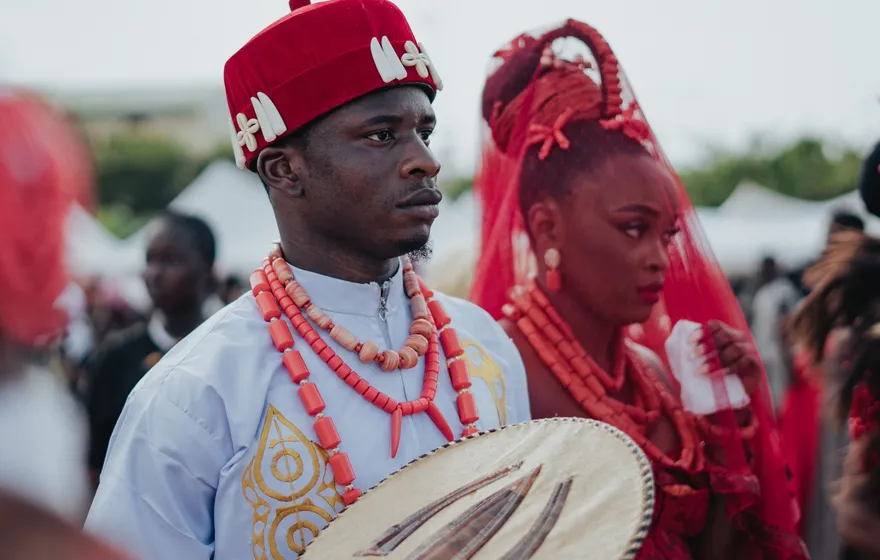
I love this ritual because it puts the bride’s choice at the center in a way Western ceremonies often do not. If your family is Igbo, this is the heart of the day, and an American “you may kiss” can feel thin next to it. Some of my couples keep the wine-carrying as the real marriage and treat the signing of the license as paperwork. I think that is the correct emotional ranking.
What is the Ghanaian knocking ceremony?
Among the Akan of Ghana, the marriage begins with a sound.
The knocking ceremony, called Kokooko for the noise of a fist on wood, or Opon-akyi bo, “knocking the back of the door,” is the formal first approach (Harusi Hub). The groom’s family arrives at the bride’s family home and literally announces themselves. They bring tri nsa, “head drinks,” usually schnapps, palm wine, or an agreed sum of money.
Here is the part couples miss: the marriage is not real until those drinks are accepted. If the bride’s family takes the drinks and the bride gives her consent, things move forward. If they do not, there is no engagement. And knocking is its own separate, earlier event. It is not the engagement party itself, it is the request for permission to have one.
What is the libation ceremony, and who should lead it?
The libation is the ritual that travels furthest across the diaspora, and the one I am asked about most.
Palm wine or water is poured onto the ground while the names of specific deceased relatives are spoken aloud. It appears across Yoruba, Igbo, Akan, and Ewe cultures, so calling it simply “African” is too broad. In Igbo it is itu mmanya n’ala. Among the Akan its job is to “cool the throats” of the ancestors and deities so they will hear the petitions of the living.
The belief underneath it is not decorative. The idea is that ancestral blessing comes before a marriage can succeed, that you stand on the shoulders of the people who made you possible, and that they should be invited to the wedding too.
Which is exactly why the choreography matters more than the words. The libation should be poured by an elder, and the names should be called by someone who actually knew the dead. When a couple asks me to “do the libation,” my first question back is: who in your family carries this? An aunt who remembers your grandmother’s voice. The oldest man on your father’s side. The blessing reads as inheritance when it comes from inside the family, and as theater when it comes from the rented officiant. I would much rather hand the cup to your uncle and stand quietly to his left.
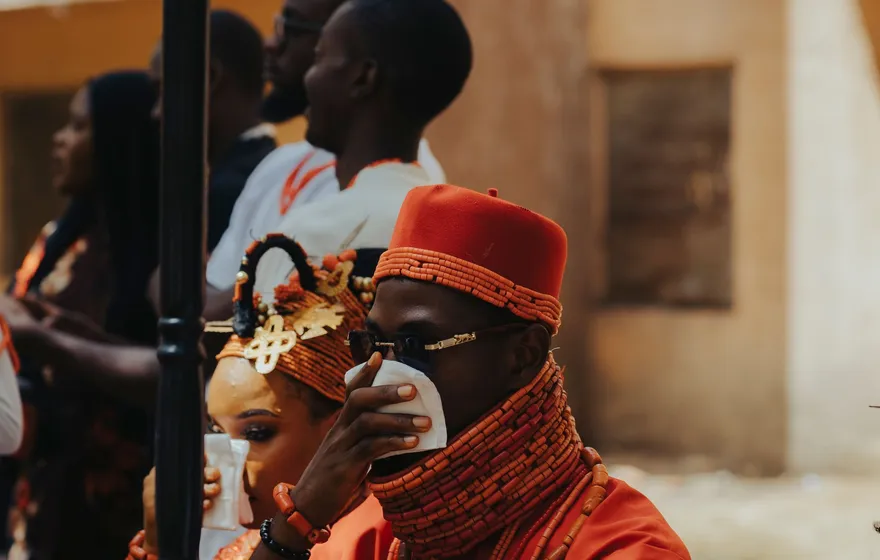
When the right person holds the cup, my part shrinks to one sentence of introduction, which is exactly how it should be.
This is also where a libation pairs naturally with other unity rituals if your families are blending faiths or cultures. If you are building a ceremony that has to hold more than one tradition at once, my notes on planning an interfaith wedding ceremony walk through how to sequence rituals so none of them gets buried.
Is jumping the broom actually African?
This is the one couples are most surprised by, so I want to be careful and accurate.
The African origin of jumping the broom is genuinely contested, not settled. Historian Tyler D. Parry, who wrote a whole book on it, found no documented evidence of broom-jumping anywhere in Africa before the transatlantic slave trade (Wikipedia). The ritual practiced by enslaved African-Americans has more in common with Welsh and Romani “besom weddings” in the British Isles than with the Ghanaian Asante custom, which involved waving brooms over the heads of newlyweds, not jumping over one.
What is certain is more powerful than a tidy origin story. Enslaved people, barred from legal marriage, took a broom and made a wedding out of it. That ritual was largely revived for modern Black couples by Alex Haley’s “Roots,” the 1976 novel and the miniseries that followed.
So how do you honor it? Honestly. The broom is best understood as a ritual of survival and reclamation, not a direct African import. For African-Americans cut off by slavery from any traceable ethnic lineage, the broom carries exactly that weight, and that is enough. It does not need a fake Akan pedigree to matter. I have a fuller history of the ritual and how couples personalize it in my piece on the meaning behind jumping the broom, and for couples weaving a family blessing into the day, my notes on building family involvement into the ceremony cover who should carry which moment.
What is aso ebi, and why does it cause drama?
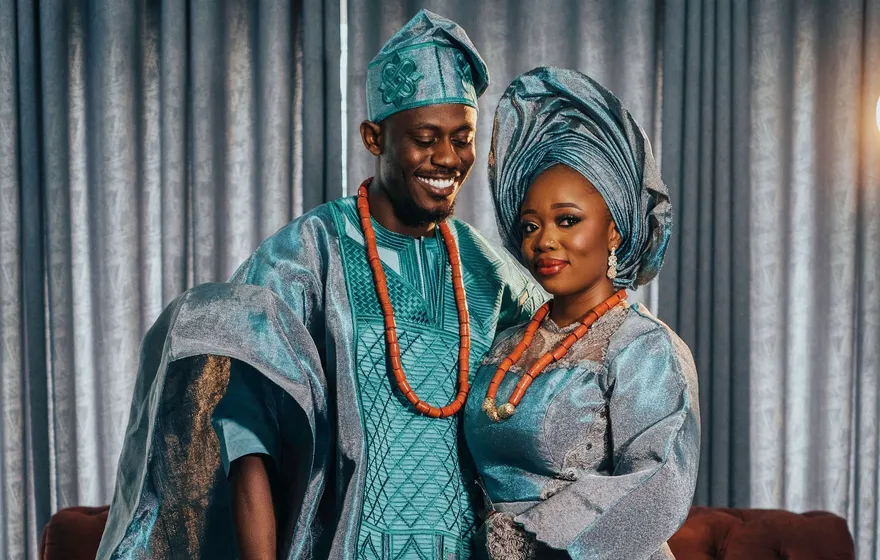
If you have been to a Nigerian wedding, you have seen a sea of guests in the same fabric. That is aso ebi, “family cloth,” from aso (cloth) and ebi (family).
It feels ancient, but its rise as a wedding feature dates to around 1920, during the post-WWI palm-oil boom that flooded West Africa with imported lace and George fabrics, with a deeper root in Yoruba age-grade groups who wore matching dress to mark a shared bond (Wikipedia). So it is a real tradition with a real history. It is also younger than your great-grandmother.
It also comes with social friction worth naming. Groups compete to outshine each other. Guests who cannot afford a full outfit add just a matching headwrap or top so they still belong to the family color. There is generosity in it and there is pressure in it, and the couples I work with usually know exactly which relatives will feel which.
I mention the social weight because well-meaning diaspora couples sometimes adopt aso ebi as a fun “everyone match” gimmick without knowing it carries money politics back home. Knowing the texture lets you do it with your eyes open.
How do I include one or two of these without appropriating?
Here is the conversation I actually have with couples, condensed.
Start from your specific lineage, not a pan-African template. If your people are Yoruba, do the Yoruba thing. If you are Ghanaian, the knocking and the libation are yours. Do not stack a Yoruba engagement, an Akan knocking, and an Igbo kola rite into one ceremony because they all read as “African.” That is the flattening I keep warning against.
Pick one or two, and hand each to the right person. Let the elder pour. Let the eldest break the kola. Let the family voice call the names. Your officiant should be the smallest presence in those moments, not the narrator.
If you have no traceable ethnic line, that is real, and the broom and libation are built for exactly that. Many African-Americans cannot trace back to a specific people, because slavery severed the record. The broom and the libation work honestly as recovered heritage rather than inherited family custom. That is not a lesser claim. It is the truest version of why these rituals survive.
And personalize without erasing. I have seen brooms custom-built with a grandmother’s lace and wildflowers, with guests writing blessings on slips of paper tied to the handle (Elsker). I have seen libations scaled from a drumming performance down to a single poured cup. The reclamation framing is what keeps personalization from tipping into props.
If your families are blending more than one heritage under one roof, the sequencing matters even more, and I lay that out in my guide to building a blended-family unity ceremony. For the wider map of where all of these rituals sit, see the hub on wedding traditions explained.
A libation you can actually use
Most posts describe the libation and stop. Here is a short, copy-ready version you can give to the family elder who will lead it. Keep the language simple so it can be spoken in English, or have the elder render it in your family’s language and use this only as the shape.
Officiant (briefly, then step back): (turn toward the elder and the couple)
“Before these two are joined, their family asks the ones who came before to bless this union. [Elder’s name] will pour for us.”
Elder: (lift the vessel, pause until the room is quiet)
“We do not stand here alone. We stand on the shoulders of those who made us. As I pour, we call their names, and we ask them to walk with [Partner A] and [Partner B] all the days of this marriage.”
(Pour a small amount as each name is spoken. The room may answer “Ase,” “Iseoluwa,” or “Amen,” whatever your family uses.)
“We remember [Ancestor 1].”
(pour)
“We remember [Ancestor 2].”
(pour)
“We remember [Ancestor 3], and all the names we hold in our hearts and cannot finish saying.”
(pour the last of the vessel)
Elder: (to the couple, hand resting near them)
“What they built, you continue. May their blessing be on this house. Drink, and be joined.”
(The couple may share a sip of palm wine here, or the elder returns the vessel and the ceremony continues.)
Print it, hand it to the person who carries it in your family, and let them make it their own, because the elder matters far more than my wording.
If you want a full ceremony built around a ritual like this, with the processional, the vows, and the pronouncement already drafted so you only have to slot in your family’s portion, that is exactly what I built the Couple’s Ceremony Kit for. It gives you a complete, modern, secular-friendly ceremony you can drop a libation or a broom jump straight into, instead of stitching one together from scratch the week of the wedding. If you just want to see the shape of a finished ceremony first, you can grab a free sample ceremony script and read how the pieces fit before you decide.
Frequently asked questions
Is jumping the broom actually an African tradition?
It is contested. Historian Tyler D. Parry found no documented evidence of broom-jumping in Africa before the transatlantic slave trade, and argues the ritual practiced by enslaved African-Americans resembles Welsh and Romani “besom weddings” more than the Ghanaian Asante custom of waving brooms over newlyweds’ heads. What is certain is that enslaved people, barred from legal marriage, made the broom jump their own, and Alex Haley’s “Roots” revived it for modern Black couples. Honor it as a ritual of reclamation and survival rather than a direct African import.
What is the libation ceremony at a wedding?
A libation is the pouring of palm wine or water onto the ground to honor ancestors and ask their blessing on the marriage, while an elder calls the names of deceased relatives. It appears across Yoruba, Igbo, Akan and Ewe traditions (in Igbo, “itu mmanya n’ala”). The belief underneath it is that the living stand on the shoulders of the dead and need their blessing for the union to thrive. It can be elaborate, with drumming and call-and-response, or as simple as an elder pouring water and naming three ancestors.
What is the kola nut for at a Nigerian wedding?
The kola nut (oji in Igbo) opens the ceremony. It is presented, prayed over, broken, and shared as a sign of hospitality, peace and communion with ancestors. In Igbo tradition it is blessed in the Igbo language, not English, and is broken by the eldest man present. The proverb “onye wetara oji wetara ndu” means “he who brings kola brings life.”
How do I include African traditions in my wedding without appropriating?
Start from your own family’s specific heritage rather than a generic “African” template, since a Yoruba engagement, an Akan libation and an Igbo wine-carrying are different ceremonies, not interchangeable. Choose one or two rituals that connect to your lineage, and hand each one to the right person: let an elder pour the libation and call the names, let the family’s eldest break the kola. If you have no traceable ethnic lineage, common in the African-American diaspora, the broom and libation function honestly as reclamation. Talk it through with your officiant so the ritual is led from inside the family.
What is the Ghanaian knocking ceremony?
The knocking ceremony (Kokooko, or Opon-akyi bo) is the formal first step in an Akan marriage, where the groom’s family literally knocks on the door of the bride’s family home to announce his intention to marry. They bring “tri nsa,” head drinks, usually schnapps, palm wine, or cash. Only when the bride’s family accepts the drinks, and the bride gives her consent, can the engagement proceed. It is a separate, earlier event from the engagement itself.
What is aso ebi at a Nigerian wedding?
Aso ebi means “family cloth” (aso = cloth, ebi = family): coordinated outfits made from the same chosen fabric, worn by family and guests to show unity and support. Despite feeling timeless, it is relatively modern, with its popularity dating to around 1920 and the post-WWI fabric boom, with deeper roots in Yoruba age-grade dress. It also carries real social weight, since groups sometimes compete over the richness of their cloth.
The Couple’s Ceremony Kit
Walk in with a ceremony that sounds like the two of you
This post covers one part of the ceremony, and the Couple’s Ceremony Kit covers the rest, with five full scripts to start from and the prompts I use to help couples write their vows.
- Five full ceremony scripts in five different styles
- The Story Mine, thirty prompts for writing your vows
- Sixteen unity rituals, with the words and what to gather
- Thirty readings, each with my notes on when it fits

CEREMONY
Caribbean Wedding Traditions Worth Keeping
A couple sat in my office in Crown Heights, both second-generation, one side Guyanese and one side Trinidadian, and the bride said, "We want it to feel Caribbean, but we don't.
READ →
CEREMONY
What Is a Unity Ceremony? The Complete Guide
What a unity ceremony is, where it fits in your wedding, and how to choose the right ritual, from an officiant who's performed them at 300+ weddings.
READ →
CEREMONY
Ways to Include Family in Your Wedding Ceremony (Matched to Comfort, Not Just Closeness)
A menu of real ways to give parents, grandparents, siblings, and kids a role in your ceremony, matched to comfort level, plus honoring a loved one who's passed and how to keep it from running long.
READ →