CEREMONY
Interfaith Wedding Ceremony
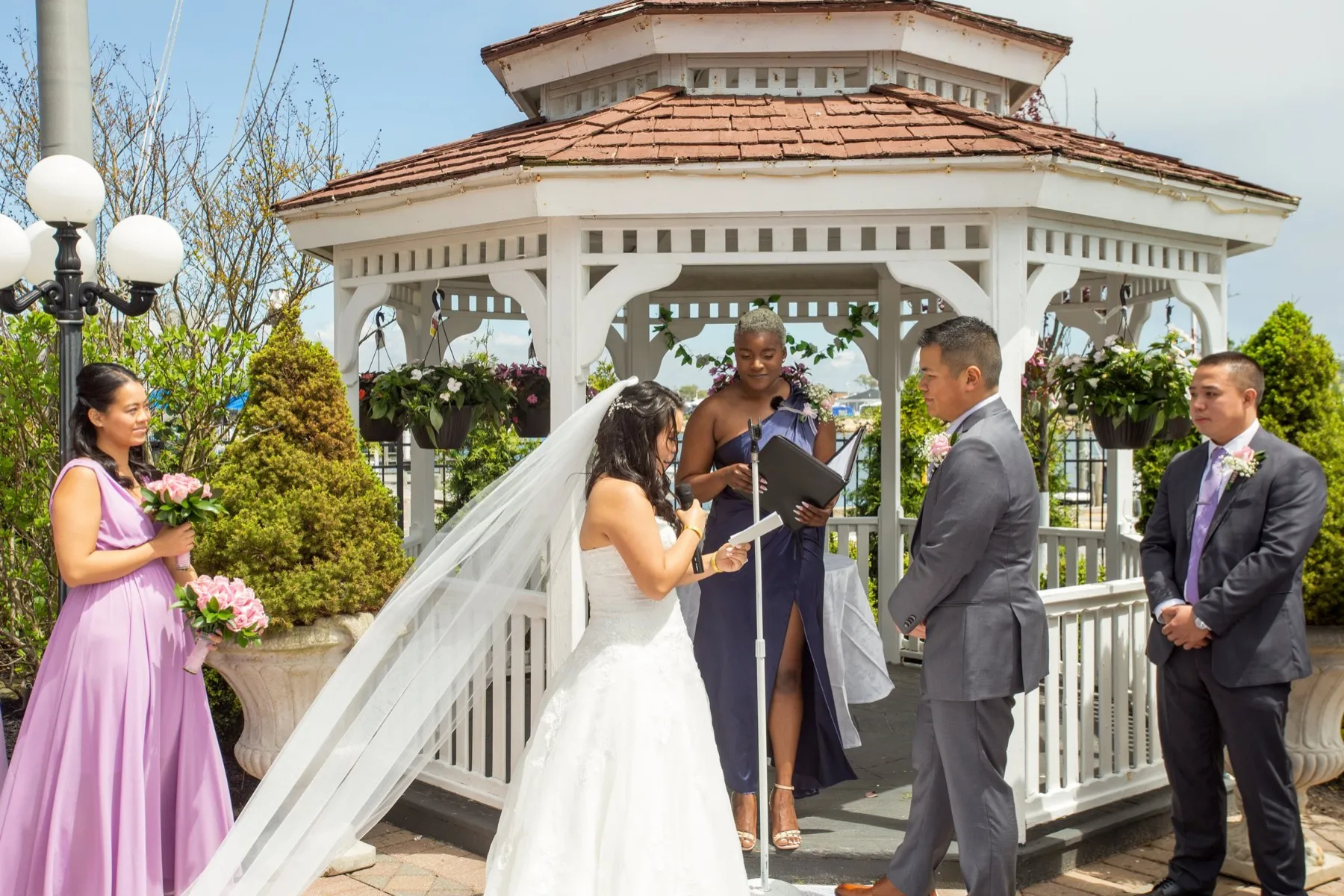
At a Brooklyn ceremony I officiated, the bride's grandmother held a Catholic rosary in one hand and watched a glass break under the groom's foot. Both sides cried at the same moment. Here's how you build that.
At a Brooklyn ceremony I officiated last fall, the bride’s grandmother sat in the front row holding a Catholic rosary while the groom stepped on a glass and the room shouted “Mazel tov.” Her side of the family had been nervous for months that the Jewish elements would crowd out her faith. When the glass broke, I explained in one breath that we shatter it because joy and grief share the same room, and that this was exactly what the next reading was about, a passage she’d chosen from Corinthians. She reached over and grabbed her daughter’s hand. Both sides cried at the same moment, for the same reason.
That’s the whole game. An interfaith ceremony works when both families cry at the same moment, not when each gets its turn.
I’ve built and officiated interfaith ceremonies across most of the pairings New York throws at you: Jewish-Catholic, Hindu-Christian, Muslim-secular, Buddhist-Protestant. This city is one of the densest interfaith-marriage markets in the country, so I’ve solved this exact problem many times for couples whose families wanted very different things. Here’s what actually works.
The short version: pick one connecting thread that both faiths already name, usually commitment, joy, or the joining of two families, and thread every ritual onto that single story. Use one officiant who narrates why each ritual is happening, not two who take turns. And settle the non-negotiables with both families in a planning meeting, long before the rehearsal.
The rest of this post is how to build each of those, in the order I’d do it with you.
Why interfaith ceremonies feel “stapled together” (and how to fix it)
Almost nobody tells couples this, so I will: the “two ceremonies back to back” feeling almost never comes from the rituals themselves. A unity candle and a glass-breaking don’t clash. What clashes is the missing connective tissue between them.
When you drop all of one faith’s rituals in a block, then all of the other’s in a second block, the ceremony reads like a relay race. Guests feel the handoff. They sense the moment where “their” part ends and “the other side’s” part begins, and that’s the moment somebody’s mother stiffens in her seat.
The fix is the same one the industry keeps arriving at on its own: find one connecting thread and build the script around it. The thread is almost always a value both traditions already share, usually commitment, the presence of the divine in a promise, or the joining of two families into one. Pick the one that’s truest for you, and then everything you include has to earn its place by connecting back to it.
Here’s how that sounds in practice. Instead of “And now we’ll light the unity candle,” you say:
“Sarah’s family lights candles every Friday night to mark a moment as sacred. David’s family lights one at every baptism to mark a new beginning. So we light this one together, because a marriage is both, a thing made holy and a thing just beginning.”
Same candle. Completely different feeling, and now it belongs to everyone in the room.
This is also where blended objects do real work. The strongest interfaith ceremonies I’ve seen don’t set two separate symbols side by side. They make a new shared one:
- A chuppah sewn from fabric of both mothers’ wedding dresses.
- A canopy that carries a Star of David and a Unitarian flaming chalice on the same pole.
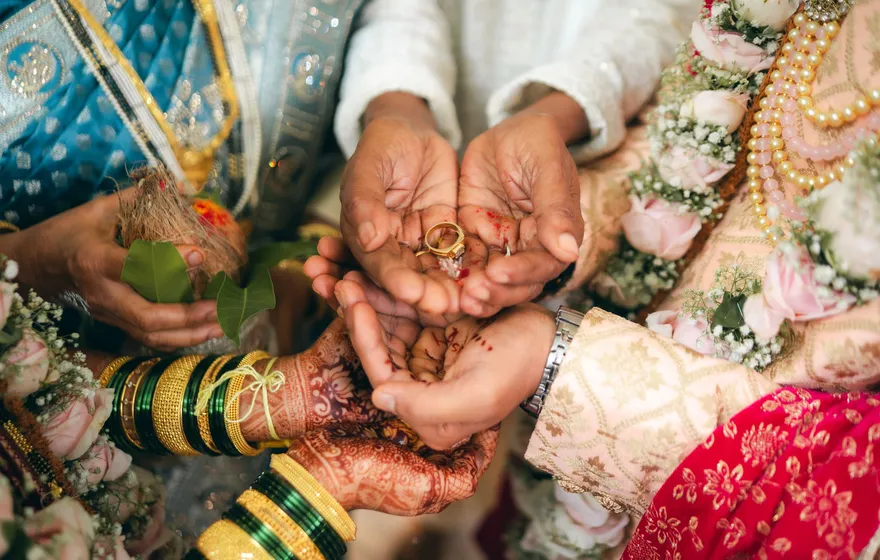
- The seven Jewish wedding blessings paired with the seven steps of a Hindu ceremony, so the count itself becomes the bridge (The Conversation).
The object stops being “his” or “hers.” It’s the marriage.
One officiant or two? The honest answer
Couples ask me this in almost every first call, and they’re usually surprised by my answer: for most interfaith weddings, one skilled officiant beats two.
I know that sounds self-serving coming from an officiant, so let me give you the data. In the Brandeis Cohen Center study of intermarried couples, only 5% used co-officiants from two faiths. A quarter had a sole Jewish officiant, 11% had non-Jewish clergy only, and a majority used nonreligious officiants (Brandeis University / JTA). Co-officiation is far rarer than couples assume going in.
| Who officiated | Share of couples |
|---|---|
| Nonreligious officiants | A majority |
| A sole Jewish officiant | About a quarter |
| Non-Jewish clergy only | 11% |
| Two-faith co-officiants | 5% |
There’s a reason for that. Clergy who’ve done it describe co-officiating as “two people trying to jockey the job of one person” (Religion News Service). It isn’t only a scheduling headache. Two officiants means two scripts to reconcile, two theologies that may not agree, and twice the risk that one of them goes off-book and tips the balance. That thread I keep talking about is hardest to hold when two different people are pulling opposite ends of it.
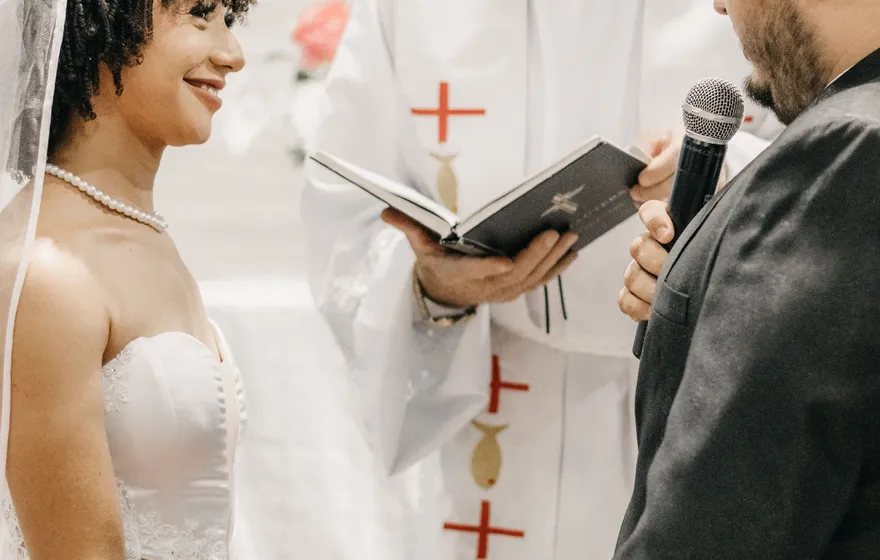
So when do you actually want two? When a specific clergyperson’s presence matters so deeply to a family that their absence would be its own wound. A grandfather who’s a pastor. The priest who baptized the bride. In those cases, hire both, but assign one of them to own the spine of the ceremony and the timing, and have them coordinate the full script weeks in advance, not at the rehearsal.
One more thing nobody warns couples about. Plenty of clergy can’t co-officiate even if they want to, because it’s policy, not preference. Several Jewish movements restrict or ban it outright, and the Conservative movement reaffirmed its ban on rabbinic participation in interfaith ceremonies in August 2023 (The Conversation). If a rabbi tells you no, it almost certainly isn’t about you. Don’t take it personally, and don’t try to argue them out of policy. Find an officiant who can give you what you actually want.
And clergy who do say yes often attach conditions you won’t see coming:
- A promise to raise children in the faith.
- Enrollment in an intro class.
- No co-officiation with another faith’s clergy.
- A rule that the ceremony can’t happen in another faith’s house of worship.
Surface those on the first call. A condition you learn about in June is a planning detail. The same condition discovered at the rehearsal is a crisis.
The family conversation, in the right order
This is the part couples get backwards, and the order genuinely matters.
Talk to each other first. Before you call a single officiant, before you mention anything to either set of parents, sit down together and answer two questions honestly. Which traditions actually mean something to me? And which one, if we included it, would make me uncomfortable standing under it on my wedding day? You need both answers from both people before anyone else gets a vote.
Then choose your officiant. Then bring in the families. Doing it in that sequence keeps money and control disputes from hijacking the ceremony (18Doors). When parents get involved before the couple has aligned, the loudest or best-funded opinion tends to win, and you end up with a ceremony that honors a tradition neither of you chose.
When you do bring the families in, lead with participation, not permission. The single best antidote to a relative who feels erased is to give them a job. Have a parent read a blessing in their native language. Ask grandparents to light a candle. Carry a family prayer shawl into the chuppah. I’ve seen it in the reporting and in my own ceremonies: relatives who feel their tradition was honored show up, and some who feel it was erased stay home (Religion News Service). A job is the clearest possible signal that this marriage is a joining of families, not a contest between two faiths. If you want a deeper playbook on this, I wrote a whole guide on how to involve both families in your ceremony without it turning into a tug of war.
A job is the clearest possible signal that this marriage is a joining of families, not a contest between two faiths.
A few small, respectful substitutions keep everyone comfortable without changing what a ritual means. Grape juice instead of wine in the kiddush cup for a halal-observant partner. Kippot offered to guests who want them rather than required of everyone. A printed program with one plain sentence explaining each ritual, so the guests who’ve never seen a glass-breaking or a saptapadi aren’t sitting there lost (Smashing the Glass). That program is one of the most useful things you can make, because it turns spectators into participants.
What rituals actually blend (and a quick reality check)
You have more room than you think. Interfaith marriage isn’t a fringe case anymore. About 26% of married Americans have a spouse of a different religion (Pew Research Center), and among people who married since 2010, 39% are in a religious intermarriage, versus just 19% of those who wed before 1960 (Pew Research Center). Roughly twice as common as it was a couple of generations ago. The traditions you’re blending have been blended before.
The move I steer couples toward is choosing a small number of rituals that each say something true about you, then pairing or layering them so they share a meaning instead of just sharing a slot in the program. A unity candle paired with a Hebrew blessing. The seven Jewish wedding blessings read in seven voices, alternating with the seven steps of a Hindu ceremony. A wine or wine-box ritual that doubles as the kiddush cup. If you want a fuller menu to draw from, my breakdown of the wedding traditions worth blending lays out where each one comes from and what it actually signifies, which matters when you’re explaining them to a skeptical aunt.
One note for couples who are also marrying across languages, which interfaith couples often are: the same “one thread” logic applies, and the mechanics overlap heavily with what I cover in planning a bilingual ceremony. Don’t translate every line twice. Let each language carry the moments where it means the most.
A full interfaith ceremony script you can use
Here’s a complete, copy-ready script for a Jewish-Christian ceremony built around a single thread: the joining of two families into one. Swap the specific rituals for your own traditions and the bones will still hold. The thread does the work; the rituals just hang on it.
Processional: (Both sets of parents walk their child down the aisle. Officiant waits at a chuppah that carries a small cross and a Star of David on the same canopy.)
Welcome:
“Friends, family, both families, welcome. Some of you grew up lighting candles on Friday night. Some of you grew up kneeling on Sunday morning. Today you’re all in the same room for the same reason, because two people you love are about to make one family out of two. That’s the only tradition this ceremony serves. Everything we do here is in service of that one thing.”
Honoring both houses: (Officiant gestures to each family in turn.)
“Maria and David did not fall in love in a vacuum. He carries his grandmother’s faith. She carries hers. Neither of them is being asked to set anything down today. They’re being asked to make room. So we begin by naming both houses out loud, with gratitude, because a marriage is built on the families that made the people in it.”
Reading (chosen by the Christian family): (A parent reads a passage, suggested: 1 Corinthians 13.)
Bridge to the next ritual:
“That reading says love bears all things and endures all things. Hold onto that, because the next thing we do says the same truth in a different language.”
The breaking of the glass, reframed: (Officiant explains before the act.)
“In Jewish tradition, we end with breaking a glass. People give it many meanings, but the one that fits today is this: even in our most joyful moment, we remember that joy and sorrow live in the same room. That’s not a sad note. It’s an honest one. It’s the same thing Maria’s family just read to us, that real love endures all things, the hard and the holy alike. So when the glass breaks, both of your traditions are saying one sentence together.”
The vows: (Each partner speaks their own vows. If they wish, each in the cadence or language of their upbringing.)
“Maria, David, you’ve each written what you promise. Say it now, in your own words, to the one person it’s for.”
Ring exchange:
“These rings are a circle, which both your traditions have used for the same reason: a circle has no end. Place it on each other’s hand and say: ‘With this ring, I marry you, and I join my family to yours.’”
Family blessing: (Both mothers, or chosen elders from each side, come forward together. Officiant invites one shared gesture, such as both laying a hand on the couple’s joined hands.)
“Will the people who raised these two come forward, from both sides, and bless them, not as a Jewish family or a Christian family, but as one family now.”
Pronouncement:
“By the power vested in me, and by the will of everyone in this room, I pronounce you married. You are now one family. You may kiss, and then, David, you may break the glass.”
(Kiss. Glass breaks.)
“Mazel tov, and amen. Both. Together.”
Recessional.
Notice what that script is doing. Every ritual gets a one-sentence narration that points back to the same idea. The glass-breaking isn’t “the Jewish part.” It’s another way of saying what the Christian reading already said. That’s the connective tissue, and it’s what your guests will remember as one ceremony instead of two.
If you want more starting points in different combinations, my collection of wedding ceremony script examples across styles and faiths is the hub I’d send you to next. Build from a template, then make it yours.
A ceremony script that already does this for you
I’ll be straight with you. You can absolutely write this yourself, and the script above gives you a real spine to start from. What takes the time, what couples underestimate, is the narration: writing the transition sentences that make a glass-breaking and a unity candle feel like the same thought instead of two unrelated acts.
That’s most of what’s inside The Couple’s Ceremony Kit. It’s a fill-in ceremony built so you choose your rituals and the connecting language is already written around them, including a neutral welcome that names both families and the transition lines that thread one faith’s moment into the next. It’s $79, a fraction of what an officiant who specializes in interfaith builds would charge to write it from scratch. If you’d rather see the bones first, you can grab a free sample ceremony script here and decide whether building it yourself feels doable.
It also helps to see what each tradition looks like on its own. I have broken down the Hindu, Jewish, and Catholic wedding ceremony in their own guides.
Either way, the principle is free, and it’s the whole post: one thread, narrated out loud, with both families given a job.
Frequently asked questions
Should we have one officiant or two for an interfaith wedding?
For most couples, one skilled interfaith officiant produces a more unified ceremony than two clergy. Two-faith co-officiation is actually rare, only 5% of intermarried couples in the Brandeis study, and clergy themselves describe it as two people doing the job of one. A single officiant who knows both traditions can thread them onto one story. Use two only when a specific clergyperson’s presence matters deeply to a family, and confirm in advance that both will coordinate the script and timing.
Can a rabbi or priest co-officiate an interfaith wedding?
Sometimes, but many will not, and it’s policy rather than personal. Several Jewish movements restrict co-officiation, and the Conservative movement reaffirmed its ban on rabbinic participation in interfaith ceremonies in 2023. Clergy who do agree often attach conditions, such as a promise to raise children in the faith or a rule against sharing the ceremony with another faith’s clergy. Ask about conditions on the very first call so nothing surfaces at the rehearsal.
How do you keep an interfaith ceremony from feeling like two ceremonies stapled together?
Pick one connecting thread, usually a value both traditions already name like commitment or the joining of families, and build the whole script around it. Then say out loud why each ritual is happening so it ties back to that thread, instead of dropping one faith’s rituals in a block followed by the other’s. Blending objects helps too, like a chuppah that carries both faiths’ symbols or pairing two traditions’ structures.
What should we discuss with our families before an interfaith wedding?
Talk to each other first, naming which traditions are meaningful to each of you and which would make either of you uncomfortable to include. Then choose your officiant, then bring in family. That order keeps money and control disputes from hijacking the ceremony. With families, name the non-negotiables early and invite relatives to participate, through a blessing, a candle, or a family prayer shawl, so they feel included rather than erased.
What interfaith wedding rituals can be blended respectfully?
Many. Common moves include substituting grape juice for wine in the kiddush cup for a halal-observant partner, offering kippot to guests who want them rather than requiring them, pairing the seven Jewish blessings with the seven steps of a Hindu ceremony, or sewing a chuppah from fabric meaningful to both families. The key is meaning, not quantity. Pick a few rituals that each say something true about you, and print a short program so guests from both sides understand what they’re seeing.
ALSO READ Wedding Ceremony Script Examples: Templates for Every StyleThe Couple’s Ceremony Kit
Walk in with a ceremony that sounds like the two of you
This post covers one part of the ceremony, and the Couple’s Ceremony Kit covers the rest, with five full scripts to start from and the prompts I use to help couples write their vows.
- Five full ceremony scripts in five different styles
- The Story Mine, thirty prompts for writing your vows
- Sixteen unity rituals, with the words and what to gather
- Thirty readings, each with my notes on when it fits
CEREMONY
Caribbean Wedding Traditions Worth Keeping
A couple sat in my office in Crown Heights, both second-generation, one side Guyanese and one side Trinidadian, and the bride said, "We want it to feel Caribbean, but we don't.
READ →
CEREMONY
What Is a Unity Ceremony? The Complete Guide
What a unity ceremony is, where it fits in your wedding, and how to choose the right ritual, from an officiant who's performed them at 300+ weddings.
READ →
CEREMONY
African Wedding Traditions, Explained With Respect
African wedding traditions by people and region: the Akan knocking, the Yoruba engagement, the Igbo kola and wine-carrying, libation, aso ebi and the broom, with how to include one or two without flattening them.
READ →