CEREMONY
GUIDEWhat Is a Unity Ceremony? The Complete Guide
What a unity ceremony is, where it fits in your wedding, and how to choose the right ritual, from an officiant who's performed them at 300+ weddings.
WHAT YOU’LL LEARN
A unity ceremony is a symbolic ritual performed during a wedding, usually after the vows and before the pronouncement, where the couple does one thing together (lighting a candle, pouring sand, binding hands) to represent two lives becoming one. It typically takes three to seven minutes and is entirely optional.
WHO THIS IS FOR
Couples planning a unity ceremony and the officiants leading them.
I’ve officiated 300+ weddings, and the unity ceremony is the one part of a ceremony your guests watch instead of only hear.
A unity ceremony is a symbolic ritual performed during your wedding ceremony that represents two lives becoming one. It’s the physical, visual moment that turns words into action. You’ve said your vows. Now you’re doing something together that your guests can see.
Plenty of good ceremonies skip one. If you want one, the rest of this guide will help you pick the ritual that fits your life.
CHAPTER 01 12
What Is a Unity Ceremony?
A unity ceremony is any symbolic ritual performed during a wedding that represents the joining of two people (and sometimes two families). It sits between the vows and the pronouncement in most ceremony structures, though some couples move it earlier or later depending on the flow.
The concept has been around for centuries. Celtic couples tied their hands together with cord. Hindu couples walked around a sacred fire. Jewish couples shared wine. African American couples jumped a broom. Every culture found a way to make the abstract (commitment, unity, partnership) into something concrete.
Today, unity ceremonies have expanded far beyond their traditional roots. Couples blend whiskey, plant trees, pour sand, light candles, lock padlocks, mix paint, and build puzzles. The options are genuinely endless.
CHAPTER 02 12
Where the Unity Ceremony Fits in Your Wedding Timeline
Most unity ceremonies happen about two-thirds of the way through the ceremony. Here’s the standard flow:
- Processional
- Welcome and opening words
- Reading (optional)
- Address or love story
- Vows
- Ring exchange
- Unity ceremony (here)
- Pronouncement
- Kiss
- Recessional
Placing it after the rings works because the couple has already made their verbal promises. The unity ceremony becomes the physical seal on those words. That said, I’ve moved it to right after the opening words for ceremonies where the ritual is the centerpiece, and it works just as well.
The ritual itself takes 3 to 7 minutes depending on the type. Sand ceremonies run shorter. Handfasting with multiple cords takes longer. Plan accordingly so your overall ceremony stays in the 20 to 30 minute range.
CHAPTER 03 12
Who Participates?
This depends on what you choose and what feels right.
Here is the short version, then the detail.
| Who | Rituals that fit |
|---|---|
| Couple only | Candle, sand, handfasting |
| Family | Sand, tree planting |
| Guests | Stones, wishes, ring warming |
Couple only: Most unity ceremonies involve just the two of you. Candle lighting, sand pouring, handfasting, cocktail mixing, love locks. These are intimate moments between partners.
Family included: Sand ceremonies and tree planting work beautifully when you want children from previous relationships to participate. I’ve done sand ceremonies where four kids each poured their own color into the family vase.
Guests involved: Some couples invite all guests to participate. Passing stones, tying wishes to a tree, warming the rings. Community participation turns spectators into active parts of the ceremony.
My recommendation: if you’re doing a unity ceremony, let it be yours. Including family is wonderful when it’s genuine. Including guests is great for small weddings. For large weddings (50+), keep it between the couple or it becomes a logistics problem instead of an emotional moment.
CHAPTER 04 12
The History of Unity Rituals in Weddings
Unity ceremonies aren’t a modern Pinterest invention. They’re ancient.
Handfasting dates back to pre-Christian Celtic and Norse cultures, where couples’ hands were literally bound together to seal their commitment. This is where the phrase “tying the knot” comes from.
Wine sharing has roots in ancient Greek, Jewish, and Christian traditions. The shared cup represented a shared life.
Fire rituals appear in Hindu (Agni, the sacred fire) and Zoroastrian (fire temple) ceremonies. Circling the fire together symbolized the couple’s process through life.
Jumping the broom became a powerful tradition in African American communities during slavery, when enslaved people were denied legal marriage. The broom jump became the ceremony. After emancipation, many families kept the tradition as a way to honor their ancestors’ resilience.
Breaking the glass in Jewish ceremonies reminds the couple that even in joy, there is fragility. It’s one of the most recognizable unity moments in any wedding tradition.
These traditions survived centuries because they work. They give the abstract concept of “becoming one” a tangible, memorable form.
The best unity ceremonies reflect your actual life.
CHAPTER 05 12
How to Choose the Right Unity Ceremony for You
I tell every couple the same thing: pick something that actually means something to you. Don’t choose a candle ceremony because you saw it on Pinterest if neither of you cares about candles.
Ask yourselves these questions:
What do you do together? If you cook together every Sunday, a spice-blending or cooking-themed ceremony makes sense. If you garden together, plant something. If you’re whiskey people, blend whiskey. The best unity ceremonies reflect your actual life.
Indoor or outdoor? Unity candles and wind are enemies. If your ceremony is outdoors (Central Park, beach, garden), go with sand, handfasting, tree planting, or anything that doesn’t involve an open flame. I’ve watched too many candle ceremonies turn into a comedy of relighting attempts.
How many people are participating? If it’s just the two of you, almost anything works. If you’re including children, sand and tree planting are easiest for little hands. If you want guests involved, ring warming or stone ceremonies scale well.
What’s your ceremony vibe? A formal black-tie wedding pairs well with a candle ceremony or wine box. A casual backyard wedding vibes with cocktail mixing or a love lock. Match the ritual to the tone.
Do you want to keep something afterward? Sand vases, planted trees, love locks, wine boxes, and painted canvases give you a physical keepsake. Handfasting cords can be framed. Candle ceremonies and drink-based rituals are beautiful but temporary.
CHAPTER 06 12
The most popular unity ceremony ideas
Here’s a quick overview of the major types. For the full ranked rundown of all of them, with a compare-at-a-glance table and which fits which couple, see my unity ceremony ideas guide. Each ritual below also has its own deep-dive with scripts and supply lists. And when you’re ready to draft the words your officiant will actually say, I walk the whole structure in how to write a unity ceremony script.
| Ritual | Best for |
|---|---|
| Unity candle | Indoor, traditional |
| Sand | Blended families |
| Handfasting | Celtic, Pagan |
| Tree planting | Garden weddings |
| Love lock | Elopements |
| Jumping the broom | Honoring heritage |
| Drink rituals | Brewery, winery venues |
| Paint pouring | Creative couples |
| Puzzle pieces | Blended families |
| Ring warming | Under 30 guests |
Each one gets its own short section below.
Unity Candle Ceremony
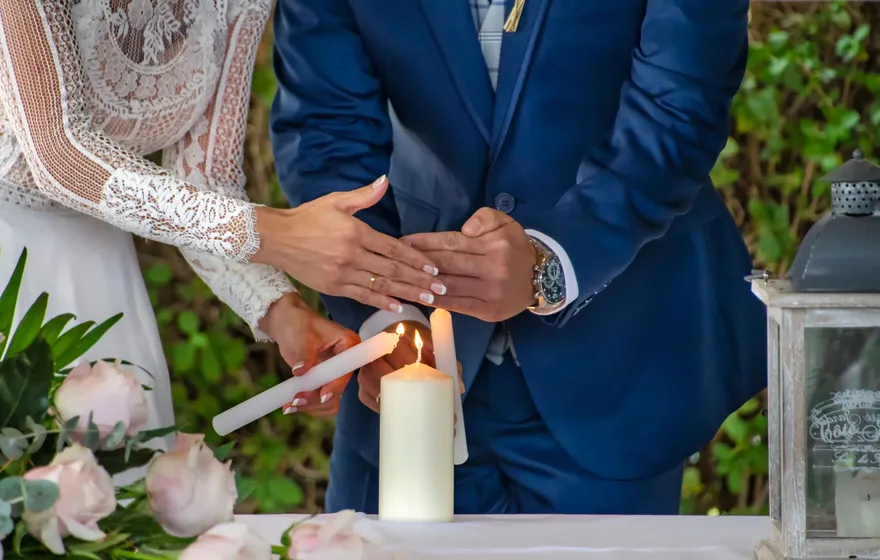
The classic. Three candles: two outer candles (representing each partner’s individual life) and one center candle (representing the new union). Each partner lights the center candle from their individual candle.
Best for: Indoor ceremonies, traditional or religious weddings, couples who want a quiet, reflective moment.
Watch out for: Wind. Seriously. If your ceremony is outdoors, have a backup plan or skip this one.
I have a full guide with three complete scripts (traditional, secular, and interfaith) in my Unity Candle Ceremony deep dive.
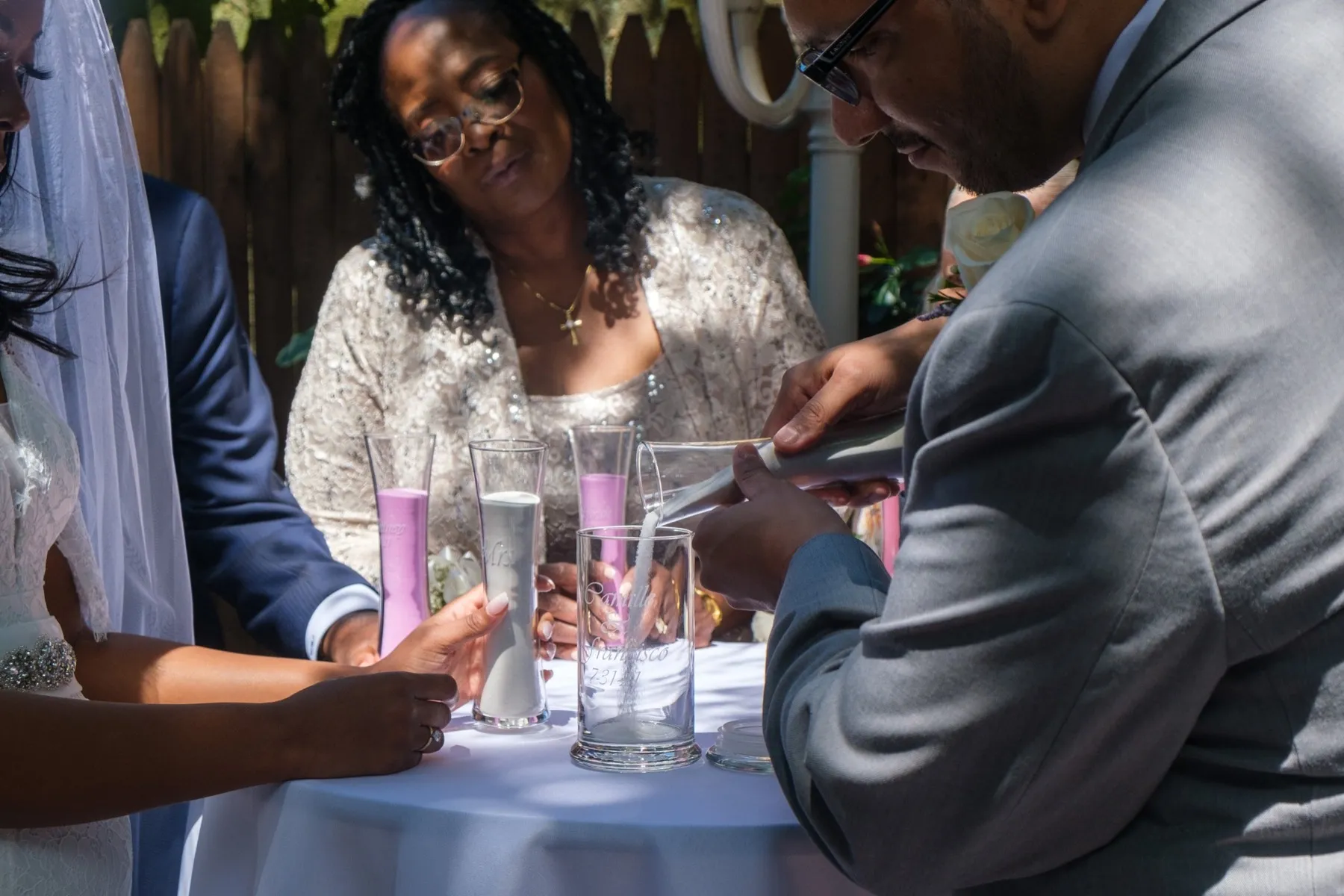
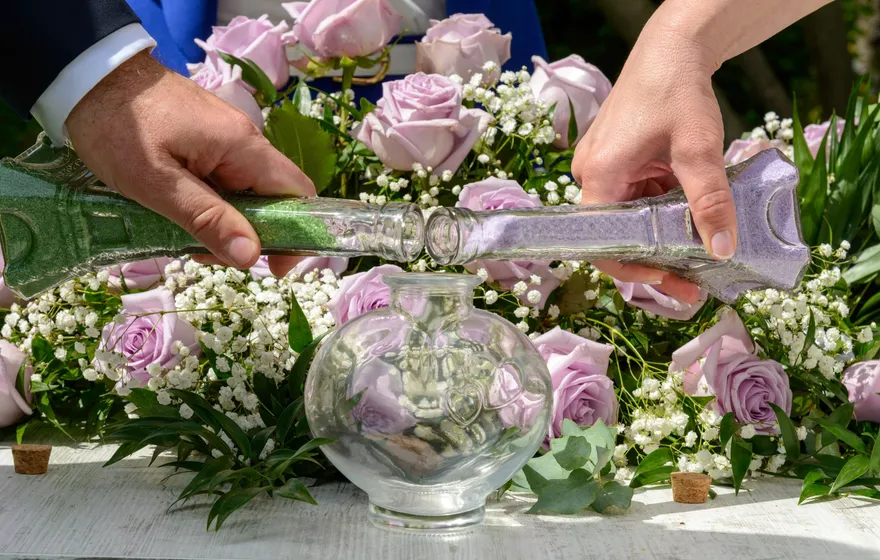
Unity Sand Ceremony
Two containers of colored sand poured into a single vessel, creating layered or blended patterns. The visual result is unique every time, and you keep the vessel forever.
Best for: Outdoor ceremonies (wind-proof), blended families with children, beach weddings, couples who want a keepsake.
Insider tip: Buy more sand than you think you need. Nerves make people pour fast, and you don’t want to run out mid-ceremony. I keep backup sand in my officiant bag for this exact reason.
Full guide with scripts and color meaning chart: Unity Sand Ceremony.
Handfasting (Cord/Ribbon Ceremony)
The officiant wraps cords or ribbons around the couple’s joined hands while reading blessings or vows for each cord. Each cord color represents a different quality (love, strength, loyalty, etc.).
Best for: Celtic, Pagan, or nature-inspired weddings. Couples who love symbolism and visual drama. Outdoor ceremonies.
My favorite version: Three cords, each tied by a different family member, with a blessing read for each. The couple’s hands stay bound together for the pronouncement and the kiss.
Full guide with cord color meanings and scripts: Handfasting Ceremony.
Tree Planting Ceremony
The couple plants a tree or small plant together, adding soil and water. The plant represents their growing relationship.
Best for: Eco-conscious couples, garden weddings, couples who want a living keepsake.
The apartment question: I get this all the time. “We live in a 500-square-foot apartment.” Start with a potted plant during the ceremony. Transfer it to a larger pot or garden when you have the space. Succulents and bonsai trees work great for small spaces.
Love Lock Ceremony
The couple attaches a padlock engraved with their names and date to a decorative structure or bridge, then throws away the key together.
Best for: Modern couples, intimate elopements, destination weddings.
Real talk: Don’t attach your lock to any NYC bridge or public structure. It’s illegal and they’ll cut it off. Bring your own decorative display piece or frame for the lock.
Full guide: Love Lock Ceremony.
Jumping the Broom
The couple jumps over a decorated broom together at the end of the ceremony, honoring African American heritage and ancestral resilience.
Best for: African American couples, anyone honoring their heritage, couples who want an energetic ceremony ending.
Personal note: As a Black officiant, this ceremony holds special meaning for me. I’ve written about the full history, including the important conversation about its origins, in my Jumping the Broom guide.
Whiskey, Wine, and Cocktail Ceremonies
The couple blends two spirits, wines, or cocktail ingredients into one drink and shares it. Some couples seal a wine box to open on their first anniversary.
Best for: Fun-loving couples, foodie weddings, brewery or winery venues, couples who want guests laughing.
Best version I’ve seen: A couple who homebrewed together created a custom beer blend during the ceremony. Their guests lost it. The drink itself was apparently terrible, and that was part of the fun.
Full guide: Whiskey Unity Ceremony.
Paint Pouring / Canvas Ceremony
Each partner pours paint onto a shared canvas, creating an abstract art piece. The result is unique and becomes wall art.
Best for: Creative couples, artists, colorful wedding themes, outdoor ceremonies (paint can drip).
Practical tip: Use a drop cloth. I learned this the hard way at a Bethesda Terrace ceremony where acrylic paint hit the stone tiles.
Puzzle Piece Ceremony
The couple (and sometimes children or family members) each place a piece into a puzzle, completing it together.
Best for: Blended families, couples with children, game-loving couples.
Custom option: Have a puzzle made from your engagement photo. Each family member places a piece during the ceremony. When it’s complete, you see the full photo for the first time together.
Ring Warming
The wedding rings are passed among all guests before the exchange. Each guest holds the rings briefly and silently makes a wish or prayer for the couple.
Best for: Small weddings (under 30 guests), intimate ceremonies, religious or spiritual couples.
Warning: Don’t try this with more than 30 guests unless you want your ceremony to take 45 minutes. For larger weddings, pass the rings through the first few rows only.
CHAPTER 07 12
Cultural and Religious Unity Traditions
African American Traditions
Jumping the broom and libation ceremonies (pouring a drink to honor ancestors) carry deep historical significance. Full guide.
Celtic and Pagan Traditions
Handfasting is the centerpiece, often combined with elemental blessings (earth, water, fire, air). Full guide.
Hindu Traditions
The Saptapadi (seven steps around the sacred fire) is one of the most beautiful unity rituals I’ve witnessed. Each step represents a vow: nourishment, strength, prosperity, happiness, progeny, longevity, and friendship.
Jewish Traditions
Breaking the glass and sharing wine from the Kiddush cup are powerful unity moments. The shattered glass reminds us that love is precious because it’s fragile.
Latin and Hispanic Traditions
The Lasso Ceremony (el lazo) wraps a floral rope or rosary in a figure-eight around both partners’ shoulders, symbolizing their eternal bond. The Arras ceremony involves the exchange of 13 gold coins representing shared prosperity.
CHAPTER 08 12
How to Plan Your Unity Ceremony: Step by Step
Planning your unity ceremony
-
Choose your ceremony type
Use the questions above to narrow it down. If you’re stuck, pick two favorites and ask your officiant which one flows better with your overall ceremony.
-
Get your supplies
Don’t wait until the week before. Order sand, candles, cords, or whatever you need at least a month out. I have full supply lists with vendor recommendations in my Couple’s Ceremony Kit.
-
Choose or write your script
Your officiant can write this, or you can customize a template. The script should explain to guests what’s happening and why. Don’t assume they’ll know.
-
Assign roles
Decide who holds the candles, who pours the sand, and who ties the cords, and make sure everyone knows their role before the rehearsal.
-
Rehearse the physical actions
Practice pouring sand, lighting candles, or tying cords at least once before the wedding day. Muscle memory matters when your hands are shaking with nerves.
-
Brief your photographer
Tell them exactly when the unity ceremony happens and what it looks like so they can photograph it properly. Many photographers miss the moment because they didn’t know it was coming.
Do them in that order and nothing gets left to the week of the wedding.
CHAPTER 09 12
Common Unity Ceremony Mistakes (and How to Avoid Them)
Mistake 1: No explanation for guests. If your officiant doesn’t explain what’s happening, guests just watch you pour sand into a vase with zero context. The explanation IS the ceremony. Without it, it’s just an art project.
Mistake 2: Choosing something for the look, not the meaning. A ceremony that looks real on Instagram but means nothing to you will feel hollow in the moment. Pick something personal.
Mistake 3: Not practicing the physical actions. Sand pours too fast when you’re nervous. Candles won’t light on the first try. Cords tangle. Practice once and you’ll feel confident on the day.
Mistake 4: Unity candles outdoors. I’ll say it one more time: wind kills candle ceremonies. If you’re outdoors, go with literally anything else.
Mistake 5: Making it too long. A unity ceremony should be 3 to 7 minutes. More than that and you lose the audience. The beauty is in the simplicity.
Mistake 6: Forgetting the supplies. I’ve seen couples forget the sand, the candle lighter, the cord. Assign one person (your coordinator or a bridesmaid) to be responsible for getting the supplies to the ceremony site.
CHAPTER 10 12
Your Unity Ceremony Planning Toolkit
I put together a Couple’s Ceremony Kit that covers everything here and more: five full ceremony scripts, all 16 unity rituals written out with what to gather and what to do if something slips, a day-of timeline, and a ceremony style quiz to help you choose.
It’s the same resource I give my own couples when they’re planning their ceremony with me. If you want to DIY your unity ceremony with confidence, it’s all in there.
CHAPTER 11 12
FAQ
Do we have to do a unity ceremony?
No. Plenty of beautiful weddings skip it entirely. A unity ceremony adds 3 to 7 minutes and a visual moment, but your ceremony is complete without one.
Can we do more than one unity ceremony?
You can, but I’d advise against it. One strong ritual is more powerful than two rushed ones. Pick your favorite and commit to it.
What if we’re not religious? Can we still do a unity ceremony?
Absolutely. Most unity ceremonies are secular by nature. Sand, candles, handfasting, tree planting, cocktail mixing, love locks. None of these require any religious element unless you want one.
Who provides the supplies?
You do. Your officiant will tell you what you need, but sourcing and bringing the supplies is the couple’s responsibility (or your coordinator’s).
Can our children participate?
Yes, and some ceremonies are designed for exactly this. Sand ceremonies, tree planting, and puzzle ceremonies are the best options for including kids. I have specific scripts for blended family unity ceremonies in the Couple’s Ceremony Kit.
Should our officiant explain the ceremony to guests?
Always. The explanation transforms a physical action into a meaningful ritual. Without narration, guests don’t understand what they’re watching or why it matters.
Every couple’s ceremony is different, and the right unity ritual depends on who you are together, not what’s trending online. If you want help choosing or planning yours, I work with couples on custom ceremonies that include the unity ritual as part of the full experience. Get in touch and let’s build something that feels like you.
CHAPTER 12 12
Looking for the right unity ceremony?
A four-question quiz that matches you to one of the four most-used rituals. Takes 2 minutes. Get the free Unity Ceremony Quiz →
If you want the rest: the full word-for-word scripts for all 16 unity rituals, including the one your quiz matched, live in the Couple’s Ceremony Kit. See the Couple’s Ceremony Kit →.
PLANNING
Getting Married in NYC: The Complete Guide From a Working Officiant
The marriage license, the 24-hour wait, who can legally sign, City Hall vs Central Park vs a venue, real costs, and a working timeline. From the officiant who files the paperwork.
READ →
PLANNING
How to Elope in NYC: The Complete Guide
The marriage license, the best locations, how to tell your family, what the day actually looks like. Everything from a NYC officiant who has done this hundreds of times.
READ →READY WHEN YOU ARE
Ready to plan it for real?
Tell me about your day. I will write back the same week.
AVAILABLE 2026 + 2027