CEREMONY
Catholic Wedding Ceremony: Order, Rules, and What to Expect
What a Catholic wedding ceremony involves: Mass vs. ceremony-only, the rite of marriage, vows, who can officiate, and the rules for interfaith couples.
A few summers ago a couple sat across from me, half-laughing and half-panicked. His grandmother wanted a Catholic wedding, she was raised Methodist, and they’d already put a deposit down on a vineyard with a view they weren’t giving up. They figured I could just make the Catholic part happen at the vineyard. I had to tell them the truth, which is the same truth I’ll tell you here.
I’m a wedding officiant, not a priest. My honest job with a question like this is to explain how a Catholic wedding really works, then point you back to a parish for the parts only a parish can do. So here’s the straight version, no gatekeeping, with the real reasons behind the rules.
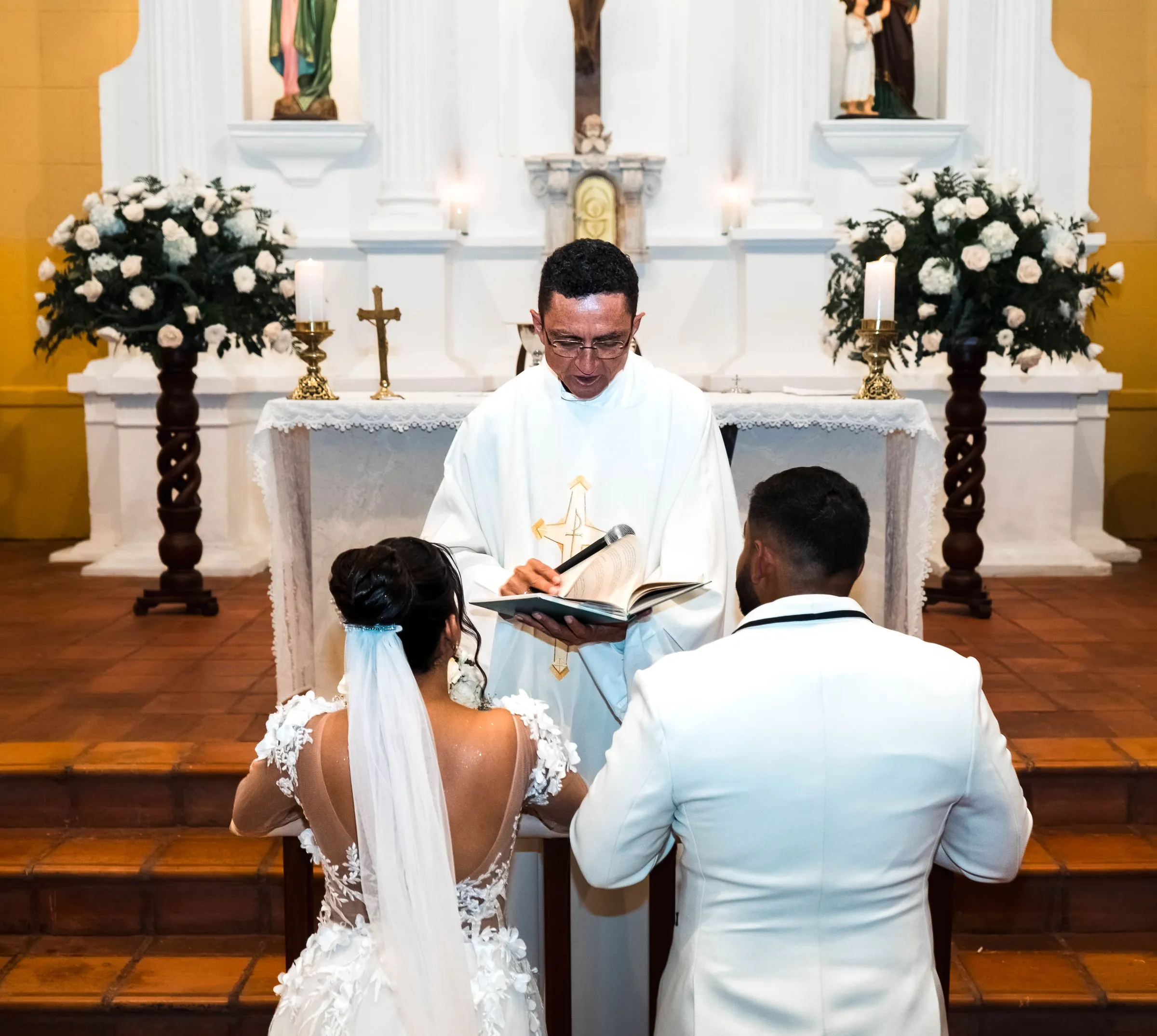
A Catholic wedding ceremony is the rite of marriage celebrated by a priest or deacon, normally in a Catholic church. It can happen inside a full Nuptial Mass or as a shorter ceremony without Mass, and either way it always contains four things: the questions before the consent, the consent (your vows), the blessing and exchange of rings, and the nuptial blessing.
What actually happens during a Catholic wedding ceremony
Strip away the nerves and a Catholic ceremony has a clear shape.
The order of a Catholic wedding
-
The entrance and greeting
The wedding party processes in, and the priest or deacon greets everyone.
-
The Liturgy of the Word
Readings from Scripture, usually two plus a psalm and a Gospel passage, often chosen by the couple from an approved list, then a short homily.
-
The questions before the consent
The rite of marriage itself begins. The celebrant asks the couple the questions you’ll find in the script below.
-
The consent
The couple exchange vows, and the celebrant receives and confirms their consent.
-
The blessing and giving of rings
The rings are blessed and exchanged.
-
The Liturgy of the Eucharist
Mass only
The gifts are brought to the altar and the Eucharistic Prayer is said, leading into the Our Father.
-
The nuptial blessing
Prayed over the couple. Within a Mass it comes after the Our Father, and Communion follows.
-
The final blessing
The celebrant blesses everyone, and the couple walks out married.
If it’s a full Mass, the Liturgy of the Eucharist follows and the congregation receives Communion. If it’s a ceremony without Mass, the rite ends after the nuptial blessing and final blessing, with no Communion. Same marriage, same vows, one fewer section.
If you want a feel for how any ceremony is sequenced before you sit with your parish, my plain-English breakdown of the full wedding ceremony order, section by section maps neatly onto the Catholic structure.
Catholic wedding Mass vs. ceremony without Mass: which one do you need?
This is the question I get most, and the honest answer is that there are three forms of the rite, not one (For Your Marriage).
The first is Matrimony within Mass, the standard for two Catholics. The second is Matrimony without Mass, the ceremony-only form, which is the norm when a Catholic marries a baptized non-Catholic Christian. The third is a form for a Catholic marrying someone who is unbaptized or a catechumen.
Here’s the part couples don’t expect. The Order of Celebrating Matrimony itself says that for a Catholic marrying a baptized non-Catholic, the rite without Mass should normally be used (Canon Law Made Easy). A bishop can permit a Mass, but it’s optional, not required for the marriage to be valid.
And a wedding without Mass is no lesser wedding. Between two baptized people it’s still fully valid and still a sacrament (For Your Marriage). You lose Communion, you keep the marriage.
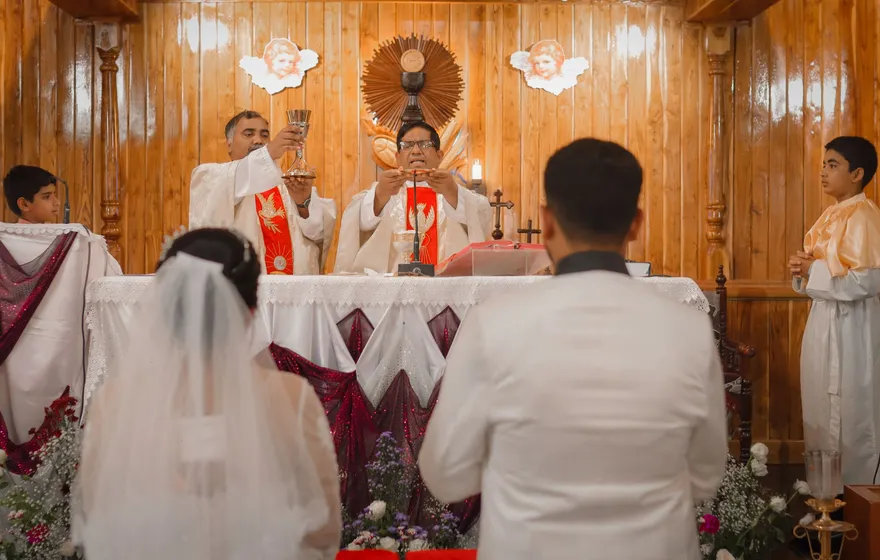
The reasoning behind steering interfaith couples to the ceremony-only form is genuinely pastoral, not bureaucratic. Communion signifies unity with the Catholic community, so a Mass where half the room can’t receive can’t really be a sign of welcome. Skipping the Mass means nobody at your wedding sits in a pew feeling like a guest in their own celebration.
The Catholic wedding vows, word for word
The vows are the heart of it. The Catholic Church teaches that the consent exchanged between the spouses is the one element that makes the marriage, the thing that can never be omitted or altered (For Your Marriage).
There are two Vatican-approved forms. Most couples use the declarative form, where each person makes a direct promise. The question form has the priest ask, and each person answers “I do.” The declarative version gets the nod because it puts you, the couple, front and center as the ministers of the sacrament, with the priest or deacon there to witness and receive your consent.
Here’s the actual rite, copy-ready, so you can read it before you ever walk into a parish office.
The Questions Before the Consent:
(The priest or deacon addresses the couple.)
“Have you come here to enter into Marriage without coercion, freely and wholeheartedly?”
Each answers: “I have.”
“Are you prepared, as you follow the path of Marriage, to love and honor each other for as long as you both shall live?”
Each answers: “I am.”
“Are you prepared to accept children lovingly from God and to bring them up according to the law of Christ and his Church?”
Each answers: “I am.” (This question is omitted when the couple is past childbearing age.)
The Consent (declarative form):
(The bride and groom face each other and join hands. Each, in turn, speaks the vow.)
“I, N., take you, N., to be my wife. I promise to be true to you in good times and in bad, in sickness and in health. I will love you and honor you all the days of my life.”
(The other partner repeats the same, saying “husband” in place of “wife.”)
The priest receives the consent:
“May the Lord in his kindness strengthen the consent you have declared before the Church, and graciously bring to fulfillment his blessing within you. What God joins together, let no one put asunder.”
The Blessing and Giving of Rings:
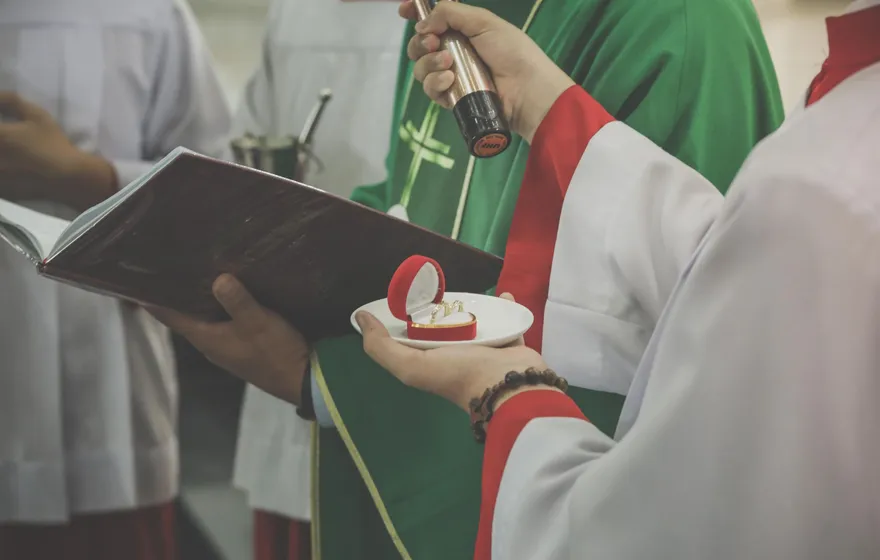
(The celebrant blesses the rings. Each partner places a ring on the other’s finger.)
“N., receive this ring as a sign of my love and fidelity. In the name of the Father, and of the Son, and of the Holy Spirit.”
Watch for that third question, the one about children. It catches couples off guard, so talk it through together before the rehearsal rather than hearing it cold at the altar.
If you’re drawn to the structure of the Catholic vows but you’re actually building a ceremony outside the Church, my walkthrough on how to write vows that sound like you borrows that same backbone of promise and specificity.
The nuptial blessing, and why it matters
After the consent and the rings comes the nuptial blessing, and this one isn’t optional. It’s a fixed high point of the rite with three approved versions, and within a Mass it’s prayed after the Our Father (Archdiocese of New York).
It’s separate from your vows. You make the promises to each other; the priest or deacon prays this blessing over you, asking God to keep what you’ve just begun. In the ceremonies I’ve watched from the side of a church, this is often the moment a parent finally lets the tears go, because this is the Church putting its arms around the marriage.
Who can perform a Catholic wedding (and why it usually can’t be me)
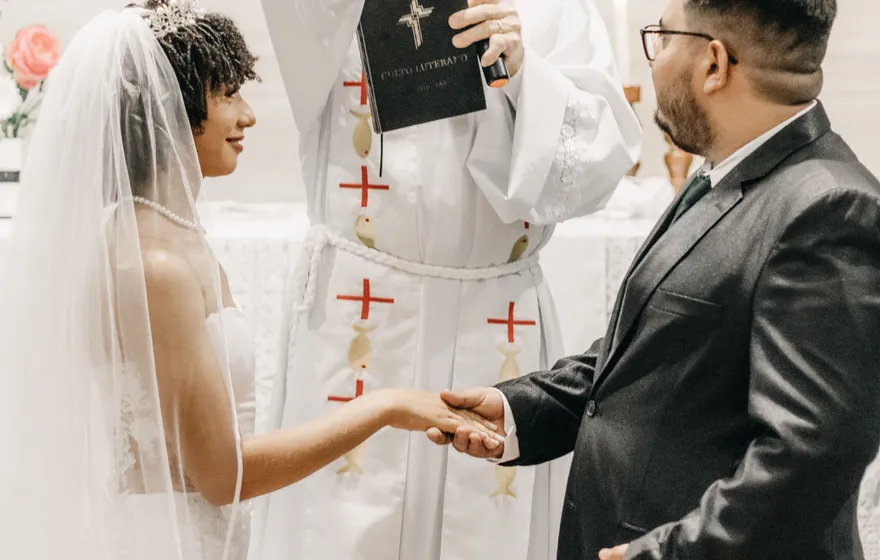
Let me be the officiant who tells you the unglamorous truth. For a sacramental Catholic marriage, the Church’s canonical form requires the wedding to be celebrated before a bishop, priest, or deacon, with two witnesses (Canon Law Made Easy). An online-ordained friend or an independent officiant like me cannot stand in for that.
Any officiant who blurs them is selling you something they can’t deliver.
I can give you a legally valid civil ceremony that’s beautiful and entirely yours. What I can’t do is make that civil ceremony count as a Catholic marriage in the eyes of the Church. Those are two different things, and any officiant who blurs them is selling you something they can’t deliver.
There’s one narrow exception. A dispensation from canonical form can let the Church recognize a marriage celebrated by, say, a Protestant minister or a rabbi, or in a non-Catholic setting. That dispensation is granted only in mixed marriages and is never given for two Catholics (Archdiocese of Saint Paul and Minneapolis). So if both of you are Catholic, the priest-or-deacon rule is firm.
Can you get married outside, or at a non-church venue?
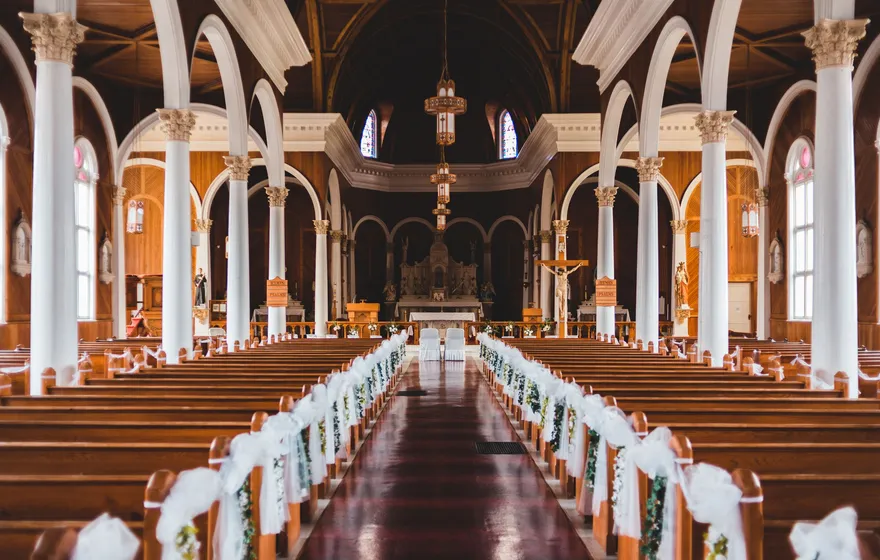
This is where the vineyard couple’s dream hit the wall. The Church expects a Catholic marriage to happen in a Catholic church. Even when a dispensation from canonical form is granted for an interfaith couple, diocesan guidelines generally rule out outdoor weddings, private homes, banquet halls, and commercial wedding chapels (Archdiocese of Saint Paul and Minneapolis).
So the beach-or-vineyard Catholic wedding most couples are picturing usually isn’t on the table.
Interfaith couples: what’s possible and what’s required
If one of you is Catholic and one isn’t, you have real options, but you also have two different permissions to keep straight, and couples mix them up constantly.
A mixed marriage, a Catholic marrying a baptized non-Catholic Christian, needs the bishop’s permission to be licit (For Your Marriage). A disparity of cult marriage, a Catholic marrying an unbaptized person, needs a formal dispensation to be valid, which is the stricter requirement. Your parish handles both, which is exactly why the conversation with a priest has to start early.
If you’re weaving two faiths or two cultures together, you’ll want more than the canon-law mechanics. My deeper guide to planning an interfaith wedding ceremony both families feel at home in covers how to honor both traditions without one side feeling like a footnote. And for the wider context of where these customs come from, my overview of wedding traditions and what they actually mean gives couples language for the choices they’re making.
Pre-Cana: the part nobody warns you about
Pre-Cana is the Church’s required marriage preparation, and it’s mandatory for everyone marrying in the Church (USCCB).
How Pre-Cana usually runs
-
Contact the parish
Six to nine months out
Contact the parish six to nine months out, sometimes more in a busy diocese.
-
Pick a format
Formats vary: a weekend retreat, a sponsor couple who mentor you, or a series of classes.
-
Answer the FOCCUS inventory
Many dioceses use the FOCCUS inventory, 180 questions each of you answers independently.
-
Talk it through
45 to 60 minutes
Then a facilitator walks you through where your answers diverge. The first session runs roughly 45 to 60 minutes, with follow-up meetings after.
It sounds like a hurdle. In practice, the couples who go in open usually come out telling me the money-and-kids-and-in-laws conversations FOCCUS forced were the most useful prep they did, full stop.
A note on why this matters more than it used to
Catholic marriage rates in the U.S. dropped by roughly 70 percent between 1969 and 2019 (Catholic News Agency). A lot of the couples I meet aren’t lifelong churchgoers planning a textbook Nuptial Mass. They’re lapsed, or mixed-faith, or simply trying to honor one devout relative without faking a level of religious practice that isn’t theirs.
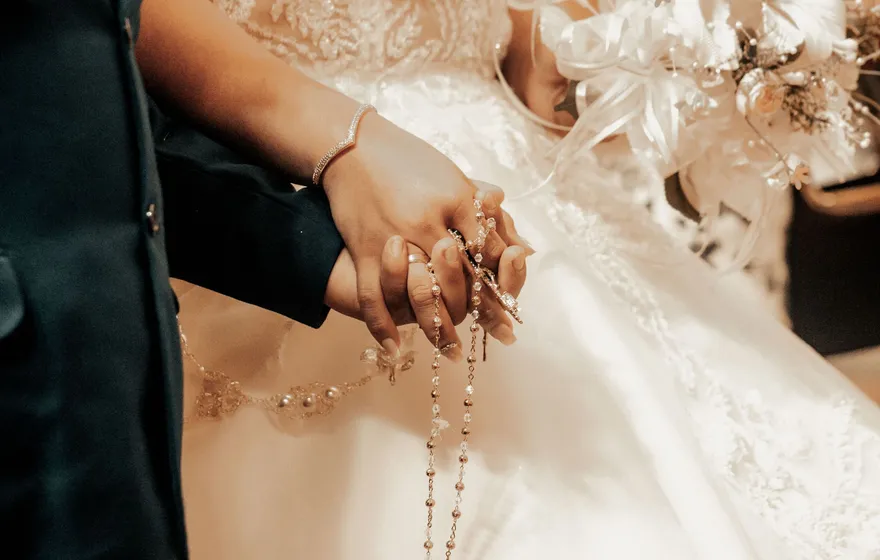
If that’s you, you have nothing to apologize for. The most useful thing I can do is help you see the boundary clearly, then send you to the right door.
Building the ceremony you’re actually allowed to have
Here’s where I’m genuinely useful as an officiant. Once you and your parish settle the Catholic mechanics, there’s still a whole ceremony to shape: which readings, how the processional runs, where family rituals fit, the words that make it sound like you and not a generic template.
For couples doing a ceremony-only Catholic rite, or a Catholic blessing paired with a separate celebration, the readings and structure are yours to make meaningful. My Couple’s Ceremony Kit ($79) walks you through choosing readings, sequencing the order, and writing the personal touches that fit inside the rite without stepping on it. It’s the difference between a wedding that follows the rules and one that also sounds like your life. You can see what’s inside the Ceremony Kit here.
And if you just want a feel for how a full ceremony reads start to finish before you commit to anything, grab my free sample ceremony script and use it as a map.
Frequently asked questions
Can a non-Catholic officiant or a friend perform my Catholic wedding?
For a sacramental Catholic marriage, no. The Church’s canonical form requires the wedding to be celebrated before a bishop, priest, or deacon with two witnesses. An independent or online-ordained officiant can give you a legally valid civil ceremony, but the Church won’t recognize it as a Catholic marriage unless the couple obtains a dispensation from canonical form, which is only granted in mixed marriages and never for two Catholics.
Do I have to have a full Mass at my Catholic wedding?
No. There are three forms of the rite. Two Catholics usually marry within a Nuptial Mass, but a Catholic marrying a baptized non-Catholic Christian normally uses the ceremony-only form, and there’s a third form for marrying an unbaptized partner. A wedding without Mass is still fully valid and, between two baptized people, still a sacrament. It includes readings, vows, rings, and the nuptial blessing, just not Communion.
Can I get married outside or at a non-church venue and still have it count as Catholic?
Generally no. The Church expects the marriage to happen in a Catholic church. Even when a dispensation is granted for an interfaith couple, diocesan guidelines typically rule out outdoor weddings, private homes, halls, and commercial wedding chapels. Couples who want a vineyard or beach often do the Catholic ceremony at a church and hold a separate celebration at the venue.
Can my non-Catholic family receive Communion at the wedding?
Ordinarily no, and that’s a big reason interfaith couples are usually steered toward a ceremony without Mass. Communion is meant to signify unity with the Catholic community, so a Mass where half the guests can’t receive isn’t experienced as welcoming. Skipping the Mass avoids that moment and keeps everyone equally part of the day.
Can a Catholic marry someone of a different faith in the Catholic Church?
Yes, with the right permission. A Catholic marrying a baptized non-Catholic Christian (a mixed marriage) needs the bishop’s permission. A Catholic marrying an unbaptized person (disparity of cult) needs a formal dispensation for the marriage to be valid. Your parish handles both, which is why the conversation with a priest needs to start early.
The Couple’s Ceremony Kit
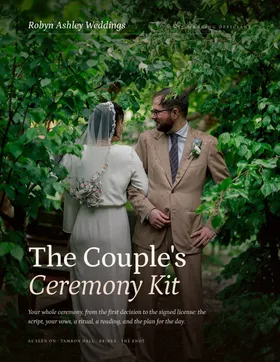
Walk in with a ceremony that sounds like the two of you
This post covers one part of the ceremony, and the Couple’s Ceremony Kit covers the rest, with five full scripts to start from and the prompts I use to help couples write their vows.
- Five full ceremony scripts in five different styles
- The Story Mine, thirty prompts for writing your vows
- Sixteen unity rituals, with the words and what to gather
- Thirty readings, each with my notes on when it fits
CEREMONY
Caribbean Wedding Traditions Worth Keeping
A couple sat in my office in Crown Heights, both second-generation, one side Guyanese and one side Trinidadian, and the bride said, "We want it to feel Caribbean, but we don't.
READ →
CEREMONY
What Is a Unity Ceremony? The Complete Guide
What a unity ceremony is, where it fits in your wedding, and how to choose the right ritual, from an officiant who's performed them at 300+ weddings.
READ →
CEREMONY
African Wedding Traditions, Explained With Respect
African wedding traditions by people and region: the Akan knocking, the Yoruba engagement, the Igbo kola and wine-carrying, libation, aso ebi and the broom, with how to include one or two without flattening them.
READ →