CEREMONY
Wedding Ceremony Programs: What to Include + Wording
What goes in a wedding ceremony program: order of service, wedding party, readings, ritual notes, memorial wording, and the unplugged request.
I was standing at the front of a Brooklyn rooftop while the couple’s grandmothers wound a cord around their joined hands, and I watched a woman in the second row lean over and whisper to her seatmate, “Wait, what are they doing?” The cord was a lasso. It meant everything to the couple. To the dozen guests who’d never seen one, it was a pretty ribbon doing something they couldn’t name.
That whisper is the whole case for a wedding ceremony program. I face the seats, so I can see the exact second a room is following along and the exact second it has quietly checked out. A good program is what separates the guest who nods through a ritual from the one who spends it tapping her neighbor for a translation.
So here’s the honest version of what goes in one, with wording you can copy outright, the formats nobody bothers to explain, and the one job the program does better than I can from the front: making your unplugged request stick before I’ve said a word.
The short answer: a ceremony program lists the order of service, names your wedding party and readers with their relationship to you, explains any unfamiliar rituals, makes your unplugged request, and quietly honors loved ones who’ve passed. You need one most when the ceremony runs long, includes readings, or blends customs your guests won’t recognize.
Do you actually need a wedding program?
Here’s what most stationery articles won’t tell you, because they’re trying to sell you cardstock: you might not need one at all.
If your ceremony is short, familiar, and there’s no separate reception, skip it. A 12-minute civil ceremony with a processional, vows, rings, and a kiss does not need a printed map. Your guests already have that map memorized.
A program earns its place when one of three things is true. The ceremony runs past about half an hour. There are readings or music guests will want to follow along with. Or it’s interfaith or multicultural, and half the room won’t recognize the customs (Adorn Bridal). Religious and interfaith ceremonies especially run on a specific order that’s much easier to track on paper (Shine Wedding Invitations).
What goes in a wedding ceremony program
A full program follows a predictable spine. You won’t use every part, but here’s the whole menu, top to bottom.
| Part | What goes in it |
|---|---|
| Header | Names, date, venue |
| Order of service | Every beat, in order |
| Wedding party | Everyone, by role |
| Readings | Passage and reader |
| Officiant, music | A line for each |
| Ritual notes | A sentence each |
| Logistics | Reception, phones |
| Memorial | Those you miss |
Up top, your two names, the date, and the venue are all you need. Some couples add “Together with their families” above the names when parents are hosting. The order of service is the heart of the whole thing, and it’s worth getting right, so I gave it its own section below.
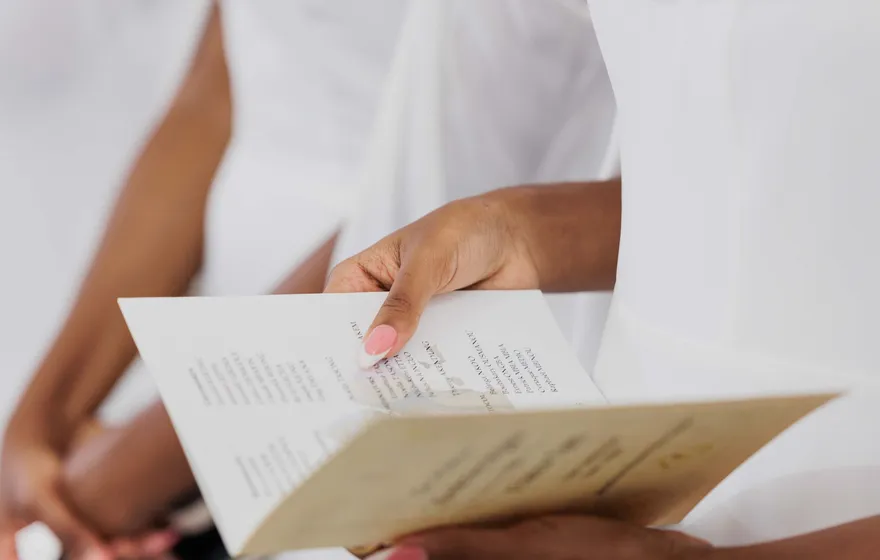
For the order itself, this maps straight onto your wedding ceremony order, which walks through every segment in sequence. The program is just that order, printed so guests can follow it.
How to write the order of service
This is the section guests actually read. Keep it scannable. Put each beat on its own line with a short label, and leave the timestamps off.
A standard non-religious order looks like this:
Processional: the wedding party and the couple enter.
Welcome: the officiant opens.
Reading: “On Marriage” from The Prophet, read by Anna Morris.
Declaration of Intent: the “I do” moment.
Exchange of Vows
Ring Exchange
Unity Ceremony: the lasso (see note below).
Pronouncement: the couple is married.
The Kiss
Recessional: the couple exits.
If your ceremony is religious, the order will carry named segments your guests may not know, like a unity candle lighting, communion, or the breaking of the glass. Those are precisely the lines that earn a one-sentence explanation, which I’ll get to in a minute.
How to list the wedding party
This is the single most useful upgrade you can make, and most couples skip it. Don’t just list names and titles. Add a one- or two-word relationship tag (Paperlust).
Half your guests know one side of the family. The relationship line is what lets your college roommate figure out who the maid of honor is, and lets your aunt place the best man.
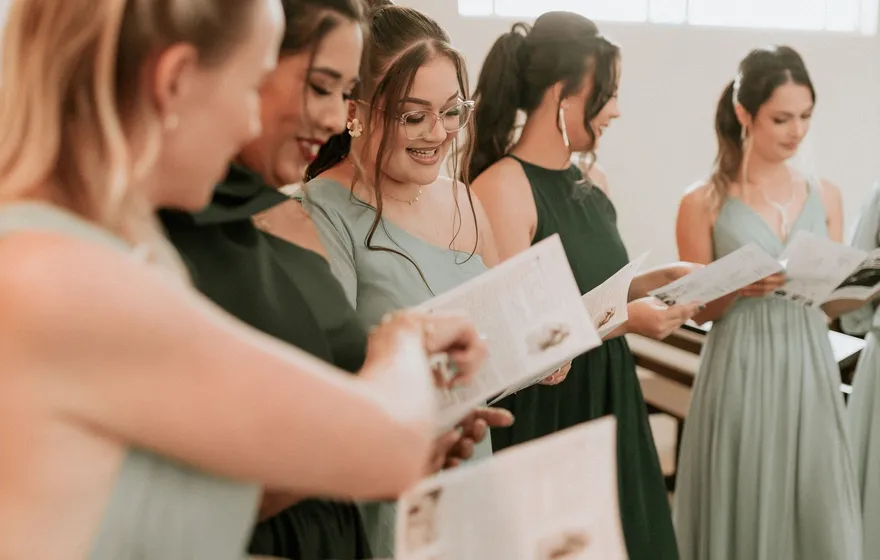
So instead of “Maid of Honor: Sophie Collins,” write:
Maid of Honor: Sophie Collins, sister of the bride
Best Man: Marcus Webb, brother of the groom
Bridesmaid: Lena Park, college roommate of the bride
Groomsman: David Osei, cousin of the groom
Formal weddings use full names and titles. Casual ones can run first names with a warmer note (“Sophie, her best friend since the seventh grade”). Either works, as long as the relationship reads clearly.
If you’re putting parents, grandparents, and other family in the program, the same tagging logic applies, and it’s worth thinking through who gets named and how. I get into the full picture of that in my guide on giving family roles in the ceremony. And if you want the order people actually walk down the aisle in, the wedding processional order covers who enters when, which is what your program’s processional line should mirror.
How to list readings and readers
Name the passage, then name the reader underneath it. That way a guest can follow the text and know who’s speaking at the same time (PsPrint).
The clean format:
First Reading
from 1 Corinthians 13:4-8
read by Anna Morris, college roommate of the brideSecond Reading
”The Art of Marriage” by Wilferd A. Peterson
read by James Okafor, uncle of the groom
The relationship tag carries over to readers too. Same reason as the wedding party: it tells the room who this person is to you.
If you’re still choosing what they’ll read, I keep a running list of options sorted by tone in my roundup of wedding ceremony readings, from scripture to poetry to lines pulled out of novels. Pick the passage first, then drop its title and author straight into the program.
How to explain a ritual so guests follow along
This is where I watch programs save a ceremony. Any ritual that happens in silence, with no spoken narration, leaves guests guessing. A handfasting, a unity candle, breaking a glass, jumping the broom. They’re watching something meaningful and have no idea what it means.
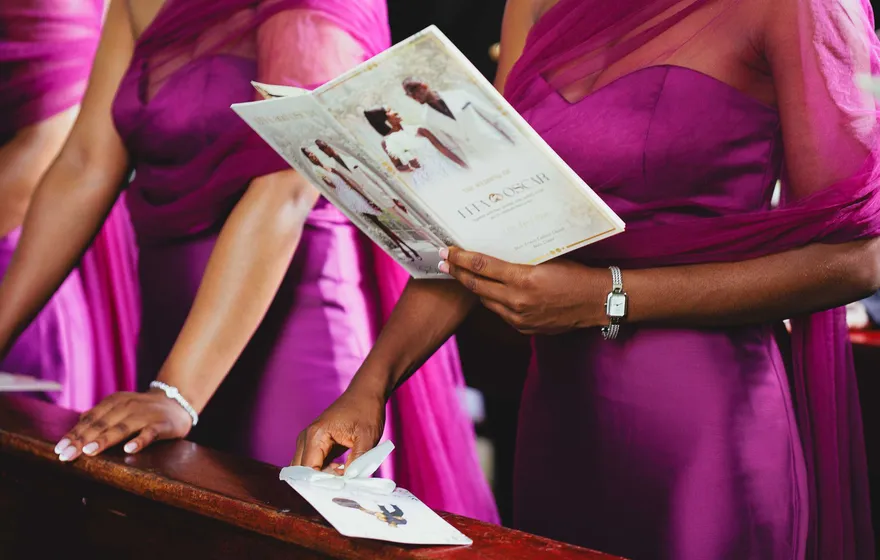
A sentence or two fixes it. Name what guests are watching and why it matters. Here’s the format with a few worked examples you can lift:
The Breaking of the Glass
A reminder that relationships are fragile and must always be treated with care and love. When the glass breaks, please shout “Mazel tov!”The Chuppah
The canopy above the couple represents the home that Maya and Daniel will build together, open on all sides to family and friends.Jumping the Broom
Performed just after the pronouncement, this ritual honors a tradition carried through generations and symbolizes sweeping away the past and stepping together into a shared new life.
A couple of these I write about at length if you want the deeper history and script. There’s a full breakdown of the handfasting ceremony and one on jumping the broom. But for the program, a single sentence is the whole job. Resist the urge to write a paragraph.
The unplugged request: where the program earns its keep
This is the one job the program does better than I can. I still ask the room out loud to put phones away, every single time, because I have to. But the program is the first line of defense, and it gets to people before they’ve reached for a screen.
The reason couples care about this has gotten sharper. You’ve probably seen why: a photographer’s post about a guest leaning into the aisle with a phone and wrecking the bride-and-father shot got shared more than 175,000 times (TODAY).
Here’s the wording I tell my couples to print:
An Unplugged Ceremony
We invite you to be fully present with us today. Please silence and put away all phones and cameras during the ceremony. Our photographer will capture how it looks, and we’d love you to capture how it feels. You’ll be free to snap away at the reception.
Now the honest part. The printed line on its own underperforms, because the second the bride appears, people reach for their phones on reflex. What actually works is layering it (The Wedding Playbook). The program note, plus a sign at the entrance, plus me saying it aloud right before the processional. Three touches. The program plants it, the sign reinforces it, and my voice closes the gap.
If you want the full set of phrasings and the timing of the spoken version, I wrote a whole piece on running an unplugged ceremony.
How to write the memorial section
This is the part that asks for the most care, and it’s also the one that does the quietest, most important work. The memorial section honors the people you wish were sitting in the front row, without stopping the ceremony to say their names out loud. For a lot of couples, that restraint is exactly the point. It acknowledges an empty seat without a hush falling over the room.
The structure is simple (AllWording). A header, then either a list of names, a short remembrance line, or a verse.
Headers people reach for: “In Loving Memory Of,” “In Memory Of,” “Never to Be Forgotten,” or “Forever in Our Hearts.”
Then one of these:
A name list, plainly:
In Loving Memory Of
Margaret Collins
Robert and Eleanor Webb
Or a single warm line:
In Loving Memory
On this day of celebration, our thoughts are also with the loved ones who have passed on and could not be here. We know they are with us, and we carry them in every part of today.
Or a verse, if you have one that suits the family.
If you’ve lost a parent and you’re weighing whether to name them out loud during the ceremony or keep it to the program, there’s no wrong answer. Some couples want the spoken moment. Many find the printed line carries the weight without asking the whole room to hold its breath. Both are right.
Formats and how many to order
Two practical things nobody explains well.
First, formats. A program isn’t only folded paper. There are six real options, and the choice comes down to ceremony length and how hot your venue runs, not just budget.
| Format | What it is |
|---|---|
| Flat card | Front and back, cheapest |
| Paddle fan | A card on a wooden stick |
| Multi-panel fan | Panels held by a grommet |
| Tri-fold | One sheet folded in three |
| Accordion fold | A strip folded back and forth |
| Bound booklet | Long or liturgical ceremonies |
If your ceremony is short, a flat card is plenty. If it’s a July rooftop, a paddle fan does double duty as a hand fan in the heat. If it’s a full religious order of service, you want a booklet.
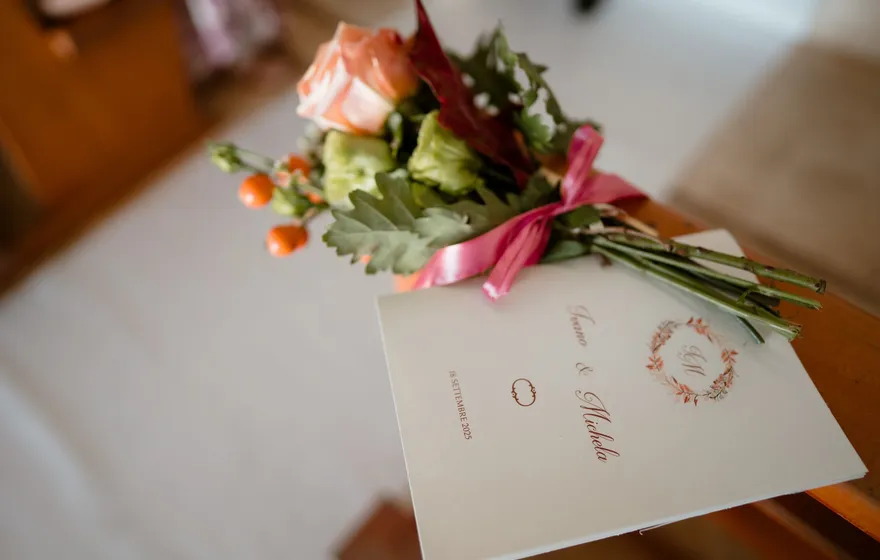
Second, quantity. Do not order one per guest. A good rule is about 75% of your guest count, because not everyone makes it to the ceremony on time and not everyone takes one. Or default to one per couple or household, plus a handful of keepsake extras for the album.
Let the program do the heavy lifting on your script
Once you’ve mapped your order of service for the program, you’ve basically outlined your ceremony. The two documents share a skeleton: one is what guests read, the other is what gets spoken.
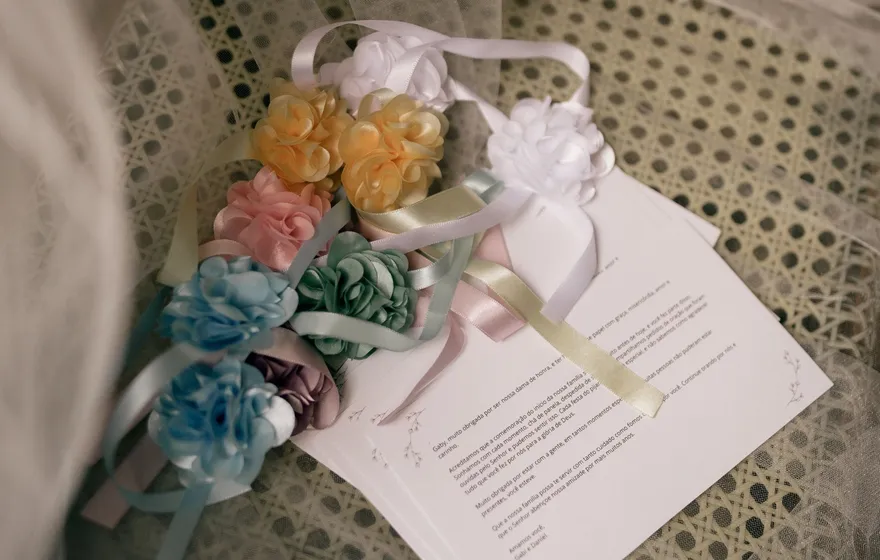
That overlap is why I built The Couple’s Ceremony Kit. It hands you the full ceremony script your program’s order points to, with the vows, the ring exchange, the ritual scripts, and the officiant’s words written and ready, so the running order on your program isn’t just a list of things that happen but a ceremony you’ve actually shaped. If you’re writing your own or coaching a friend to officiate, it’s the difference between a program that promises a “unity ceremony” and one backed by words that earn the line.
You can pull a free starting point first too. Grab a sample ceremony script to see how the order on a program turns into the words I’d say standing in front of your guests.
If you want the master walkthrough that ties all of this together, start with the full wedding ceremony order guide and build your program from there.
Frequently asked questions
Do you really need a wedding ceremony program?
No, it isn’t required. You’ll get the most out of one if your ceremony runs longer than about 30 minutes, includes readings, or blends customs your guests won’t recognize. For a short, familiar ceremony with no separate reception, you can skip it and nobody will notice.
What should be included in a wedding ceremony program?
Your names, the date, and the venue; the order of service from processional to recessional; the wedding party with each person’s relationship to you; readings and readers with the passage named; the officiant and musicians; a one-line note on any unfamiliar ritual; an unplugged or logistics request; and a memorial section for loved ones who’ve passed.
How do you word an unplugged ceremony on the program?
Keep it warm and short: “We invite you to be fully present with us. Please silence and put away all phones during the ceremony. Our photographer will capture how it looks, and we’d love you to capture how it feels.” Back it up with a sign at the entrance and have the officiant repeat it aloud before the processional, because the printed line alone rarely sticks.
How do you list the wedding party in a program?
List each name with a short relationship tag so guests who don’t know both families can follow along, like “Maid of Honor: Sophie Collins, sister of the bride” and “Best Man: Marcus Webb, brother of the groom.” Formal weddings use full names and titles; casual ones use first names with a personal note.
How do you write a memorial section in a wedding program?
Open with a header like “In Loving Memory Of,” then add a list of names, a short remembrance line, or a verse. A common one: “On this day of celebration, our thoughts are also with the loved ones who have passed on and could not be here.” It honors an empty seat without pausing the ceremony to do it out loud.
How many wedding programs should you order?
Don’t order one per guest. A common rule is about 75% of your guest count, or one per couple or household, plus a handful of keepsake extras. If an usher hands them out instead of leaving a stack, plan for more, because handed-out programs get taken far more often.
The Couple’s Ceremony Kit
Walk in with a ceremony that sounds like the two of you
This post covers one part of the ceremony, and the Couple’s Ceremony Kit covers the rest, with five full scripts to start from and the prompts I use to help couples write their vows.
- Five full ceremony scripts in five different styles
- The Story Mine, thirty prompts for writing your vows
- Sixteen unity rituals, with the words and what to gather
- Thirty readings, each with my notes on when it fits
CEREMONY
Caribbean Wedding Traditions Worth Keeping
A couple sat in my office in Crown Heights, both second-generation, one side Guyanese and one side Trinidadian, and the bride said, "We want it to feel Caribbean, but we don't.
READ →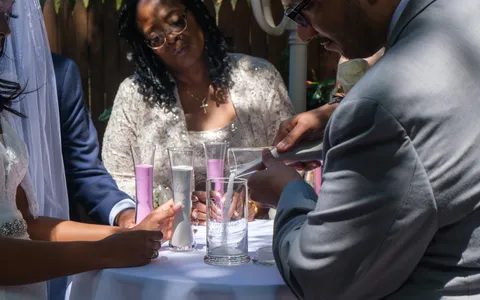
CEREMONY
What Is a Unity Ceremony? The Complete Guide
What a unity ceremony is, where it fits in your wedding, and how to choose the right ritual, from an officiant who's performed them at 300+ weddings.
READ →
CEREMONY
African Wedding Traditions, Explained With Respect
African wedding traditions by people and region: the Akan knocking, the Yoruba engagement, the Igbo kola and wine-carrying, libation, aso ebi and the broom, with how to include one or two without flattening them.
READ →