CEREMONY
Wedding Ceremony Readings That Actually Move a Room
Wedding ceremony readings sorted by tone, with the real text, who should read each, and an officiant's take on what works aloud. Funny, romantic, secular.
I once watched a groom’s college roommate read the “becoming Real” passage from the Velveteen Rabbit at a rooftop ceremony in Brooklyn, and by the third line I could see the front row reaching for their phones. The words were lovely. Everyone had just heard them at two other weddings that summer.
Three weeks later, a bride’s younger sister read eight plain sentences about how the couple still argued over the dishwasher, and the room went so quiet you could hear the wind off the river. Same job. Wildly different result.
I’m an NYC wedding officiant, and from three feet away I’ve heard the same dozen readings recited more times than I can count. So my read on this isn’t about which passage is “best” on paper. It’s about which ones survive contact with a live audience and a nervous reader. That’s a different test, and most couples never run it.
Here’s the thing nobody tells you: the text of a reading matters far less than how well it fits the human delivering it. And most ceremonies fail this on purpose, by handing the most emotional passage to the most nervous person. Below, I’ve sorted readings by tone, given you the real text or a usable excerpt, and added a line on who should read each. Then I’ll hand you a full, copy-ready reading you can use as-is.
What actually makes a reading work out loud?
A reading lives in the ear, not on the page. The passage you screenshot off Pinterest at midnight reads beautifully in your head. Your reader’s lungs and nerves have other plans.
So choose for the ear: short sentences, concrete images, and lines you can finish on one breath. Officiant guides tell readers to go through every paragraph aloud and split any line where they run out of air. I coach first-time readers (the maid of honor, the groom’s dad, the friend who “isn’t really a public speaker”) on exactly this, and it’s the single biggest predictor of whether a reading works.
The other half is delivery under nerves. My favorite trick: have your reader rehearse the passage once completely flat and robotic, then once wildly over-dramatic, and then settle somewhere in the middle. Nerves on the day shave off expression, so you want some banked.
There’s a bit of pacing math couples almost never run, and it filters out half the bad choices on its own. It takes just under a minute to speak 100 words, and ceremony readings typically run one to three minutes (Easy Weddings). A reading much past 275 words starts to lose a standing, sun-baked crowd. So when a gorgeous literary passage clocks in at 400 words, you’re not picking a reading. You’re picking a test of your guests’ patience.
Which readings are overused (and what to do if you love one)?
Let me be clear, because couples hear “overused” and assume I mean “bad.” I don’t. These are overused because they’re good. The trouble is everyone has heard them.
The single most-chosen passage at weddings is 1 Corinthians 13, “Love is patient, love is kind.” The Velveteen Rabbit “becoming Real” excerpt is now near-ubiquitous, and a lot of wedding pros flag Shakespeare’s sonnets as so overused that guests stop hearing them. Your aunt has heard Sonnet 116 enough times to mouth along.
So what do you do if one of these is genuinely your favorite? You have two real options. You give it to a reader so good they make it sound like the first time anyone has spoken those words, or you keep the sentiment and find a passage the room hasn’t memorized. I’ve watched a plain, short reading from the right person flatten a gorgeous literary passage mangled by the wrong one. Every single time.
If you want a deep bench of fresh secular options that skip the wallpaper entirely, I keep a running set here: non-religious wedding ceremony readings that aren’t cliché.
Funny wedding readings that actually get laughs
Funny readings are high-reward and high-risk. They die for one reason above all others: the reader rushes the setup. Comedy needs a beat before the punchline, and a nervous reader plows straight through it. So give your funny reading to someone comfortable with timing, ideally a person who’s told a story at a dinner table and held the floor.
How Falling in Love Is Like Owning a Dog
Mark the spot where it turns tender, and slow down there.
The one I steer NYC couples toward is Taylor Mali’s “How Falling in Love Is Like Owning a Dog.” It opens, “First of all, it’s a big responsibility, / especially in a city like New York,” which makes it almost custom-built for a city wedding (Taylor Mali). It’s a genuine wedding poem from his 2002 collection, built as one extended metaphor that runs through the funny stuff and then turns tender at the end. That turn is the whole game. A reader who can hit the comic lines and then drop into the soft ending will own the room.
The Owl and the Pussy-cat
Practice the nonsense words with a young reader before the day.
The whimsical-but-charming alternative is Edward Lear’s “The Owl and the Pussy-cat” (1871). People forget it’s literally a marriage story. Two creatures sail off in a pea-green boat, fall in love, find a ring, and get married by a turkey (Wikipedia). It’s short, it’s a rare genuinely happy ending in Lear’s catalog, and it’s light enough to recite quickly without taxing a standing crowd. It plays especially well from a child reader or a grandparent.
Romantic and literary readings worth the airtime
When couples ask for something with weight, I send them to three passages that earn their length.
The literary heavyweight is the love passage from Captain Corelli’s Mandolin by Louis de Bernières:
Captain Corelli’s Mandolin, the love passage
“Love itself is what is left over when being in love has burned away… Those that truly love have roots that grow towards each other underground, and when all the pretty blossoms have fallen from their branches, they find that they are one tree and not two.”
Source: Wikiquote
Ask your reader to slow down for the last sentence.
Here’s the context most blogs leave out, and it’s exactly why this one works aloud. In the novel, these are a father’s words of warning to his daughter, not a swooning romantic declaration. That’s what keeps it earned and unsentimental instead of gooey. Give it to a reader who can be matter-of-fact, an older relative or a friend with gravity, and let the plainness do the work.
The one that surprises people is Carl Sagan’s dedication to Ann Druyan from Cosmos:
The dedication of Cosmos
“In the vastness of space and the immensity of time, it is my joy to share a planet and an epoch with Annie.”
It’s over in one breath, so pair it with a longer reading.
It’s a real book dedication, and the backstory makes it hit. They got engaged on a phone call about the Voyager Golden Record before they had ever kissed (Discover Magazine). I’ve seen it work even on religious guests, because it reads as awe, not argument. It’s short, which is a gift, and it suits a reader with a calm, unhurried voice.
The third I reach for is Robert Fulghum’s “Union,” from his book From Beginning to End. It begins:
Union
“You have known each other from the first glance of acquaintance to this point of commitment,”
Source: Love My Dress
Have the reader turn and face the couple for this one.
It’s written in the second person, addressed directly to the couple. That’s the trick to it. It doubles as something the officiant can deliver, and it works best when spoken straight to the two people getting married rather than out to the crowd. If you’re choosing where this sits in your ceremony, “Union” works beautifully as the bridge right before the vows.
Short readings under one minute
Sometimes the room (or the heat, or the lineup of six other speakers) calls for short. Short readings are also forgiving. There’s less rope for a nervous reader to hang themselves with.
The Sagan dedication above qualifies. So does a tightened excerpt of “The Owl and the Pussy-cat.” And honestly, the most-moving reading I mentioned at the top, the bride’s sister with her eight plain sentences about the dishwasher, ran under forty seconds. Specific, concrete, true. That beats famous every time.
If you want the cleanest possible structure for a short reading, here’s a model you can hand to a reader who’s terrified. It’s tone-flexible, it reads in about fifty seconds, and it’s built on short, breathable lines.
Reader steps forward:
(pause, look up at the couple before starting)
“I was asked to say something true about [Name] and [Name], so I’ll skip the part where I pretend they’re perfect.
They are not perfect. They are stubborn about the thermostat and worse about the dishes.
But I have watched [Name] save the last of the coffee without being asked. I have watched [Name] laugh at a joke they’d already heard four times, just to be kind.
That’s the thing nobody warns you about love. It isn’t the grand gestures. It’s the small ones, repeated, until they add up to a whole life.
So here is what I wish for you both: a thousand more small kindnesses. And the good sense to notice them.”
(small nod to the couple, return to seat)
Use that as written, or treat it as a template your reader fills with two real, specific details about the couple. The specifics are what make a room go quiet. Generic love language is what makes them check the time.
Where the reading actually goes in your ceremony
A reading doesn’t float in space. It sits in a slot, and the slot changes how it works. Most often a reading comes after the welcome and before the vows, where it sets the emotional temperature for everything that follows. If you have two readings, I usually split them, one early as a warm-up and one closer to the vows for the emotional peak.
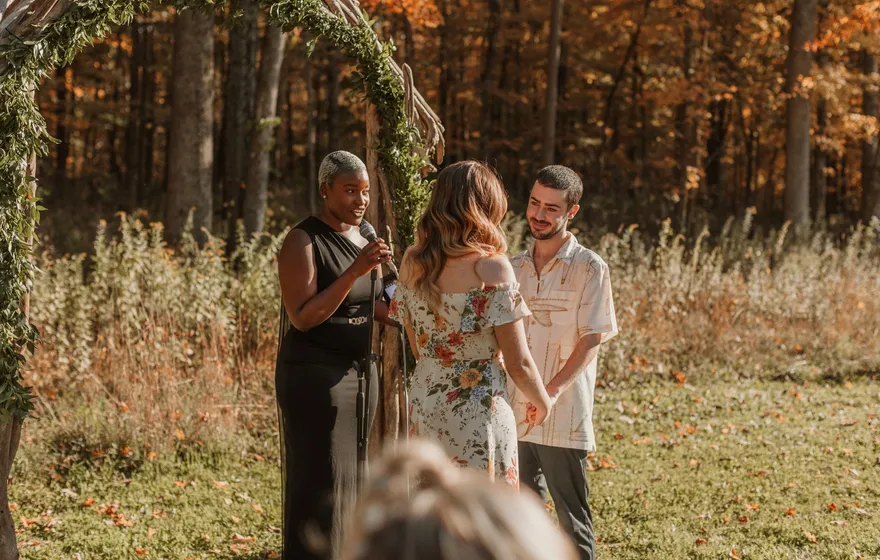
If you’re still mapping the whole thing, here’s where readings fit in the standard wedding ceremony order, and here’s the bigger picture of how a ceremony script is built section by section so the reading sits in the right place rather than interrupting the flow.
Readings are also one of the best ways to give family members a real role in the ceremony without making them give a speech. A parent or sibling who’d freeze up writing their own words can absolutely deliver a passage you hand them. And if your ceremony has no religious framing at all, the whole reading question gets easier, because a secular wedding ceremony is practically built around well-chosen readings carrying the meaning the liturgy would otherwise hold.
Who should read it (the casting question couples skip)
This is where most couples go wrong, so I’ll say it plainly. Pick your reader by their voice, not by how much you love them.
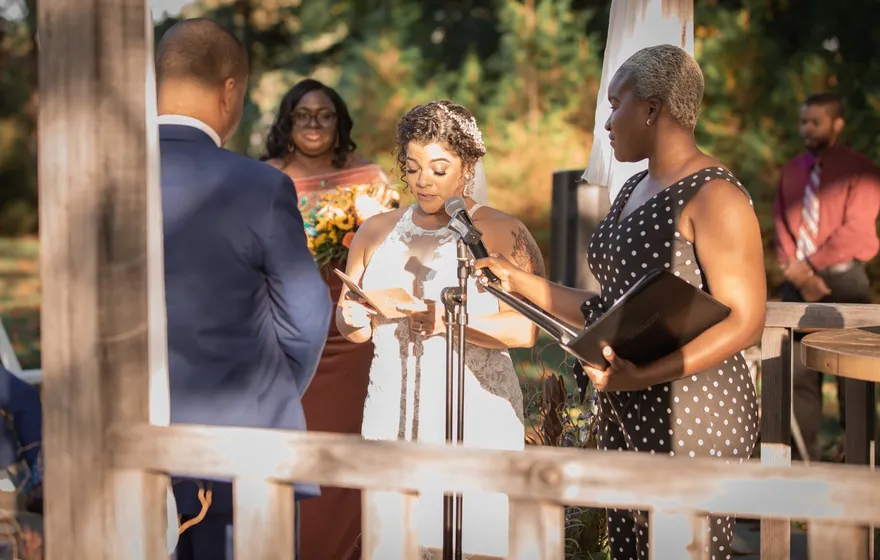
The non-obvious rule, and it’s the standard officiant advice for a reason, is that famous words matter less than whether the passage feels true in the specific reader’s mouth. You have to hear your candidate read it aloud before you lock them in, because people sound completely different reading than talking. The aunt who is warm and funny across a dinner table can go stiff and flat the second she’s holding a printed page in front of a crowd. It’s no character flaw. Reading aloud is a separate skill.
So before you assign anything: pick the passage, pick two or three possible readers, and have each of them read it to you once. You’ll know within ten seconds. Then match the tone to the person. The funny reading goes to someone with timing. The emotional one goes to someone who can hold their composure (or who’ll cry in a way that’s moving rather than derailing). Anything long stays away from a visibly anxious reader, because length and nerves are a bad combination.
A simpler way to choose (and print) your readings
If you’ve read this far, you already know more about ceremony readings than most couples ever will. The hard part isn’t finding options. It’s choosing, casting, and laying out a ceremony where the readings sit in the right place and the right hands.
That’s most of what’s inside The Couple’s Ceremony Kit. It’s the build I’d hand you if you were sitting across from me: a structure for where readings go, guidance on matching tone to reader, and a clean way to assemble the whole ceremony so nothing reads like a template. It exists because I got tired of watching couples stitch a ceremony together from twelve open browser tabs at 1 a.m.
If you’re not ready for the full kit, I keep a free set of vetted readings sorted by tone, with the real text and a note on who should deliver each. You can grab those over here and start auditioning your readers tonight.
Frequently asked questions
What are the most overused wedding readings to avoid?
1 Corinthians 13 (“Love is patient, love is kind”) is the single most-read passage at weddings, followed closely by the Velveteen Rabbit “becoming Real” excerpt and Shakespeare’s sonnets. None of them are bad writing. The problem is overexposure, because guests have heard them so many times they tune out by the second line. If you love one, give it to a reader who can make it sound like the first time anyone has said it, or pick something the room hasn’t already memorized.
How long should a wedding reading be?
Aim for roughly 100 to 275 words, which runs about one to three minutes aloud, since it takes just under a minute to speak 100 words. Past three minutes, a standing audience starts to drift. Shorter is safer than longer, especially outdoors or in heat.
What are good non-religious wedding readings?
Strong secular options include Robert Fulghum’s “Union,” the love passage from Captain Corelli’s Mandolin, Carl Sagan’s Cosmos dedication to Ann Druyan, and Taylor Mali’s “How Falling in Love Is Like Owning a Dog” for something funnier. Each carries real weight without religious framing. Several read as awe or honesty rather than doctrine, so they work even with a mixed-belief crowd.
Who should read at a wedding ceremony?
Pick by voice, not just relationship. Hear your candidate read the passage aloud before you lock them in, because people sound completely different reading than talking, and a passage that’s gorgeous on paper can flatten in a nervous mouth. Match tone to person: give the funny reading to someone with timing, the emotional one to someone who can hold composure, and keep anything long away from a visibly anxious reader.
What makes a wedding reading work when it’s read aloud?
Short sentences, concrete images, and natural breath. A passage written for the eye can choke a reader who runs out of air mid-line. The reliable fix is rehearsal: read it once flat and robotic, once wildly over-dramatic, then settle in the middle, so even if nerves hit on the day there’s still expression left in the delivery.
The Couple’s Ceremony Kit
Walk in with a ceremony that sounds like the two of you
This post covers one part of the ceremony, and the Couple’s Ceremony Kit covers the rest, with five full scripts to start from and the prompts I use to help couples write their vows.
- Five full ceremony scripts in five different styles
- The Story Mine, thirty prompts for writing your vows
- Sixteen unity rituals, with the words and what to gather
- Thirty readings, each with my notes on when it fits
CEREMONY
Caribbean Wedding Traditions Worth Keeping
A couple sat in my office in Crown Heights, both second-generation, one side Guyanese and one side Trinidadian, and the bride said, "We want it to feel Caribbean, but we don't.
READ →
CEREMONY
What Is a Unity Ceremony? The Complete Guide
What a unity ceremony is, where it fits in your wedding, and how to choose the right ritual, from an officiant who's performed them at 300+ weddings.
READ →
CEREMONY
African Wedding Traditions, Explained With Respect
African wedding traditions by people and region: the Akan knocking, the Yoruba engagement, the Igbo kola and wine-carrying, libation, aso ebi and the broom, with how to include one or two without flattening them.
READ →