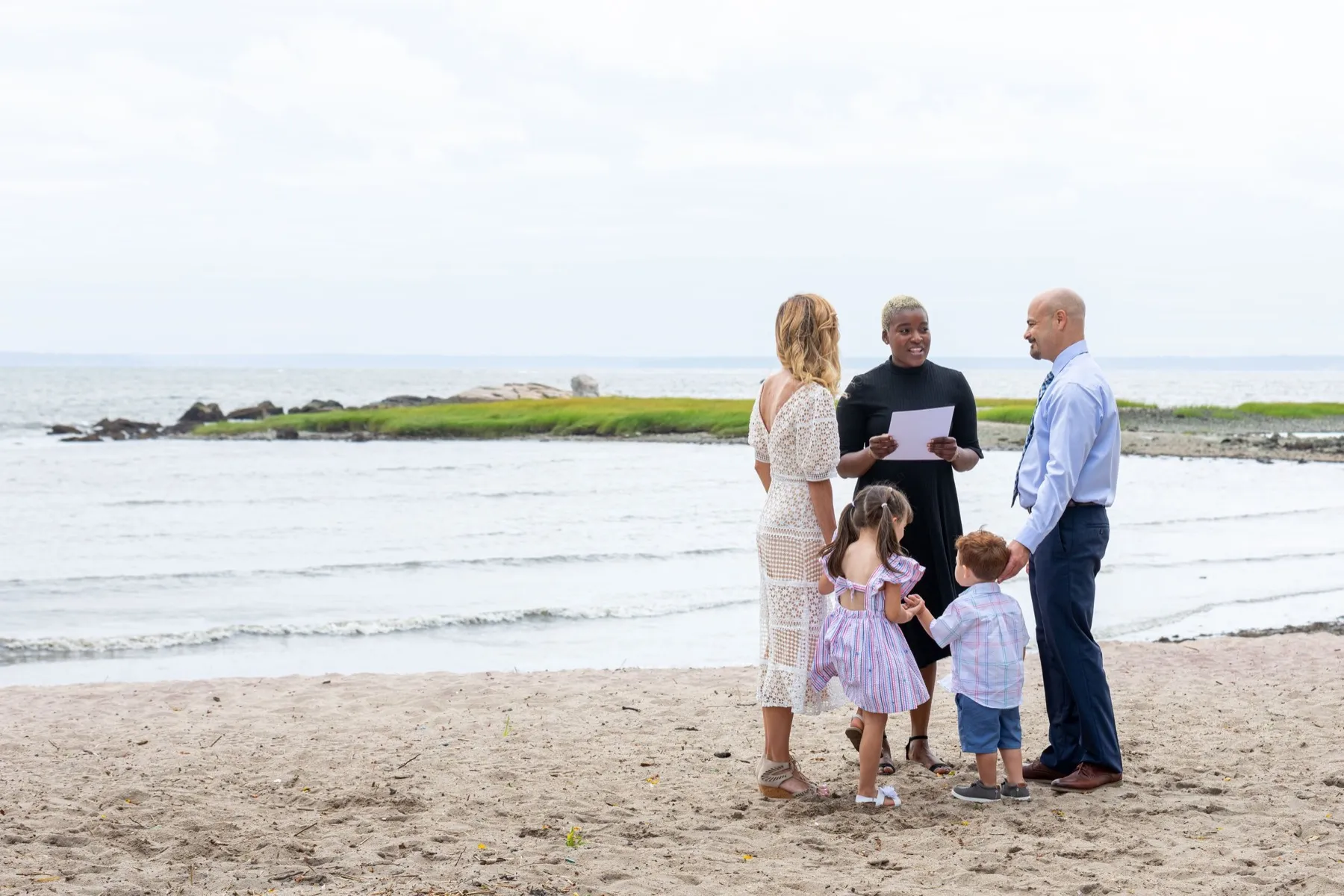
CEREMONY
Ways to Include Family in Your Wedding Ceremony (Matched to Comfort, Not Just Closeness)
A menu of real ways to give parents, grandparents, siblings, and kids a role in your ceremony, matched to comfort level, plus honoring a loved one who's passed and how to keep it from running long.
I once gave a couple’s most beloved aunt a gorgeous three-minute reading, because of course you hand the big moment to the person you love most. She got two lines in, her voice broke, and she stood frozen at the mic for what felt like an hour to her and about eight seconds to everyone else. She loved them. She just couldn’t perform under that kind of pressure.
From the front of the room, I see the thing couples can’t. Closeness and comfort are two completely different things, and almost everyone confuses them. The most loving family member gets the longest job, and the longest job is the one nobody should have given them. Match those two variables and family involvement becomes the warmest part of the day instead of the part everyone braces through.
Here’s the short version: match each role to how close the person is to you and how comfortable they are speaking in front of a crowd. Confident family read or speak. Nervous family get a silent role, a ring warming, lighting a candle, a hand they pour into a shared vessel. Then keep all the readings under five minutes total, so heartfelt never turns into a slog.
How do I decide who gets which role?
Two questions, asked about each person. How close are they to you? And can they hold a room?
Here’s every role in this post, sorted by how much talking it asks of the person who takes it.
| Role | Talking it asks for |
|---|---|
| Ring warming | None |
| Lighting a candle | None |
| Walking you down the aisle | None |
| Sand pour or family puzzle | None |
| Family Medallion | None |
| Circle-of-love blessing | Two words, together |
| Blessing of the Hands | A short reading |
| A reading | Up to three minutes |
A sibling who’s also your best friend and tells the jokes at parties can take a real reading, maybe even a short address. A grandmother who means the world to you but has never spoken into a microphone in her life should never be handed a script. That isn’t a snub. That’s protecting her.
When you match the role to comfort instead of just closeness, nobody freezes, nobody resents the assignment, and the people who can’t or won’t speak still get a moment that’s visibly theirs.
Roles for family who don’t want to speak (most of them)
This is the bucket most of your relatives belong in, and it’s the one couples forget exists. You don’t need a microphone to give someone a real job.
A ring warming. The rings travel hand to hand through your family, each person holding them for a few seconds to add a silent wish before you exchange them. It’s the best role I know for relatives who are too nervous, too many, or too emotional to read. The custom traces back to Celtic and Nordic tradition, where passing rings through the hands of elders signaled their approval of the union. Tie both rings onto one ribbon so they can’t get dropped or pocketed, and give one trusted person the job of carrying them up at a cue. I break down the full mechanics in my guide to the ring warming ceremony.
Lighting a candle as family is seated. Quiet, no words, and it doubles as a way to honor someone who couldn’t be there.
A circle-of-love blessing. Near the end, I invite the whole family to gather around the couple, and I ask the gathered guests aloud whether they’ll support this marriage. They answer together. Nobody needs a script and nobody stands alone at a mic (Provenance). When a lot of people want in but few are comfortable solo, this is the move.
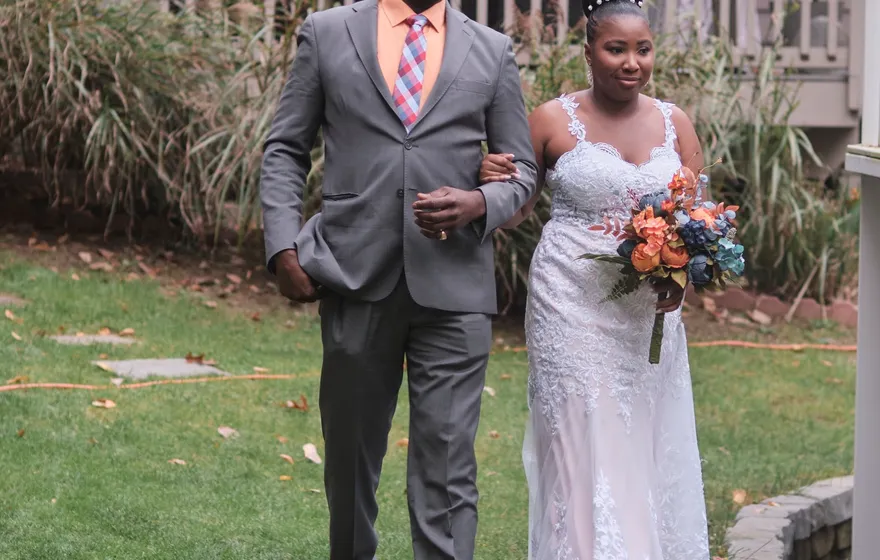
Walking you down the aisle. Obvious, and still one of the most moving roles you can give. It doesn’t have to be a parent, and it doesn’t have to be one person.
Roles for the one or two people who can actually speak
Now the readers. Be honest with yourself about who these are. You usually have one or two, not five.
Give them a reading, but keep it short. Each one should run one to three minutes, and all your readings together should stay under about five minutes (American Marriage Ministries). Anything over three minutes gets edited down. I’ll come back to the clock, because it’s where most ceremonies quietly fall apart.
For a family member who’s emotional but can hold it together, the Blessing of the Hands is my favorite assignment. It’s read after the vows and rings, while you turn to face each other and clasp hands (“These are the hands of your best friend…”). The reading is tied to a physical action, which gives an emotional reader something to anchor to instead of open-ended stage time staring back at them. A parent, a sibling, or a grandparent can all carry it.
If you want a menu of pieces to assign, I keep a running list in my collection of wedding ceremony readings, sorted by tone so you can match the piece to the person.
ALSO READ Wedding Ceremony Readings That Actually Move a RoomWhat about a family member who’s honored to be asked but terrified?
Let them off the hook early, and reassign them.
If someone is touched to be asked but genuinely dreads public speaking, give them permission to decline before they’ve memorized a thing, and hand them a non-speaking role instead. I’d always rather see a loved one relaxed and present than watch them suffer through three minutes they never wanted.
For the ones who do want to read, set them up to win:
- Print the reading in large font.
- Hand them their own copy so they’re not sharing a program.
- Tell them to eat something beforehand, because an empty stomach plus nerves is how people get lightheaded at a mic.
- Tell them to hold the mic close, like an ice cream cone near the mouth, not down at the chest where it picks up nothing.
I carry a backup copy of every reading in my folder, and I quietly cue nervous readers when it’s their turn so they’re never scanning the room wondering if it’s time yet. That’s the officiant’s real job during family moments. Be the silent safety net so the family can just feel it.

How do I honor someone who has passed away?
Gently, and usually without asking anyone to speak.
The options that work best are quiet and built into the ceremony rather than bolted on as a separate eulogy:
- Reserve a seat. Drape their jacket over the chair, lay a single bouquet, or mark it with ribbon and a small “In Loving Memory” card.
- Carry them with you. Pin a photo charm inside your dress hem or the back of your shoes, so a late father symbolically walks you down. Sew a swatch of a loved one’s clothing into the wrap of your bouquet.
- Light a memorial candle during the seating of family. No words required, and it sits naturally inside the flow.
- Fold a tribute line into the program so it’s acknowledged without taking ceremony time.
Pick one. Maybe two if they’re small. I’ve watched couples stack a reserved seat plus a candle plus a long spoken tribute plus a moment of silence, and the joy of the day quietly drained out of the room. A wedding can hold grief beautifully. It just can’t become a memorial service and still be a wedding.
How do I include kids and stepchildren?
This is a mainstream need, not an edge case. Among new U.S. marriages in 2013, four in ten included at least one partner who’d been married before (Pew Research Center). A lot of you are marrying into a family, not just a person, and the kids notice everything.
Match the role to age and comfort, same as the adults.
Younger kids do best with something hands-on. A sand blend where each child pours their own colored layer into one shared vessel makes the new family visible and gives a four-year-old a job that can’t really go wrong. I walk through that ritual in detail in my unity sand ceremony guide. A family puzzle works the same way: each member brings a piece forward near the end and the picture completes.
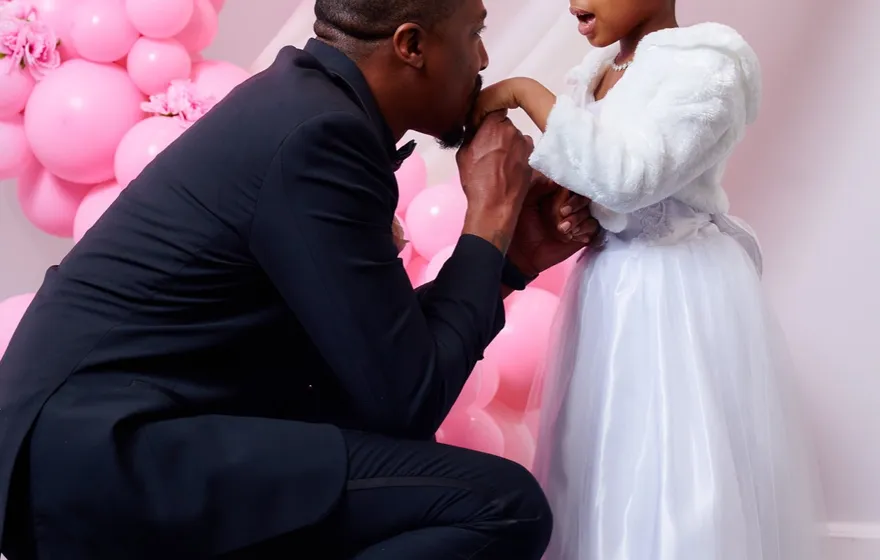
Older kids can read, or receive a Family Medallion. The medallion was created by Rev. Dr. Roger Coleman in 1987, after he noticed that courthouse weddings often had more children present than adults, yet nothing in the ceremony so much as acknowledged them. It bears three interlocking circles instead of the usual two, one for the child being welcomed, and the child-inclusion piece adds only about five minutes after the rings (Family Medallion).
Some couples now speak a short line of vows directly to the children.
“I promise to show up for you, to learn your jokes, to be in your corner.”
It shows acceptance of your partner’s kids without being as on-the-nose as handing a shy nine-year-old a candle in front of two hundred people. For the full blended-family playbook, see my unity ceremony for blended families.
ALSO READ Blended Family Unity Ceremony: Honest Scripts, the Consent Conversation, and What the Ritual Can't DoWhatever you choose, keep it brief and keep the stakes low. A kid-centered ritual that asks a shy child to perform is the one place this can backfire. Give them a pour, not a paragraph.
How do I keep all of this from running long?
Here’s the part that actually controls whether your ceremony feels intentional or endless.
A tight ceremony runs about 15 to 20 minutes, and most run 25 to 40 (American Marriage Ministries). The moment you cross 45, you’ve lost the room, and the fix is always the same: trim readings first. Never cut the vows, never cut the unity ritual. Vows are the entire point. Readings are supporting content.
Silence during a unity ritual feels twice as long as it is.
The fastest way to a bloated ceremony is three long readings stacked back to back, plus a slow unity pour with nobody narrating it. Silence during a unity ritual feels twice as long as it is. So I talk the whole way through a sand or candle pour, which keeps it moving and tells guests what they’re watching.
Where you place these moments matters as much as how long they run. Readings sit between the welcome and the vows. Unity rituals and the Blessing of the Hands come after the rings. If you want each family moment to fall in the right spot, here’s my breakdown of the wedding ceremony order.
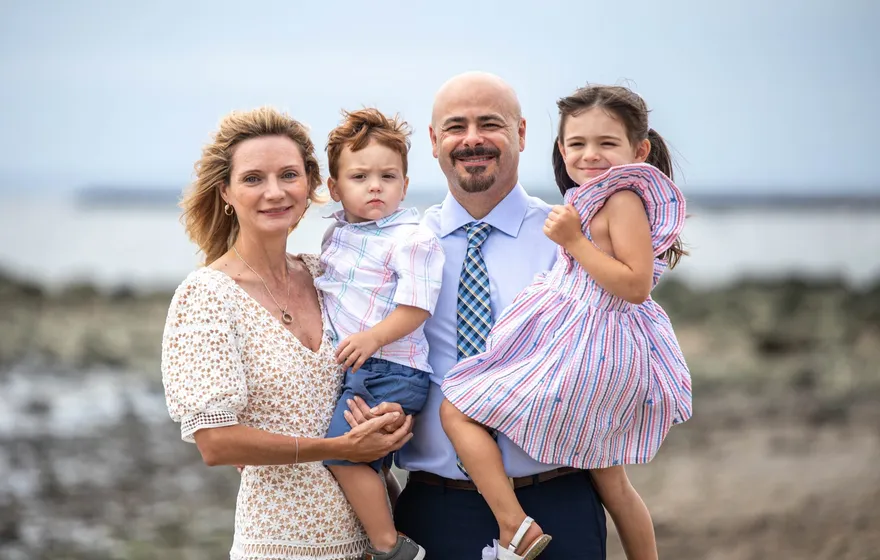
A short script that gives family a role without a speech
This is the one I reach for most when a couple wants several relatives involved but only one or two can comfortably speak. It folds a ring warming, a candle, and a family gathering into a few minutes, and the officiant carries all the words.
OFFICIANT (early, after the welcome):
“Before [Partner A] and [Partner B] exchange their rings, they’d like every one of you to be part of them. As these rings come down the rows, hold them for a moment, make a silent wish for this couple, and pass them along. By the time they return to us, they’ll carry every blessing in this room.”
[Hand the ribbon-tied rings to the first family member. They travel through the front rows as the ceremony continues.]
OFFICIANT (as a parent lights the memorial candle, optional):
“We light this candle for the ones who are here in heart, especially [Name], who shaped these two and is in every part of this day.”
OFFICIANT (near the end, the circle of love):
“Family, will you come stand around them?”
[Family gathers and forms a loose circle around the couple.]
“You are the people who raised them, fed them, drove them to practice, and put up with them. So I’m going to ask you plainly. Will you support this marriage, in the easy seasons and the hard ones?”
FAMILY (together):
“We will.”
OFFICIANT:
“Then [Partner A] and [Partner B], turn and look at them. This is your circle. Everything ahead of you, you face inside this ring of people. That’s what family is for.”
[Couple faces the gathered family for a beat before returning to the vows or close.]
Notice what nobody had to do: write a speech, memorize a reading, or stand alone at a mic. Three different relatives got a real, visible role, and the whole thing runs about four minutes.
A note on getting the wording right
You can mix and match every role above, but the wording is where family involvement either feels warm or feels like the officiant is reading off a clipboard. The transitions matter, the cues matter, and so does giving each relative a moment that sounds written for them and not pulled off a template.
That’s most of what I packed into the Couple’s Ceremony Kit ($79): a full ceremony you can drop these family roles into, plus the exact transition lines that move from a reading to the vows to a unity moment without it feeling stitched together. If you’d rather start by feeling the shape of a real ceremony, you can grab a free sample ceremony script and see how the pieces fit before you build your own.
The kit exists because I got tired of watching couples paste five readings into a Google Doc and call it a ceremony. Family involvement done well is structure, not a pile of nice moments.
Frequently asked questions
What’s the best way to include family if they’re too nervous to give a speech?
Give them a role that doesn’t need a microphone. A ring warming lets relatives pass the rings hand to hand and add a silent blessing. A circle-of-love blessing involves the whole family at once while the officiant does the talking. Lighting a candle as family is seated is another quiet option. Save the readings for the one or two people who are genuinely comfortable in front of a crowd.
How do I honor a parent or loved one who has passed away during the ceremony?
Low-pressure options work best: reserve a seat with their jacket, a single bouquet, or a small “In Loving Memory” card; pin a photo charm inside your dress hem or the back of your shoes so they walk with you; light a memorial candle as family is seated; or add a brief tribute line to the program. Pick one. Stacking several tributes can tip a joyful ceremony into a memorial.
How long should a wedding reading be?
Keep each reading to roughly one to three minutes, and all readings combined under about five minutes. Have the reader time themselves reading slowly out loud. Anything over three minutes gets trimmed. If the whole ceremony runs past 45 minutes, cut readings first, never the vows or a unity ritual.
How do I include kids and stepchildren in a blended family ceremony?
Match it to age and comfort. Younger kids do well with a hands-on role like pouring their own layer of sand or placing a puzzle piece. Older kids can read or receive a Family Medallion. Some couples speak a short line of vows directly to the children. Keep any kid-centered moment brief and low-stakes so a shy child isn’t put on the spot.
What roles can I give family without making the ceremony run too long?
Use short, defined roles. One or two readings of one to three minutes each, a ring warming that runs in the background, the Blessing of the Hands tied to a single action after the vows, or a parent lighting a candle. Avoid open-ended stage time. The fastest way to a bloated ceremony is three long readings plus a slow unity ritual with no narration.
The Couple’s Ceremony Kit
Walk in with a ceremony that sounds like the two of you
This post covers one part of the ceremony, and the Couple’s Ceremony Kit covers the rest, with five full scripts to start from and the prompts I use to help couples write their vows.
- Five full ceremony scripts in five different styles
- The Story Mine, thirty prompts for writing your vows
- Sixteen unity rituals, with the words and what to gather
- Thirty readings, each with my notes on when it fits
CEREMONY
Caribbean Wedding Traditions Worth Keeping
A couple sat in my office in Crown Heights, both second-generation, one side Guyanese and one side Trinidadian, and the bride said, "We want it to feel Caribbean, but we don't.
READ →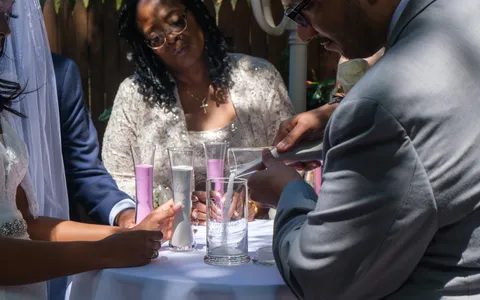
CEREMONY
What Is a Unity Ceremony? The Complete Guide
What a unity ceremony is, where it fits in your wedding, and how to choose the right ritual, from an officiant who's performed them at 300+ weddings.
READ →
CEREMONY
African Wedding Traditions, Explained With Respect
African wedding traditions by people and region: the Akan knocking, the Yoruba engagement, the Igbo kola and wine-carrying, libation, aso ebi and the broom, with how to include one or two without flattening them.
READ →