CEREMONY
Unplugged Ceremony Scripts That Actually Work (2026)
Exact unplugged ceremony wording for your sign, program, and officiant line, plus how hard to enforce it and the one moment to protect.
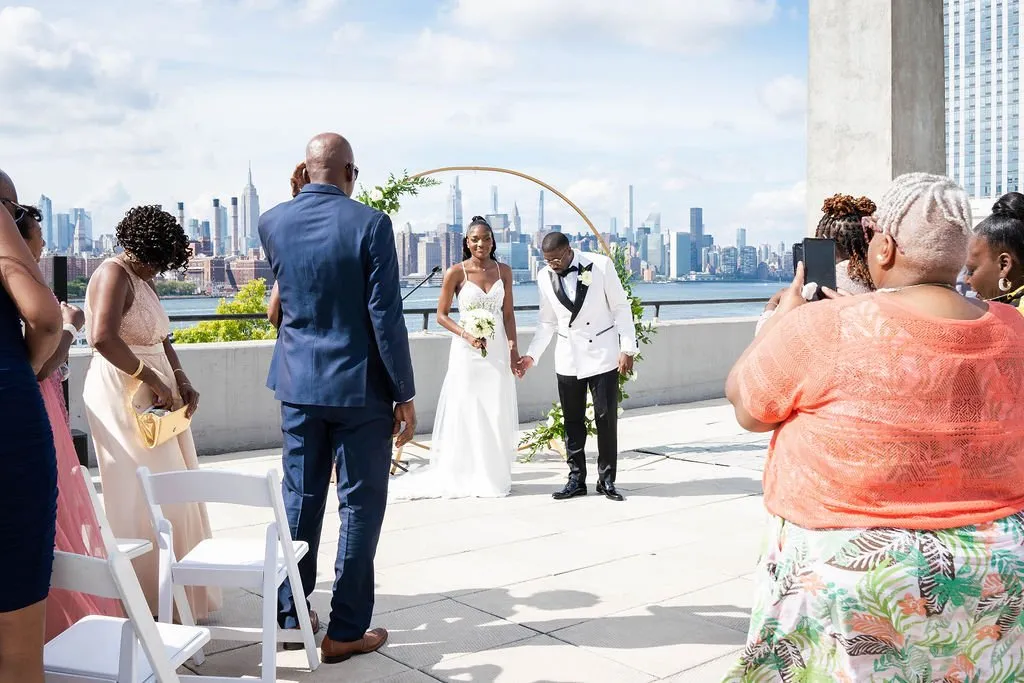
I was at the front of a loft ceremony in Brooklyn, mid-sentence, when a guest in the third row stood straight up and stepped into the aisle to film the bride walking in. Phone held high, screen pointed at me, and his elbow was now sitting exactly where the photographer needed to be. The bride’s father caught the photographer’s face fall before he caught his own daughter coming down the aisle.
That one moment is the whole argument for going unplugged. The walk down the aisle happens once. You can’t ask anyone to do it again.
So let me hand you the part nobody gives you cleanly: the exact words for every place this request lives, how hard to push on the day, and the single moment to protect even if you let phones stay out for everything else.
Here’s the short version. An unplugged ceremony isn’t about banning phones. It’s about protecting three or four shots that can’t be re-taken and giving your guests permission to actually be there. The thing that works is your officiant saying it out loud, framed as your wish, as the last thing before the music starts, backed up by a sign, a program line, and a note on your website.
What an unplugged ceremony actually is (and isn’t)
You’re asking guests to keep their phones and cameras put away during the ceremony so a professional captures it and everyone in the room gets to witness it with their own eyes. That’s the whole thing.
It isn’t a wedding-long phone ban. It isn’t confiscating devices at the door. It isn’t your officiant scolding Aunt Carol. The good versions are gentle and specific, and they almost always end at the recessional, when phones come back out for the reception.
It’s more common now than you’d guess. Your guests have very likely sat through one already. The request won’t surprise anyone.
Why bother? The real reason photographers beg for this
The honest answer isn’t “phones are tacky in your photos,” though they are. The answer is geometry.
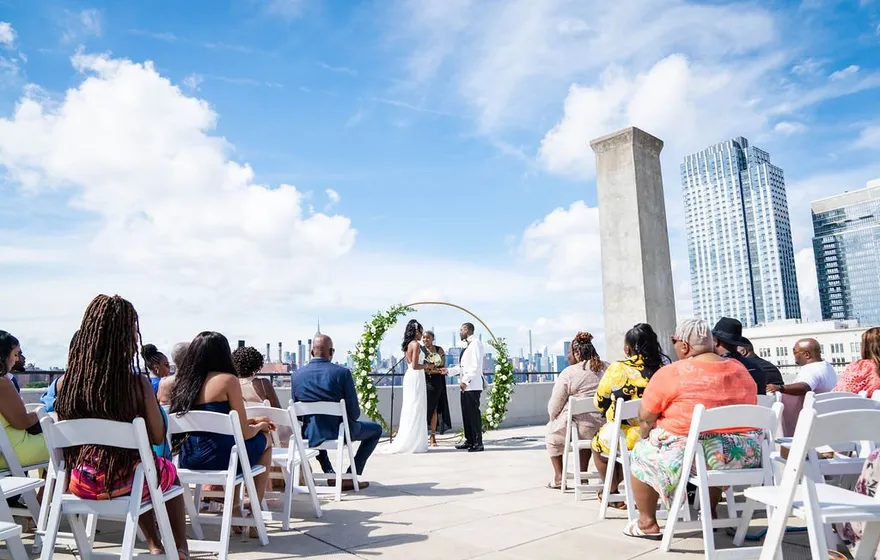
In a wide outdoor ceremony, one raised phone is a nuisance. In the rooms I work in around the city, lofts, brownstones, the tight spaces near City Hall, one guest leaning into a narrow aisle leaves the photographer with no other angle. There’s nowhere else to stand. The shot is just gone.
And some shots can’t be saved after the fact. The processional and the kiss are too brief and too final to reposition for. You can re-do a portrait. You can’t ask your partner to walk back up the aisle and come in again, or hold the kiss while someone re-frames.
This turned into a national conversation a few years back, when photographer Hannah Stanley shared an image where a guest stood to film the bride’s entrance and blocked the professional frame. Her post got shared more than 150,000 times (TODAY). It stuck because every couple looked at it and recognized their own fear.
The thing most advice gets wrong: where the request actually works
Most unplugged guidance is written by photographers protecting their own frame, so it leans on signs. I’m the one standing at the front of the room watching what guests actually do, and I’ll tell you plainly: the sign is the weakest tool you’ve got.
Guests put their phones down when a real person standing in front of them asks them to.
A sign on an easel is easy to walk past. A direct, spoken request from your officiant, right before the music starts, is not. Guests put their phones down when a real person standing in front of them asks them to. Paper doesn’t have that pull.
So the request should live in four places, and you want to think of them as layers, not alternatives:
- Your website, so people know before they arrive.
- The program, so it’s in their hands as they sit down.
- A small sign at the entrance, so it’s the last thing they read on the way in.
- The officiant’s spoken line, which is the one that actually changes behavior.
Two things make the spoken line work, and I’ve watched both prove out across hundreds of ceremonies. First, it has to be framed as your wish, not a rule the officiant is imposing. “The couple asks” reads as a favor between friends. “Please refrain from” sounds like a flight attendant. Second, it has to be the last thing said before the music starts. Say it too early, buried in housekeeping about restrooms and cell signal, and it’s forgotten by the time the doors open. Say it during the processional and you’re already too late.
The exact wording for every touchpoint
Copy these, swap the names, and you’re done. It’s the same request three times, sized for wherever guests will read it.
The written versions
On your wedding website
“We’re so glad you’ll be with us. We’ve chosen to have an unplugged ceremony, which means we’re asking you to put phones and cameras away and just be present with us. We’ve hired a photographer to capture every moment, and we’ll happily share the photos. Phones welcome again at the reception.”
Best fit Guests read it weeks ahead, so nobody arrives surprised.
On a sign at the entrance
“Welcome to our unplugged ceremony. Please silence and put away phones and cameras until the recessional. Our photographer has it covered. We just want to see your faces.”
Best fit The last thing guests read on their way to a seat.
One line in the program
“This is an unplugged ceremony. Please be fully present with us, phones away, until we walk back up the aisle as newlyweds.”
Best fit Couples who print a program and want the request in every hand.
The phrasing that does the most work, and you’ll find some version of it in nearly every good source, is this: we hired someone to capture how this day looks so you can be present for how it feels. That flips the whole thing from a restriction into a gift you’re handing guests. You aren’t taking the phone away. You’re giving them permission to stop performing the day and actually live in it.
The officiant’s line: a full, copy-ready script
This is the one that matters most, so here it is in full, ready to hand to whoever’s marrying you. If a friend is officiating, it slots straight into their opening. If you’re building your full text, this is where it sits, right after the seating settles and right before you signal the musicians. For where it fits in the larger arc, see how I lay out the order of a wedding ceremony, and for the document it lives inside, the full wedding ceremony script.
Setting: (Guests are seated. The room has gone quiet. You are at the front, before the processional.)
Officiant:
“Before we begin, [Partner A] and [Partner B] have one small request, and it’s a generous one.
They’ve asked that for the next little while, you put your phones and cameras away. Tuck them in a pocket, a bag, wherever. They want to look out and see your faces, not a wall of screens.
There’s a photographer here whose whole job is to capture how today looks. So you don’t have to. You get to do the harder, better thing, which is simply be here. Feel it. Cry if you need to, laugh out loud if you want.
Phones come right back out at the reception, I promise. But for these next few minutes, they’re yours. Thank you.”
Then: (Pause. One full beat of silence. Make eye contact with the back of the room. Only then nod to the musicians.)
That pause at the end is doing real work. It signals that the music is about to start, and it gives latecomers a half-second to slip the phone away. Whoever delivers this shouldn’t rush it. If you want more on how an officiant carries the room in a moment like this, I get into delivering the officiant’s lines so the warmth comes through and the request never reads as a scold.
How hard do you actually enforce it?
Lightly. The wording does the heavy lifting, so your job on the day is almost nothing.
Don’t station someone at the door confiscating phones. What I hear from guests, and what shows up again and again in real couples’ write-ups, is that heavy-handed enforcement backfires: tell people their phone is being taken and a few of them dig in. You want willing compliance, not a checkpoint.
If you want a backstop, hand one member of the wedding party the job of giving a quiet, friendly reminder to anyone who forgets. Never make this the photographer’s job, because then your photographer is in a standoff with your guests instead of shooting your wedding. And never make it yours. You’re getting married. You shouldn’t be aware of a single phone.
| Who | Their part |
|---|---|
| The officiant | Asks once, out loud |
| A wedding-party member | Quiet, friendly reminders |
| The photographer | Never polices phones |
| The two of you | Nothing at all |
Accept that one or two people will sneak a shot. That’s fine. You’re protecting against a wall of screens and a blocked aisle, not chasing perfection. If 90% of the room is present, you’ve won.
If you don’t want to go fully unplugged: the one moment to protect
Plenty of couples want guests to get a few snaps. Totally reasonable. You can have both with a small bit of choreography.
The move is to give guests their photo on purpose, then close the door. Once you and the wedding party reach the altar, the officiant has everyone turn, faces the room, and says something like:
“Go ahead, take the photo you really want right now. You’ve got ten seconds.”
Guests get their shot. Then the officiant takes the room back:
“Beautiful. Now phones away, and let’s begin.”
A rabbi-popularized version of this has the couple face the audience for exactly this beat before the ceremony proper starts.
You give them roughly ten to thirty seconds, satisfy the urge, and take the room back for the part that matters.
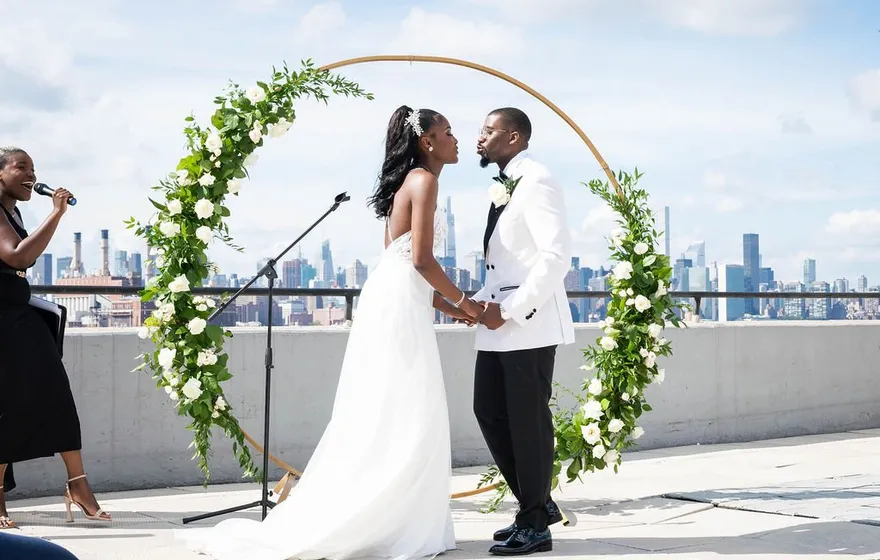
But here’s the non-negotiable. Even in the relaxed version, protect the processional and the first kiss. Those are the only beats that physically can’t be redone or re-shot. A guest stepping into a narrow aisle to film the entrance, or leaning out during the kiss, can cost you the only frame the photographer had. If you protect just one stretch of your whole wedding, make it from the start of the walk down the aisle through the kiss.
Make the request part of a ceremony that actually sounds like you
Here’s the part I care about most. The unplugged line shouldn’t feel like a bolted-on rule. When it’s woven into a ceremony that already sounds warm and personal, guests put their phones down because they can feel the room is about to matter, not because they were told to.
That’s the whole idea behind the Couple’s Ceremony Kit. It’s the full ceremony, written in plain, human language you can shape to your own story, with the unplugged announcement built in exactly where it belongs and worded so your officiant, pro or first-timer friend, can deliver it without it reading as a scold. Vows, the order of events, the readings, the announcement, all of it ready to make yours.
If you just want to hear how a real one reads first, grab a free sample ceremony script and see how the announcement sits inside the flow before you commit to anything.
Frequently asked questions
What exactly should the officiant say for an unplugged ceremony?
Keep it short, warm, and framed as your wish. A reliable version: “Before we begin, the couple asks that you put your phones away and be fully present with them. They’ve hired a photographer to capture how today looks, so you can simply enjoy how it feels.” Deliver it as the last thing before the music starts, once everyone is seated and quiet.
Is an unplugged ceremony rude to guests?
No, when it’s framed as an invitation instead of a ban. Guests respond well to “be present with us” and “we’ve got the photos covered.” It only reads as rude when it sounds like a rule imposed on them, or when someone is aggressively policing phones. Let your officiant deliver it graciously and skip the phone-confiscation theatrics.
Do unplugged ceremonies actually work?
They work best with layered reminders, not a single sign. Put a note on your website, a line in the program, a sign at the entrance, and most importantly a spoken request from your officiant right before the processional. A sign alone gets ignored. The spoken line, delivered last, is what guests act on.
What if I don’t want to ban phones the whole ceremony?
Protect one moment instead of all of them. Have your officiant give guests a few seconds to take a photo as you reach the altar, then ask everyone to put phones away for the vows and the kiss. The non-negotiables are the walk down the aisle and the first kiss, because those are the only beats that physically cannot be redone.
Which single moment should be phone-free if nothing else?
The processional and the first kiss. A guest stepping into a narrow aisle to film the entrance, or leaning out during the kiss, can block the only angle the photographer has, and neither can be re-shot. If you protect just one stretch, make it from the start of the processional through the kiss.
ALSO READ Wedding Ceremony Order ALSO READ A Complete Wedding Ceremony Script You Can Actually Use (2026)The Couple’s Ceremony Kit
Walk in with a ceremony that sounds like the two of you
This post covers one part of the ceremony, and the Couple’s Ceremony Kit covers the rest, with five full scripts to start from and the prompts I use to help couples write their vows.
- Five full ceremony scripts in five different styles
- The Story Mine, thirty prompts for writing your vows
- Sixteen unity rituals, with the words and what to gather
- Thirty readings, each with my notes on when it fits
CEREMONY
Caribbean Wedding Traditions Worth Keeping
A couple sat in my office in Crown Heights, both second-generation, one side Guyanese and one side Trinidadian, and the bride said, "We want it to feel Caribbean, but we don't.
READ →
CEREMONY
What Is a Unity Ceremony? The Complete Guide
What a unity ceremony is, where it fits in your wedding, and how to choose the right ritual, from an officiant who's performed them at 300+ weddings.
READ →
CEREMONY
African Wedding Traditions, Explained With Respect
African wedding traditions by people and region: the Akan knocking, the Yoruba engagement, the Igbo kola and wine-carrying, libation, aso ebi and the broom, with how to include one or two without flattening them.
READ →