PLANNING
Wedding Processional Order
Who walks when, for traditional, Jewish, Catholic, same-sex, and blended families, plus where divorced parents go and how to seat a parent who can't walk.
At a rehearsal in Central Park last spring, the bride’s divorced parents hadn’t been in the same room in eleven years. We had ninety seconds of aisle to get through, and the whole family was watching to see who would flinch first. I rebuilt the walking order right there so neither of them had to escort the other, and on the day, nobody in those folding chairs had a clue there’d ever been a problem.
That’s the part most processional articles skip. The order of who walks down the aisle is easy to find. The hard part is your specific family, your specific awkward case, and the quiet staging that defuses it before anyone notices. I’m the one standing at the front cueing each person forward, so everything here comes from running these live, not from reading an etiquette chart.
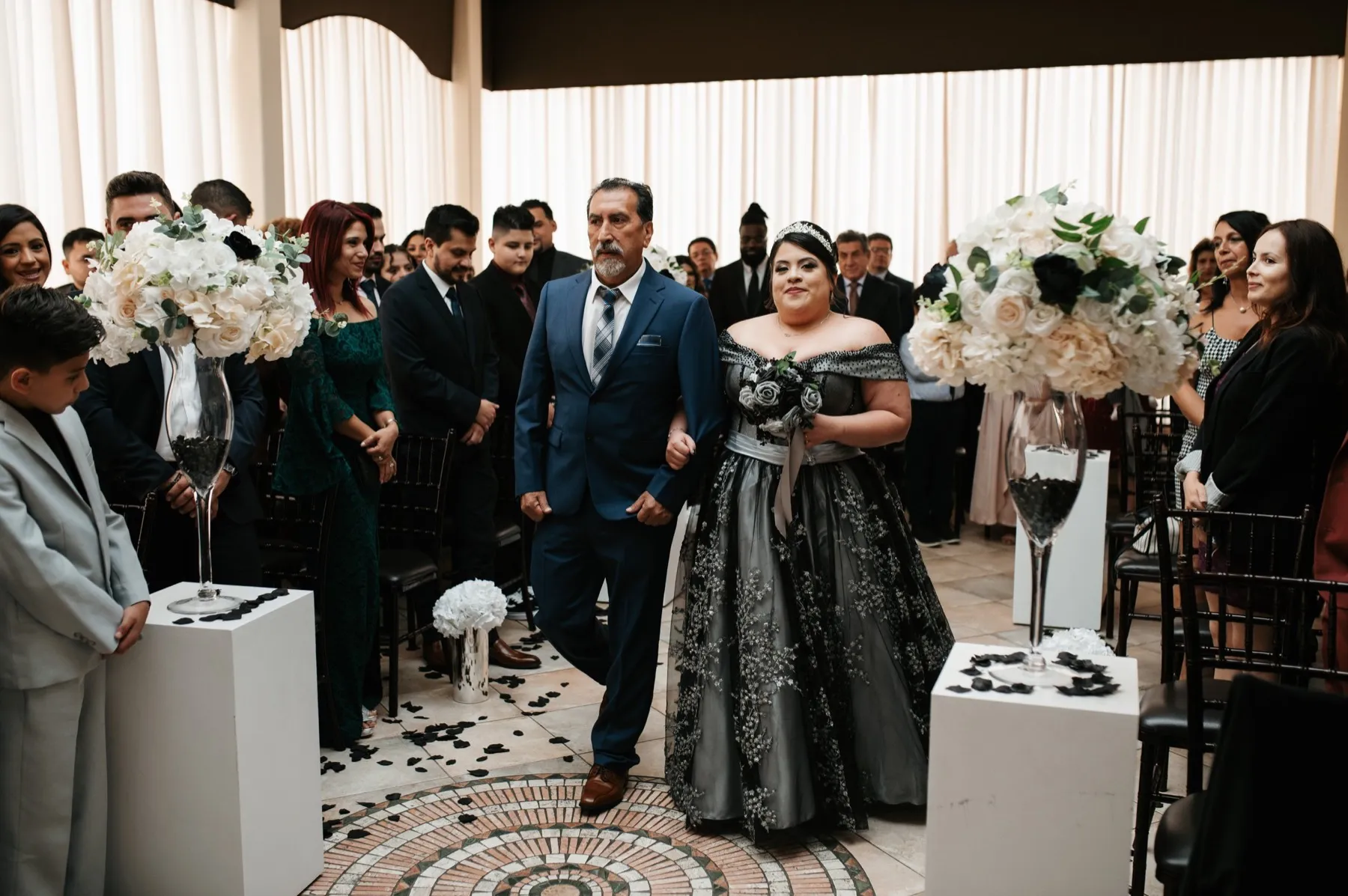
The short version: in a traditional Western processional, the officiant goes to their place first, then the groom and best man, then the wedding party, the maid of honor, the kids, and finally the person getting married, who always enters last. Below is the full map for five traditions, plus the fixes for divorced parents and a parent who can’t walk.
Who walks down the aisle first, and in what order?
Here’s the traditional Western order, top to bottom. The officiant takes their place at the front first. Then the groom and best man enter, usually from a side door, so they’re already standing when the doors open. The signal that the whole thing is starting is small and easy to miss: the mother of the bride being seated. That’s your cue to start.
After that, the wedding party comes down, either in pairs or one at a time. The maid of honor walks last of the party, right before the kids. Then the ring bearer and flower girl. Then the bride, on her escort’s arm, last of everyone.
The traditional Western processional
-
The officiant
Takes their place at the front first.
-
The groom and best man
Usually from a side door, so they’re standing when the doors open.
-
The mother of the bride is seated
The cue that the processional is starting.
-
The wedding party
In pairs or one at a time, with the maid of honor last of the party.
-
The ring bearer and flower girl
Right before the entrance.
-
The bride and her escort
Last of everyone.
That last step holds no matter whose wedding it is.
One detail that breaks a lot of generic diagrams: the bride doesn’t always stand on the left. In most Christian and Western ceremonies she stands on the left and the groom on the right, a leftover from when a groom kept his right “sword hand” free to defend her. In a traditional Jewish ceremony it flips, and the bride stands on the right. So before you memorize “bride on the left,” check which tradition you’re actually building.
| Tradition | First in | Bride |
|---|---|---|
| Western | Officiant | Left |
| Jewish | Rabbi or cantor | Right |
| Catholic | Priest | Left |
| Same-sex | No rule | Your call |
If you want the full picture of what happens once everyone’s in place, I walk through the whole sequence in my guide to the order of a wedding ceremony, from processional through pronouncement to recessional.
What is the processional order for a Jewish wedding?
A Jewish processional is built differently, and it’s one of my favorites to run because the family is woven right into it. The rabbi or cantor goes first, then the grandparents, who get seated right after they process.
Then comes the part that surprises people. The groom is walked in by both of his parents, one on each arm. After him, the bride is walked in by both of hers. The groom has to reach the chuppah before the bride. And here’s where it parts ways with a Christian wedding: both sets of parents don’t hand off and sit down. They stay standing under the chuppah for the entire ceremony, alongside the couple and the rabbi (Chabad.org).
So the chuppah is crowded by design. Six adults and a couple, all standing close. If you’re officiating one of these, walk the rehearsal with everyone physically standing in their final spot, because the photos and the sightlines depend on who ends up where.
What is the Catholic processional order?
A Catholic processional looks close to the traditional Western one, with a few specifics. The priest enters with the groom and best man, often from the side. The attendants walk in pairs, and the convention is to start with the pair who’ll stand farthest from the couple, so the people who end up closest walk in last.
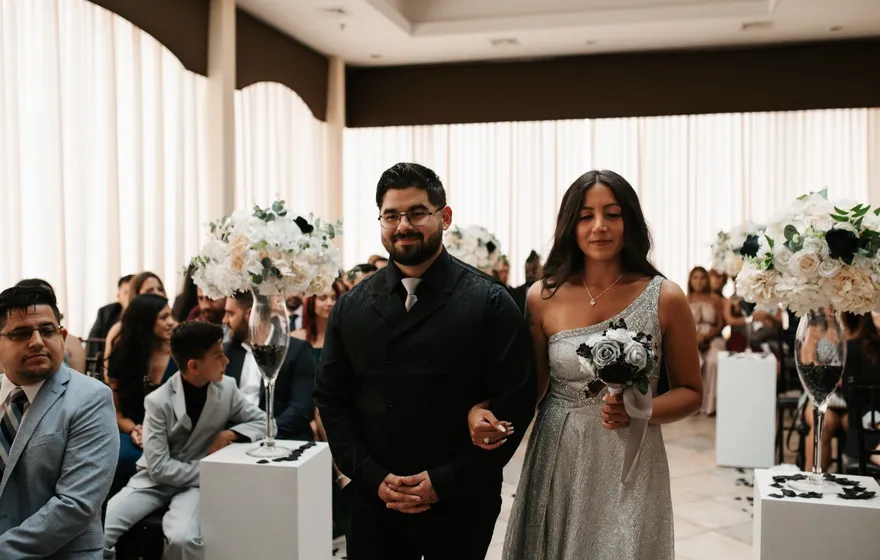
At the altar, the standard arrangement puts the men on the right and the women on the left as you face the front (Minted). Parishes vary more than couples expect, though. Some have firm rules about where the wedding party stands, whether a runner is used, and how the entrance is timed to the music. Confirm with your clergy before you lock the order, because the parish wins that argument every time.
Where do divorced parents go in the processional and seating?
This is the question couples lose sleep over, so let me give you the working answer.
If the parents are amicable, it’s simple. They can share the front row, and a divorced father can still escort his child down the aisle the way he always would have. Nothing changes.
If they’re not amicable, you stage around it. The standard etiquette, the one I actually use, seats the mother and her partner in the front row, and seats the father with his family a few rows back, typically the third or fourth row, with a buffer row of family in between so the exes aren’t directly behind each other (Emily Post Institute). Both parents still sit in the reserved front section. It’s their child’s wedding, and pushing one of them to the back creates a different kind of problem.
For the processional itself, stepmothers and stepfathers get their own separate escorted entrances rather than getting crammed in next to a biological parent (Wedding and Party Network). When the family is genuinely raw, I’ll quietly rewrite who walks with whom so nobody has to take the arm of someone they’re no longer speaking to. Decide all of this at the rehearsal, never on the day.
When the family is genuinely raw, I’ll quietly rewrite who walks with whom so nobody has to take the arm of someone they’re no longer speaking to.
If you want more on weaving parents and family into the ceremony itself, not just the walk in, I cover that in involving your family in the ceremony.
How do you handle a parent who can’t walk or uses a wheelchair?
I get this question a lot, and I want to be clear: a parent using a wheelchair can absolutely walk their child down the aisle. The word “walk” is doing too much work. What we’re really staging is a dignified entrance, and there are several ways to do it well.
If the parent uses a power chair, the move that reads beautifully is having them drive the chair with one hand while holding their child’s hand with the other. The couple walks alongside. If it’s a manual chair, a third family member pushes from behind while the couple walks next to it. There’s also a real product path some families use, where a parent starts seated and switches to a walking-support device partway down the aisle so they finish on their feet (LifeGlider).
| Chair | Entrance |
|---|---|
| Power chair | Parent drives, holds hands |
| Manual chair | Family member pushes |
| Seated start | Stands partway down |
Whichever setup you choose, the staging around it matters more than the chair.
The emotional truth here is that these are some of the most moving entrances I see all year. Nobody in the room is thinking about the chair. They’re watching a parent get their child to the front, which is the entire point of the walk.
Who walks down the aisle in a same-sex wedding?
There’s no single rule, which is freeing and a little paralyzing. I’ve staged two-bride and two-groom processionals more ways than I can count, and there are roughly five patterns worth knowing:
- One partner waits at the front while the other processes, mirroring the traditional setup but without the gendered assumption about who waits.
- Both partners enter from opposite ends of the aisle, walk toward each other, and take the final steps to the altar together. This is the signature same-sex move, and it photographs beautifully.
- Both partners use separate aisles and meet in the center.
- The couple walks in together, sometimes with a shared escort like a child, a sibling, or the friend who introduced them.
- Side entrances, with the wedding party falling in behind.
For sides at the altar, ignore “bride on the left” entirely and pick whatever suits your sightlines, your photographer’s angle, and which of you wants the light from the windows. As for the opening line, I’ve moved almost entirely to this one instead of anything gendered:
“Please stand for our couple”
It reads as warm, and it works for everyone.
I cover the spoken side of all this in my wedding ceremony readings collection, if you want language that fits a same-sex ceremony without retrofitting.
How do you include kids from a blended family in the processional?
The blended-family signature move mirrors the same-sex one, and I love it. Instead of a single “giving away” moment, you build a whole-family entrance. The kids walk in with the couple, or meet them halfway down the aisle, so the family arrives at the altar as a unit.
For roles, match them to age. Older stepkids slot in as junior bridesmaids or junior groomsmen, walking with the party. Younger ones take the ring bearer and flower roles. A teenager doesn’t want to throw petals, and a five-year-old doesn’t want to stand still for twenty minutes, so cast accordingly.
If you want to carry that message into the ceremony itself, a unity ritual built around the kids works beautifully, and I lay out options in my unity ceremony for blended families guide.
How much space should you leave between people in the processional?
Spacing is the thing that separates a smooth processional from a stop-and-go traffic jam, and it’s easy to get right.
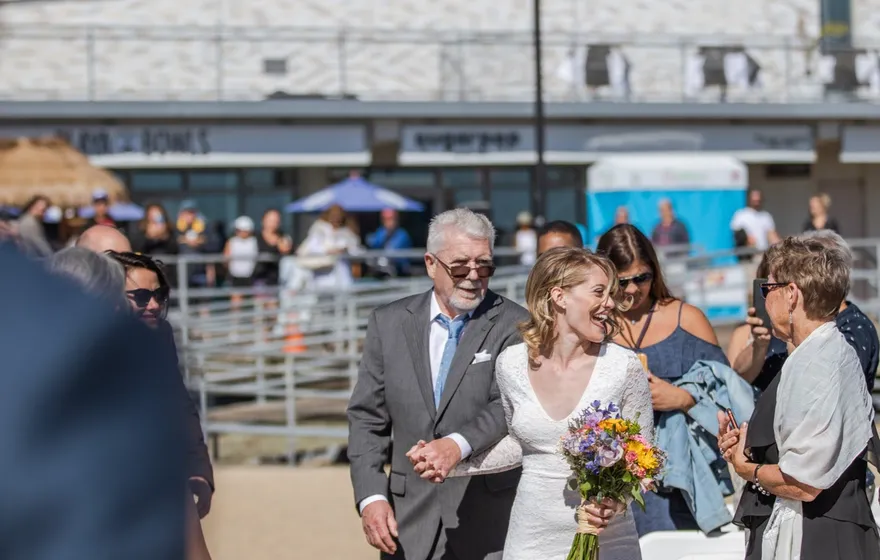
Leave about three to five seconds between each walker, or roughly half the length of the aisle, which usually works out to eight to ten feet. The simplest cue: start walking when the person ahead of you reaches the midpoint of the aisle. Pace it slow, about one step every two beats of the music, because normal walking speed looks rushed and frantic on video.
Here’s the part nobody tells your wedding party. People can’t count seconds while they’re nervous and being stared at. So I never ask them to. I stand at the front and quietly nod each person forward when it’s their turn. They don’t watch a clock, they watch me, and the spacing comes out right every time. If you’re the officiant or coordinator, make yourself that single point person. Don’t leave six anxious people each guessing when to go.
Get the ceremony that follows the walk
The processional gets everyone to the front. What happens next is the actual ceremony, and that’s where most couples freeze up, because a blank script is harder than a walking order.
That’s the gap my Couple’s Ceremony Kit fills. It’s a full, fill-in-the-blanks ceremony you can hand to a friend who’s officiating, or use yourself, with the welcome, the readings, the vows, a unity ritual, and the pronouncement already written and timed. You build the walk; the kit builds everything that happens after the doors close behind you. If you want to see the shape of it first, grab a free sample ceremony script and read exactly how the words flow once everyone’s standing at the front.
For the full walkthrough of writing that part yourself, my wedding ceremony script guide takes you line by line.
Frequently asked questions
Who walks down the aisle first in a wedding processional?
In a traditional Western ceremony the officiant takes their place first, followed by the groom and best man, who often enter from a side door. The mother of the bride being seated is usually the cue that the processional is starting. The wedding party follows, then the ring bearer and flower girl, and the person getting married enters last with their escort.
What is the processional order for a Jewish wedding?
After the rabbi or cantor and the grandparents, the groom is walked in by both of his parents, then the bride is walked in by both of hers. The groom reaches the chuppah before the bride, and both sets of parents stay standing under the chuppah for the whole ceremony. The bride stands on the right and the groom on the left, the reverse of most Christian weddings.
Where do divorced parents sit at a wedding ceremony?
If the parents are amicable they can share the front row. If they are not, the mother and her partner take the front row, and the father and his family sit a few rows back, usually the third or fourth row with a buffer of family in between. Both parents stay in the reserved front section because it is their child’s wedding.
How do you handle the processional if a parent uses a wheelchair?
You have several dignified options. The parent can drive a power chair with one hand while holding the couple’s hand, a relative can push a manual chair while the couple walks alongside, or the parent can start seated and switch to a walking-support device partway down. Pre-stage the chair before the doors open, keep the aisle wide, and watch where the dress train falls so it does not catch.
Does the bride stand on the left or the right?
In most Christian and Western ceremonies the bride stands on the left and the groom on the right, a holdover from when a groom kept his right sword hand free. In a traditional Jewish ceremony it flips, so the bride stands on the right. For same-sex couples, pick the sides that suit your sightlines and photos, because there is no fixed rule.
BOOK YOUR CEREMONY
Need help with your ceremony?
Tell me about your day. I will write back the same week.
AVAILABLE 2026 + 2027
PLANNING
Where to Elope in NYC: Best Spots, Costs & Packages
Last spring I married a couple at Wagner Cove on a Saturday in May, peak season, the lake full of rowboats. They'd braced for chaos. We tucked under that little wooden gazebo, the.
READ →
PLANNING
NYC Marriage License: Step-by-Step Guide (2026)
A couple once called me from a hotel lobby an hour before their rooftop ceremony, panicked. They'd picked up their license at 4 PM the day before, and the rooftop slot was 3 PM..
READ →
PLANNING
Microwedding Guide: How to Plan a Small NYC Wedding
A couple booked me last spring for nineteen guests in a SoHo loft. Halfway through their vows, the groom's grandmother, who had flown in from Kingston and barely knew a soul in.
READ →