CEREMONY SCRIPTS
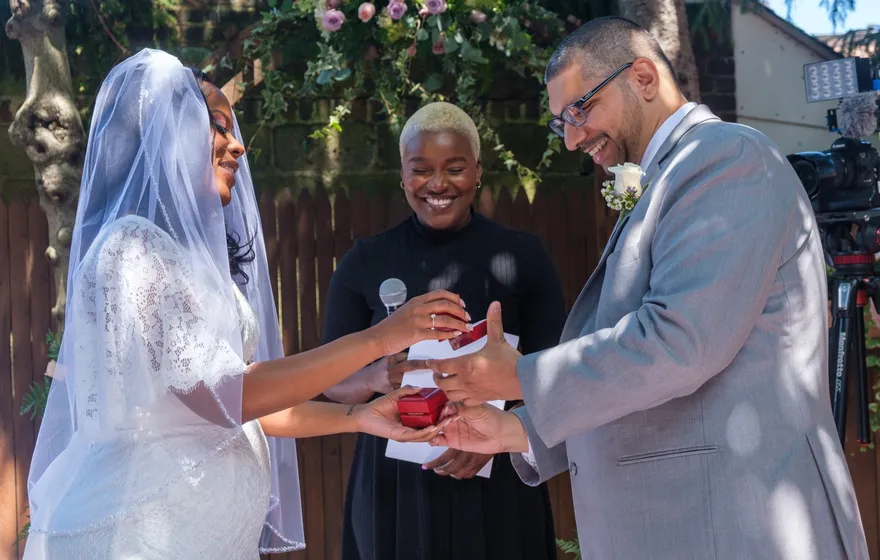
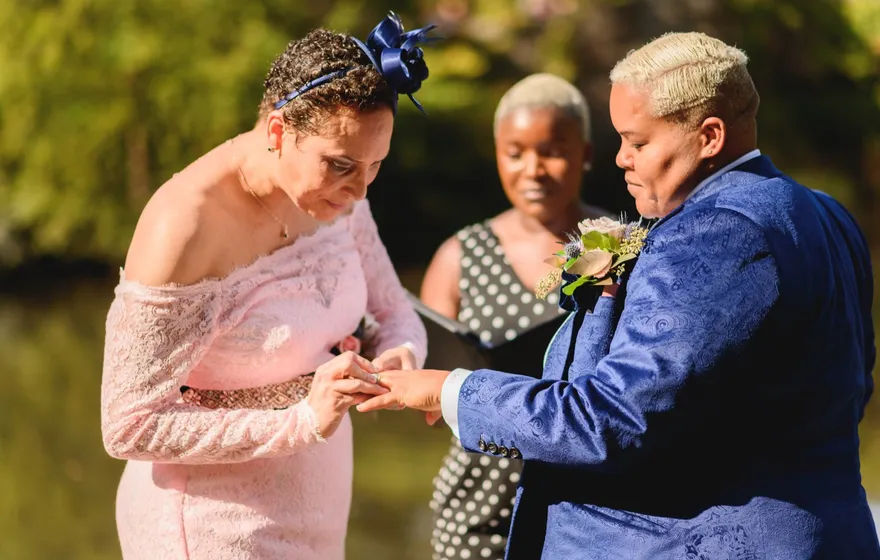
Ring Exchange Wording
Copy-ready ring exchange wording for every couple: traditional, secular, playful, one ring, blended family. Full lines plus what to do if a ring drops.
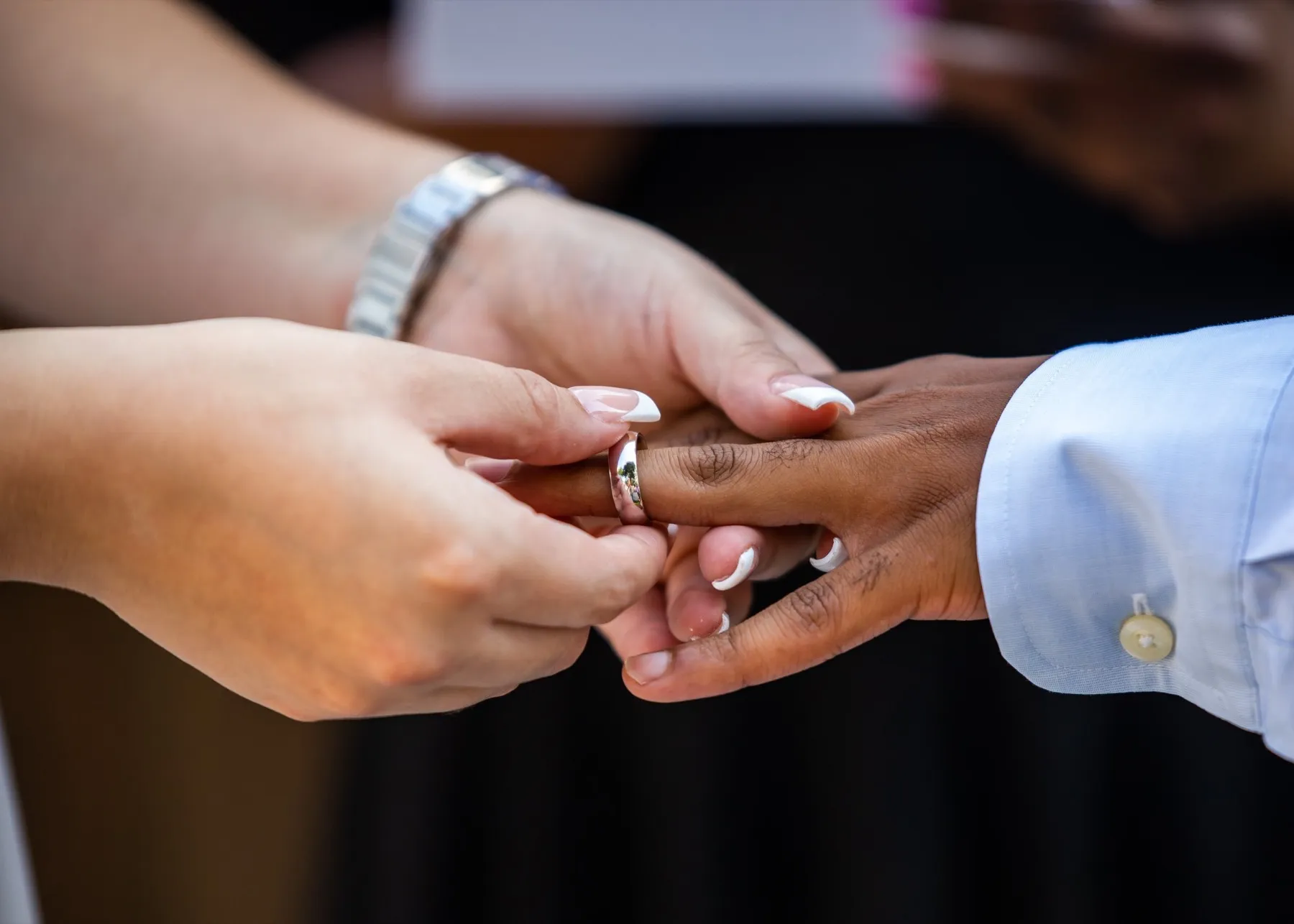
A groom once handed me both rings before the ceremony with the kind of relief you give someone holding your wallet at the beach. Twenty minutes later, mid-vow, his hands were shaking so hard he couldn’t get the band past his bride’s knuckle. The front row leaned in. I slowed everything down, gave him one short phrase, waited for him to say it back, and he got there.
Here’s what nobody tells you about the ring exchange. The wording is the easy part. The hard part is that this is the one moment in the whole ceremony when the couple’s hands are shaking the most, so the words have to be short enough to actually say out loud.
I’ve written and delivered this moment in religious, interfaith, secular, and blended-family ceremonies, and I’ve coached first-time officiants through it line by line. Below is every version I reach for, the full lines to say, and my honest read on which couple each one fits.
The short answer: there is no required line. “With this ring, I thee wed” is traditional, not mandatory. You can say anything that holds meaning, as long as it’s short enough to repeat under pressure.
What do you actually say during a ring exchange?
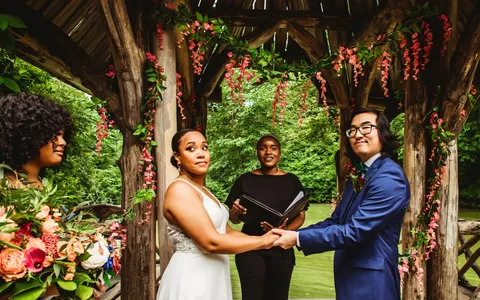
The structure stays the same no matter the words. The officiant frames the moment in a sentence or two. Then each partner places the ring while repeating a short line back, fed to them one phrase at a time.
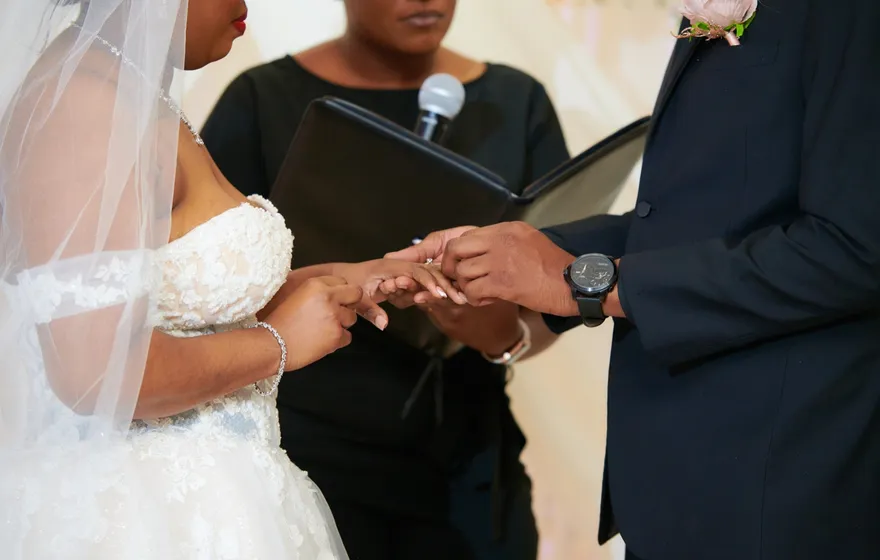
That repeat-after-me cadence is the whole trick. Hand a nervous person a full paragraph and they freeze. Give them four words, wait, give them four more, and they sail through it.
A framing line helps too. I like to call the rings a physical reminder of the promises the couple just made, a circle with no beginning and no end. You can say something like that, then move into the exchange itself.
The traditional ring exchange wording
This is the version most people picture, and it still works for couples who want their ceremony to feel rooted in something older than themselves.
“With this ring, I thee wed. With my body, I honor you, and with all that I am, I give myself to you.”
Repeat after me, in 6 pieces
- With this ring,
- I thee wed.
- With my body,
- I honor you,
- and with all that I am,
- I give myself to you.
One thing worth knowing before you choose it. That phrasing traces back to the 1662 Book of Common Prayer, where the line reads “With this Ring I thee wed, with my body I thee worship” (here). So it carries a liturgical root even though it sounds neutral to modern ears. Plenty of couples keep it without realizing where it came from, which is fine, but if a fully secular ceremony matters to you, you’ll want one of the swaps below.
Best fit: couples who want gravity and tradition, religious or culturally Christian families, and anyone who likes the old cadence on its own terms.
Secular and non-religious ring exchange wording
If you want the weight of the moment without the liturgy, the fix is simple. Keep the rhythm, swap the root.
Two secular versions
Full
“With this ring, I marry you. I give you my love, my trust, and my whole self, today and every day after.”
Best fit Couples who want the whole promise said out loud, with time to say it.
Shorter
“On this day, I give you this ring as a symbol of my love and my promise to you.”
Best fit Shaky hands, a quick ceremony, or a partner who hates speaking in public.
Both keep the structure of the traditional line while dropping anything that reads as scripture. I use these constantly for secular and non-religious ceremonies, and no guest has ever noticed a thing was missing.
There’s also a more deliberate version some couples love. Instead of binding language, you use consent language. One couple’s wording puts it plainly: “I cannot bind you to [Partner]. Only you can choose to do this.” You can carry that idea into the exchange itself: instead of placing the ring on your partner, you put it in their open hand and say “It is my wish,” and they slide it onto their own finger. The choreography flips from ownership to choice.
Best fit: secular couples, humanist ceremonies, and anyone who wants the moment to feel like a decision rather than a claim.
Playful and modern ring exchange wording
Some couples don’t want solemn. They want the room to laugh and then go soft. You can do both in two lines.
Two playful versions
The thermostat
“I give you this ring as a reminder that I chose you, I keep choosing you, and I’ll still be choosing you when we’re old and arguing about the thermostat.”
Best fit A couple with a running argument at home that everyone in the room already knows about.
The last bite
“With this ring, I promise you my love, my patience, and the last bite of whatever I’m eating.”
Best fit The food people, and anyone who wants the laugh to be short.
The structure stays serious underneath. The warmth on top is what gets the room laughing before it goes quiet. Keep it to one joke, then end on something real, or the moment tips into a comedy set.
Best fit: couples whose whole relationship runs on banter, lighter receptions, and anyone who wants guests grinning before the tears.
What to say when only one partner has a ring
This comes up more than people expect. One partner doesn’t want a ring, can’t wear one for work, or the second band just isn’t ready. The instinct is to apologize for it. The better move is to change the action, not the meaning.
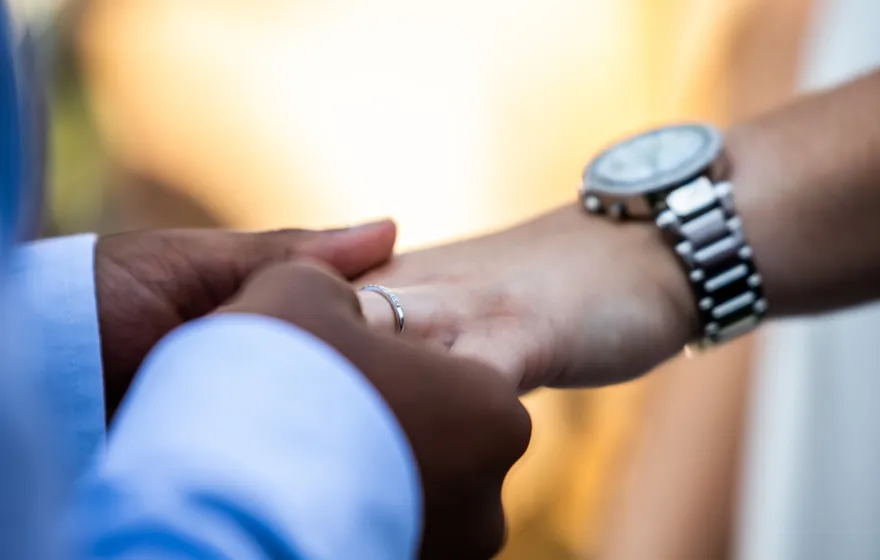
The partner without a ring takes the other’s hand and says the line as a gesture rather than a placement:
“On this day, I wed thee. I take your hand as my own and give you all of me.”
You swap “with this ring” for the hand-holding, and the rhythm stays intact. I’ve done this many times and it never reads as a gap. It reads as a choice. Some couples grab an inexpensive band just for the ceremony, which is fine too, but holding hands is the more deliberate option.
Religious and cultural ring exchange wording
If your ceremony is rooted in a faith tradition, the wording usually isn’t yours to invent, and that’s part of the beauty of it.
In a traditional Jewish exchange, the groom places the ring on the bride’s right index finger, not the left ring finger, and says:
“Harei at mekudeshet li b’taba’at zo k’dat Moshe v’Yisrael”
It means “Behold, you are consecrated to me with this ring according to the law of Moses and Israel” (My Jewish Learning). The index finger is chosen because it’s the finger used to bind tefillin, so the symbolism is being bound to one another.
One detail couples love once they hear it: Jewish law requires the ring to be a plain, solid metal band with no stones, specifically so the bride can’t misjudge its value at the moment of consent (My Jewish Learning). The marriage rests on her agreeing to what’s actually in front of her.
For interfaith ceremonies, I often let each partner use the wording of their own tradition back to back, so neither one has to give theirs up.
Ring exchange wording for a second marriage with kids
This is the version I get asked about most, because the wording online almost never covers it well. When you’re marrying into a family, the ring exchange has two parts, and the order matters.
Do the couple’s exchange first, complete and unhurried. Then move to the children as a separate beat so neither moment crowds the other (FamilyLife). Many blended families use a small family medallion, a pendant, or a little ring for each child.
“Take this as a symbol of our family, and our love for you. You are part of everything we promised each other today.”
Kids old enough to answer can respond “We do” to a short line, which turns them from spectators into participants. I’ve watched a nine-year-old say those two words and undo every adult in the room.
If you want to go deeper on weaving children and parents into the vows themselves, I wrote a whole piece on building family into the ceremony.
A full ring exchange script you can use
Here’s a complete, copy-ready version with a framing line, the exchange itself, and a closing. Swap the bracketed names and pick whichever ring line above fits your couple. This sits inside the larger wedding ceremony script, and if you’re still figuring out where the exchange goes, my guide to the order of a wedding ceremony maps the whole thing.
Officiant (framing):
“[Partner A] and [Partner B], these rings are the visible sign of everything you’ve just promised. A circle with no beginning and no end, worn where the whole world can see it. [Partner A], please take [Partner B]‘s ring.”
(Partner A holds the ring at the tip of Partner B’s finger.)
Officiant (repeat-after-me, in short phrases):
“With this ring / I marry you. / I give you my love, / my trust, / and my whole self, / today / and every day after.”
(Partner A repeats each phrase and slides the ring on.)
Officiant:
“[Partner B], please take [Partner A]‘s ring.”
(Repeat the same lines.)
Officiant (closing):
“These rings will catch the light at red lights, at kitchen sinks, in the middle of ordinary days. Let each one remind you of this exact moment, when you chose each other in front of everyone you love.”
What to do if someone drops the ring
I’ve stood at the front when a band hit the floor and rolled. Here’s the truth: a dropped ring is a story, not a disaster, and the officiant decides which one it becomes.
The recovery is a calm pause, then a small directed search. Ask the two or three people nearest the ring to scan the immediate area, because small focused searches beat a frantic crowd every time (The Pink Bride). Outdoors, mark the last-seen spot and search downhill and downwind from it. Don’t let the whole party rush in and kick it further.
The better answer is prevention, and most of it happens before anyone walks down the aisle. The pro move with a ring bearer is decoy rings: the child carries fake bands tied to the pillow while the best man keeps the real ones in his pocket. A dropped pillow becomes a non-event.
A warmer alternative: the ring warming
If you love the idea of the rings carrying meaning before they reach your hands, there’s a ritual for that. In a ring warming, guests hold and silently bless the bands before you exchange them, a custom usually traced back to ancient Ireland, where passing rings through family elders signaled approval of the union.
It has a hard size limit. Passing the rings to everyone works best under about 30 guests. Past that, the rings can’t circulate and return in time, and the loss risk climbs with every hand, so pass them through the front rows or family only. For larger weddings, a stationary “ring warming station” at the entrance solves it: guests bless the rings on the way in instead of mid-ceremony. I broke down the full setup in my ring warming ceremony guide.
Writing the wording yourself
If none of these fit and you want to write your own, the rules are short. Keep each line to one or two phrases. Make sure it can be repeated back under pressure. Match the tone to the rest of your ceremony so the ring moment doesn’t feel like it wandered in from a different wedding. My walkthrough on how to write a ceremony covers the whole arc, but the ring exchange in particular rewards plain words over poetry. The shaking hands will thank you.
Where to get the rest of it
The ring exchange is one beat in a ceremony that has a dozen. If you’re building the whole thing yourself, the Couple’s Ceremony Kit gives you every section already written and ready to adapt, including the ring exchange in all the variations above, the vows that come before it, and the pronouncement that follows. It’s $79, and it exists because I got tired of watching couples stitch their ceremony together from twelve different blog tabs at midnight.
If you just want to see how a full ceremony reads start to finish before you commit to anything, grab the free sample ceremony script. It’ll show you exactly where the ring exchange sits and how the pacing carries you into it.
Ring exchange wording: common questions
What do you say during a ring exchange?
The classic line is “With this ring, I thee wed,” but the words are yours. A simple secular version is “I give you this ring as a sign of my love; with this ring, I join my life with yours.” Keep each repeat short so a nervous couple can manage it.
Is “With this ring, I thee wed” religious?
Yes, in origin. It comes from the Book of Common Prayer, so it carries a liturgical root even though it sounds neutral now. For a fully secular ceremony, swap to “With this ring, I marry you” and you keep the same cadence.
What do you say when only one partner has a ring?
Change the action, not the words. The partner with no ring takes the other’s hand and says “On this day, I wed thee.” It keeps the rhythm without a stand-in prop, and holding hands reads as intentional.
How do you include children in a ring exchange for a second marriage?
Do the couple’s exchange first, then move to the kids as a separate beat. Use a small medallion or pendant with a line like “Take this as a symbol of our family, and our love for you.” Children old enough can answer “We do.”
What happens if someone drops the ring during the wedding?
Nothing, if the officiant stays calm. Pause, and let the people nearest the ring scan the floor. Outdoors, mark where it was last seen and search downhill and downwind. Prevent it by having the ring bearer carry decoy rings while the best man holds the real ones.
The Couple’s Ceremony Kit
Walk in with a ceremony that sounds like the two of you
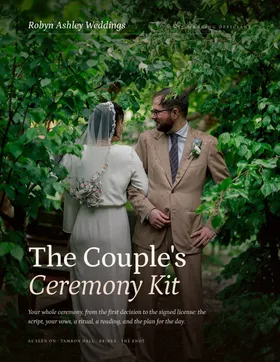
This post covers one part of the ceremony, and the Couple’s Ceremony Kit covers the rest, with five full scripts to start from and the prompts I use to help couples write their vows.
- Five full ceremony scripts in five different styles
- The Story Mine, thirty prompts for writing your vows
- Sixteen unity rituals, with the words and what to gather
- Thirty readings, each with my notes on when it fits
CEREMONY SCRIPTS
DIY Wedding Ceremony: A Full Template You Can Actually Use
Two summers ago I sat in the third row at a friend-officiated wedding. The couple wanted me there as a guest, not a vendor, so I left the clipboard at home. The best man stood up,.
READ →
CEREMONY SCRIPTS
A Complete Wedding Ceremony Script You Can Actually Use (2026)
A full wedding ceremony script you can read or adapt, with the legal wording included and an officiant's notes on where to slow down and look up.
READ →
CEREMONY SCRIPTS
Wedding Ceremony Script Examples: Templates for Every Style
A few years back, a bride's brother stood up to officiate with his script printed in a font so small he had to hold the page at arm's length. He read the whole thing head-down,.
READ →