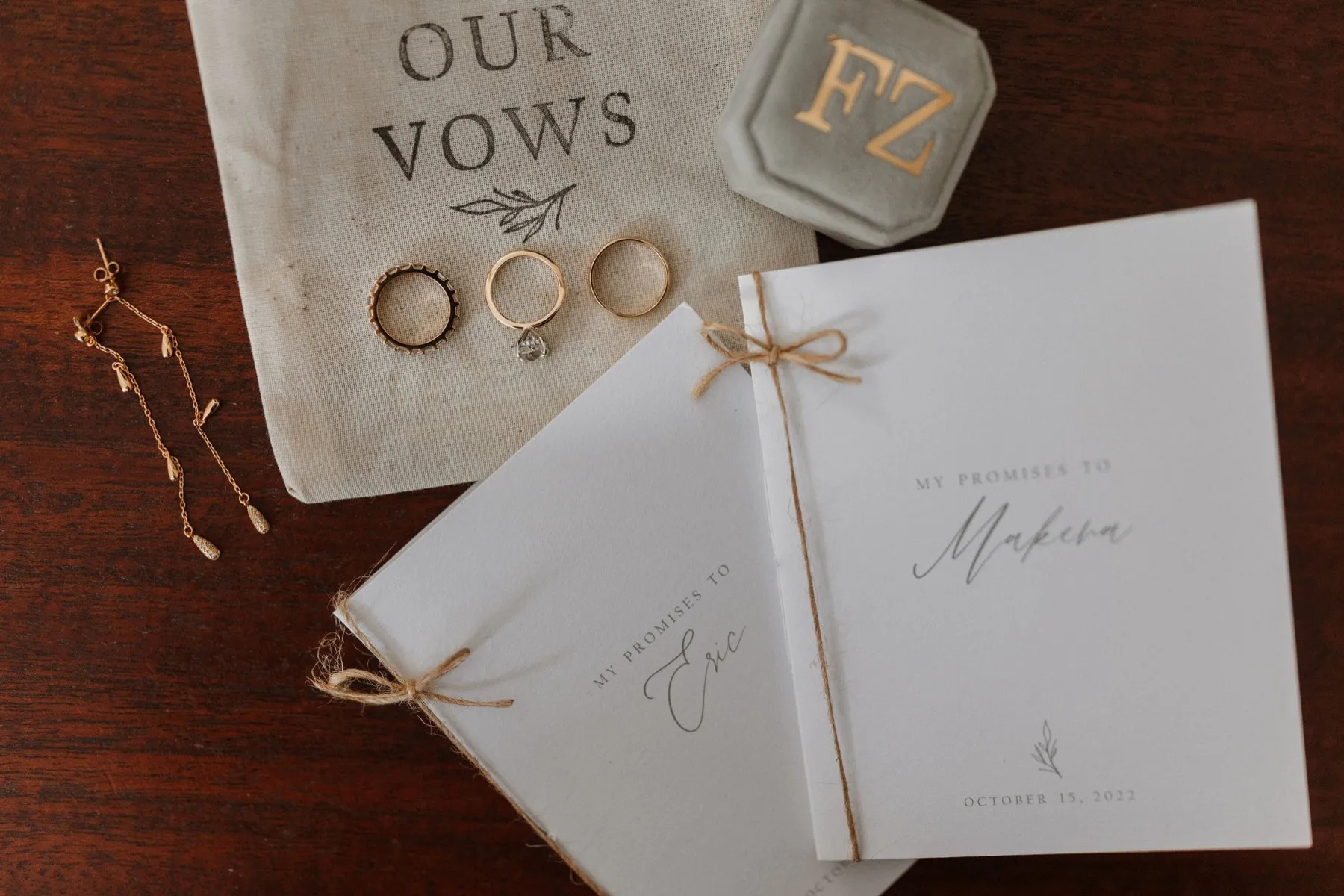
VOWS
How to Write Wedding Vows (Even If You're Not a Writer)
How to write wedding vows that sound like you, even if you are not a writer. A structure: one story, concrete promises, a forward line, plus delivery.
A groom once handed me his vows folded into a tiny square, the paper soft from being opened and refolded a hundred times. He’d written one line on it: “I don’t know how to do this.” When his turn came, I leaned in and told him to forget the paper and just tell me the coffee story, the one he’d let slip at the rehearsal. He did. Two hundred people went quiet, and his grandmother in the front row pressed a tissue to her face, because he’d described exactly how his partner pretends to hate mornings but always steals the first sip.
That’s the whole secret, and it’s why I stopped letting my couples open a blank document. The blank document is where vows go to die. Give yourself a structure instead and they come alive.
Here’s where most “how to write your vows” advice goes wrong. It hands you a fill-in-the-blank list and a word count, then sends you off to be poetic. You don’t need to be poetic. You need to be specific, and you need an order to put things in.
The structure I give every couple: one specific story, then your concrete promises, then a single forward-looking line. That’s it. Story, promises, future. Do those three things and you can write vows that work, whether or not you’ve ever written anything in your life.
Why your vows sound like a greeting card (and how to fix it)
I’ve stood three feet from hundreds of people reading their vows, close enough to watch the exact second a room either leans in or politely waits for it to be over. After a while you stop guessing what works. You know.
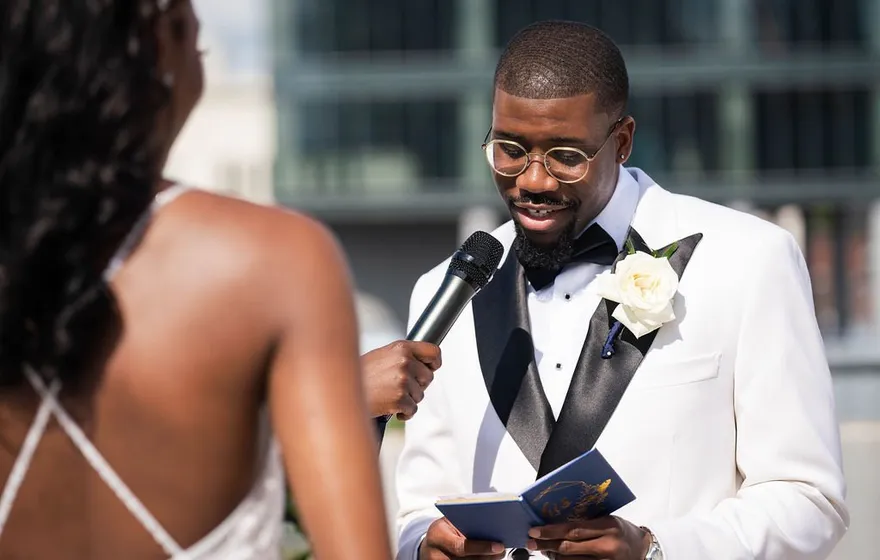
The strongest line in a set of vows is almost never the most beautiful sentence. It’s the most specific one. “You complete me” does nothing for a listener, because it could be said to anyone, about anyone. “You taught me to like cilantro and I taught you to parallel park, and I think that’s the whole deal, really” works, because only the two of you live inside that sentence.
The people who do this for a living put it plainly: specificity, not eloquence, is what makes vows work (Jane’s Personalized Weddings). I’d take it further. That small, slightly embarrassing detail you want to cut for being “too little” is almost always the exact line that catches the room. My couples try to delete it every single time. I make them keep it.
You’re in good company doing this work yourself, by the way. Plenty of couples write their own vows now, so nobody in the room will think you’re doing something unusual. You just need a way in that isn’t a flashing cursor.
The three-part structure, broken down
Think of your vows as three short movements. Each one runs only a few sentences. Together they come in under three minutes, and they give the room something to feel at every stage.
Part one: one specific story (about four to five sentences)
Pick a single moment, not a highlight reel. Don’t try to sum up your whole relationship. Tell one true thing that happened.
Pick the day you knew, or the fight that turned into something, or the ordinary Tuesday that somehow stuck, or the first time they did the small annoying loving thing they still do. One scene with real detail in it beats five years of summary.
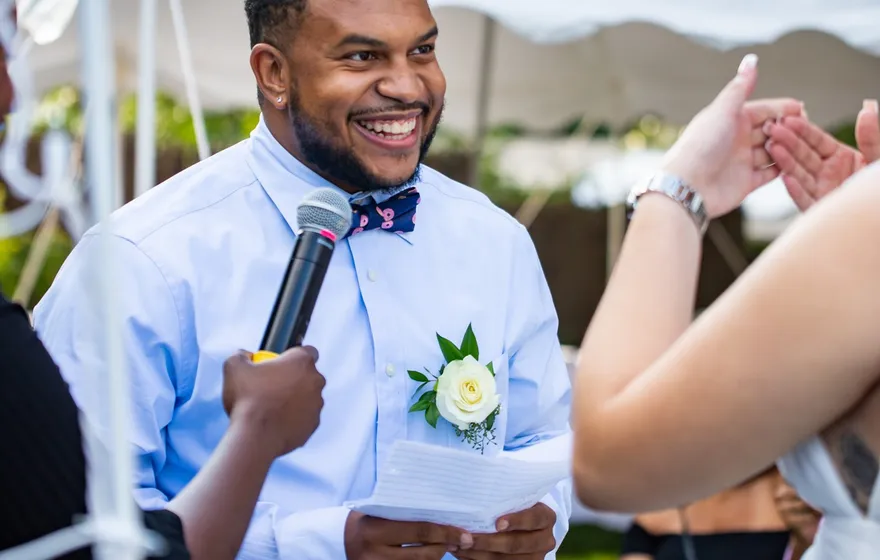
If you’re stuck, finish this sentence out loud: “I knew this was different when…” Then write down what you actually said, in your actual words. That’s your opening.
Part two: your concrete promises (about four to five sentences, three to six promises)
This is where most vows go vague, and vague is where guests check out. “I promise to always love you and support you” gives the room nothing to picture.
Make your promises tangible. Three to six of them, most of them sincere and built to last, with maybe one playful (Wedding Words). “I promise to keep making your coffee before you’re awake enough to ask.” “I promise to be the one who handles the spiders.” “I promise to fight fair, and to apologize first more often than I want to.” Those are promises a person can actually keep, and a crowd can actually feel.
Part three: one forward-looking line (one to two sentences)
End by pointing at the life ahead, not the day you’re standing in. This is the line that lifts the vow off the page and puts the lump in everyone’s throat on the way out.
Two ways to close
Sincere
“And whatever the next fifty years hand us, I want to meet it next to you.”
Best fit Vows that stayed tender all the way through.
Playful
“I can’t wait to be old and unbearable with you.”
Best fit Vows with a joke or two in them already, where a light last line fits.
One sentence about the future, and you’re done. Resist the urge to keep going. The forward line is your mic drop, and tacking on three more thoughts after it just softens the ending.
A worked example you can actually copy
Let me show you the structure doing its job. Here’s a full set of vows built exactly on story, promises, forward line, the kind a self-described non-writer could produce in an afternoon. Steal the shape. Swap in your own details.
The story:
“Three years ago you showed up to our second date forty minutes late, soaked from the rain, holding a grocery-store umbrella you’d bought for me because you’d watched me get caught without one the week before. You didn’t make a thing of it. You just handed it over and said, ‘I figured.’ That’s the moment I stopped pretending I wasn’t already in love with you.”
The promises:
“So here is what I promise you, out loud, in front of everyone.
I promise to keep buying you the good coffee, even when the budget says otherwise.
I promise to be the calm one when you’re spiraling, and to let you be the calm one when it’s my turn, because it will be my turn.
I promise to laugh at your jokes, especially the bad ones, which are most of them.
I promise to fight fair, to never go to sleep cold-shouldered, and to apologize first more often than my pride would like.
And I promise to keep showing up forty minutes late if I have to, as long as I show up holding exactly what you need.”
The forward line:
“I don’t know what we’re walking into. I just know I want to walk into all of it with you, umbrella or no umbrella, for the rest of my life.”
Notice what the example doesn’t do. It doesn’t reach for poetry, and it doesn’t use a single fancy word. The umbrella, the coffee, the “I figured,” those are the things that work, and not one of them needed talent. They needed honesty and a structure to hang it on.
How long should wedding vows be?
Short answer: roughly 150 to 300 words, one to two minutes per person. I’ll be honest that the “right” number gets argued about, and some vow writers see clients naturally run longer, closer to three to five minutes. From where I stand at the altar, aim for around two minutes and you’ll almost never be wrong.
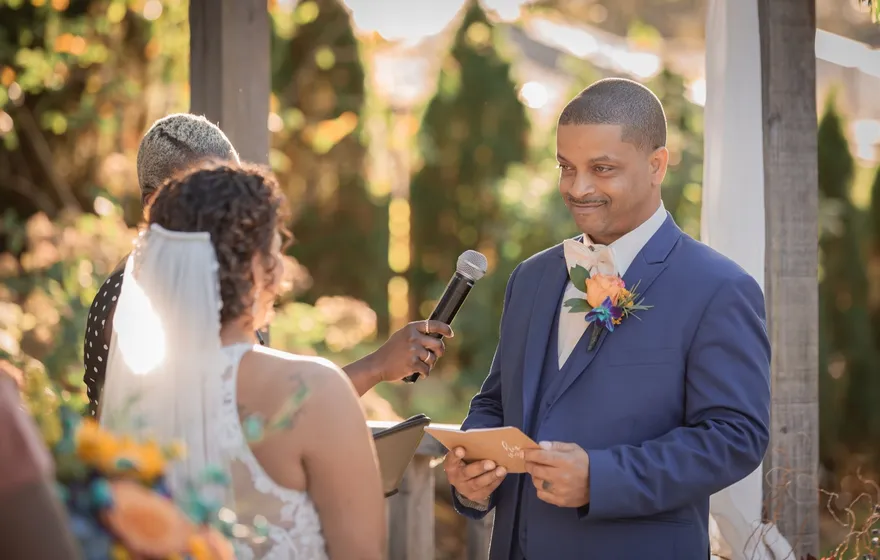
Here’s the rule nobody tells you, and it causes more quiet hurt than anything else: coordinate length with your partner. One person reading thirty seconds while the other reads four minutes makes the shorter set feel thin and the longer one feel like a monologue. Agree on a rough length together. Two paragraphs each, or one page each in big type. Match the weight.
What to leave out
The cutting is half the craft. Here’s what I pull out of my couples’ drafts most often.
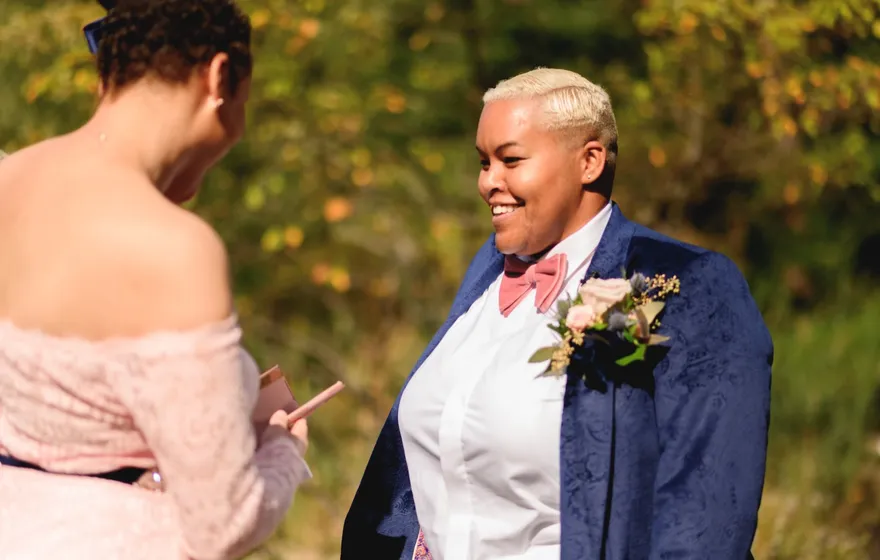
Inside jokes that need a backstory. If a line takes three sentences of setup the guests don’t have, it falls into silence. I’ve watched it happen. The couple cracks up, and two hundred people smile politely at a joke they weren’t in on. Save it for the private letter.
Anything too raw for a microphone. Some things are true and tender and absolutely not meant for a sound system and a videographer. Those belong in a note you exchange privately, away from the public vows.
The grandparent test. Read your draft aloud and picture your eldest relatives in the front row. If a line would confuse or embarrass them, move it to a letter you exchange before the ceremony (Wedding Words). This one filter saves more vows than any writing tip I know.
And cut the borrowed clichés. If you’ve heard the line at three other weddings, so have your guests. “You’re my rock,” “my better half,” “my best friend and my soulmate.” There’s nothing wrong with the sentiment. There’s just nothing of you in it.
Reading them out loud without falling apart
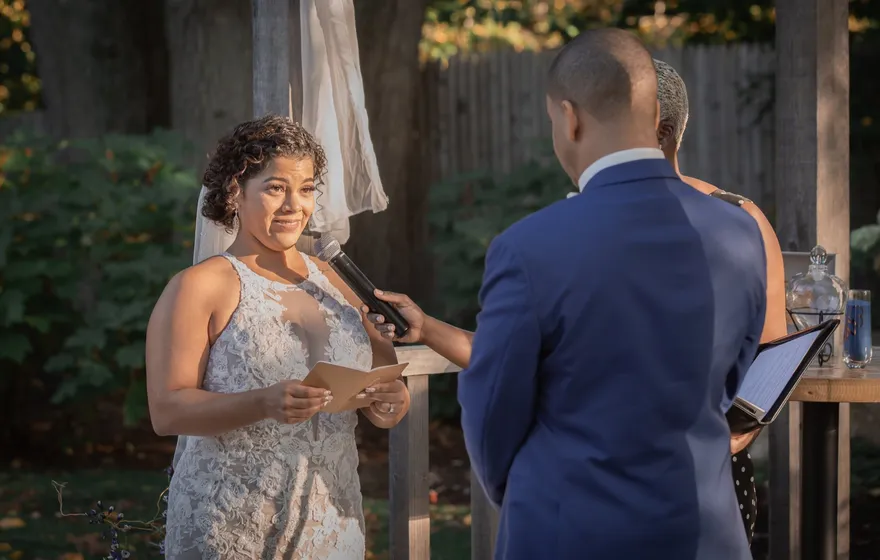
Writing the vows is only half the job. Reading them is the other half, and it’s the half I watch go wrong from the front.
Getting them ready to read
-
Break your lines short.
As you write
Don’t write in dense paragraphs. Write the way you’d breathe, a few words per line, so when you pause to cry or laugh you can look up, find your partner’s eyes, and drop back to your place without losing the thread.
-
Read your draft aloud before the day.
The weeks before
Say it out loud more than once, to your dog or in the shower or alone in the car (Jane’s Personalized Weddings). That’s how you find where your voice cracks before the moment ambushes you at the altar. Vows that read fine on paper can come out completely different once your throat tightens. You want to meet that crack in your car, not in front of everyone.
-
Print them properly.
The week before
Large font, double-spaced, in a little vow book or on nice paper (Unboring Wedding). Please, not your phone. I’ve watched too many couples read off a glowing screen that died, photographed terribly, and pulled them right out of the moment with a thumb-scroll. The vow book costs ten dollars and shows up in every photo looking like you meant it.
Where the vows sit, and what’s next
Your vows are one moment inside a larger ceremony, and they feel better when the whole thing around them holds together. If you’re shaping more than just the vows, my walkthrough on how to write a wedding ceremony from start to finish covers the full arc, and the wedding ceremony script guide shows you exactly where personal vows slot in among the welcome, the readings, and the ring exchange.
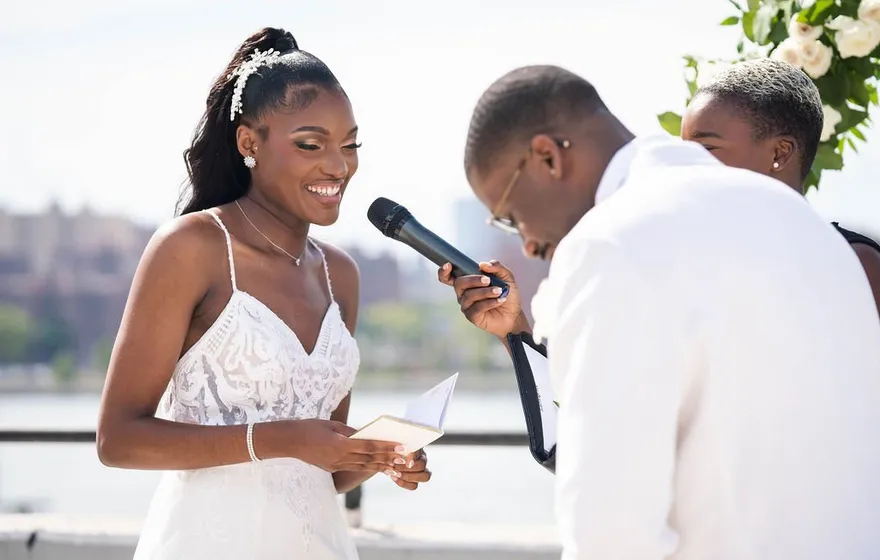
And if you’re writing vows not for a first wedding but for a renewal, the rules shift in lovely ways. You have history to draw from now. My guide to vow renewal vows is built for couples who’ve already lived some of the promises they once made.
The shortcut, if you want one
Everything above, you can do with a notebook and an honest hour. I mean that.
That said, the hardest part for most couples isn’t the structure. It’s finding the specific story and the real promises when their mind goes blank under pressure. That’s exactly where my couples freeze, and it’s the moment a few good prompts fix in seconds.
The Couple’s Ceremony Kit carries the vow-writing prompts I use to unfreeze people, the kind of questions that pull out the umbrella story when you swear you don’t have one. It walks you through the same structure on this page with worked examples for your situation, and it sits alongside the rest of the ceremony so the vows aren’t floating on their own. If you’d rather not face the blank page without a hand on your back, that’s what it’s for.
You can also grab my vow-prompt questions on their own for free if you just want the unfreezing part. Either way, the goal is the same: get the true, specific thing out of you and onto the paper.
Frequently asked questions
How long should wedding vows be?
Aim for about 150 to 300 words, or one to two minutes per person. That’s long enough to mean something and short enough to read without falling apart. Coordinate with your partner so the two sets run roughly the same length, and keep it under five minutes, which is where rooms start to drift.
What if I’m not a writer and I freeze up?
Skip the blank page and use a structure: one specific story about the two of you, then three to six concrete promises directed at your partner, then one forward-looking line about the life you’re building. You’re not writing poetry. You’re saying true things in order, and the specificity does the emotional work, not the wordsmithing.
Why do my vows sound like a greeting card?
Almost always because they’re abstract. “You complete me” and “I’ll always be there” are sentences that could be said to anyone. The fix is detail only the two of you would recognize: the exact thing you do, the specific Tuesday, the real habit. Specificity, not eloquence, is what makes vows sound like yours.
What should I leave out of my wedding vows?
Cut inside jokes that need backstory, anything too sensitive for a microphone, and lines that sound like clichés you’ve heard at other weddings. A good filter is the grandparent test: if a line would confuse or embarrass your eldest relatives in the front row, move it to a private letter you exchange before the ceremony.
Should I memorize my vows or read them?
Read them. Print them in large, double-spaced type or a vow book, not your phone, which photographs badly and pulls you out of the moment. Break the lines short so you can look up, and read the draft aloud beforehand to find where your voice will crack before it ambushes you at the altar.
The Couple’s Ceremony Kit
Walk in with a ceremony that sounds like the two of you
This post covers one part of the ceremony, and the Couple’s Ceremony Kit covers the rest, with five full scripts to start from and the prompts I use to help couples write their vows.
- Five full ceremony scripts in five different styles
- The Story Mine, thirty prompts for writing your vows
- Sixteen unity rituals, with the words and what to gather
- Thirty readings, each with my notes on when it fits
VOWS
Best Anniversaries to Renew Vows | Don't Wait
A couple I worked with spent years saying "we'll do it at 25." Then her mother got sick, and waiting four more years for a tidy number suddenly felt absurd. They renewed at year.
READ →
VOWS
Vow Renewal Officiant, How to Ask + What to Send
A couple who'd been married twenty-two years got on a call with me and asked, almost sheepishly, who they were supposed to "get" to make the renewal official. I told them the.
READ →
VOWS
Vow Renewal vs Wedding: The Real Differences
A couple sat across from me last spring, planning what they kept calling their vow renewal. Twenty minutes in, the wife asked me, almost shyly, whether they'd "sign something" at.
READ →