CEREMONY SCRIPTS
Wedding Ceremony Script Examples: Templates for Every Style
Full, copy-ready wedding ceremony script examples for traditional, modern, short, and interfaith weddings, plus the exact lines to swap between them.
A few years back, a bride’s brother stood up to officiate with his script printed in a font so small he had to hold the page at arm’s length. He read the whole thing head-down, into the paper, and never once looked at the couple. The vows were lovely. Nobody felt a word of them, because he was reading them to a sheet of paper instead of to his sister.
The next time he did it, I fixed the problem in about ten minutes, and the fix had nothing to do with the words. The words were never the issue. Here is what most couples and most first-time officiants get backwards: they decide the script is the hard part, so they pour everything into writing it and almost nothing into owning it.
I have married couples in Central Park, in living rooms, in backyards up in Westchester, and I have walked a lot of nervous friends and family through their very first time at the front. A wedding ceremony is mostly fill-in-the-blank. Two lines do the legal work. Everything else is yours to write, swap, soften, or cut. Once you see that, the thing stops being scary.
This page hands you full, copy-ready scripts for every common style, free, all the way through. Traditional, modern and secular, short and simple, religious-lite, and blended interfaith. After that I show you which exact lines change between them, because here is the honest truth: the gap between a “traditional” script and a “modern” one is usually about five sentences and the God references, not a different ceremony.
Pick a style by tone and by runtime, then come back to the swap sheet when you want to blend two.
CHAPTER 01
What you actually have to say (and what’s optional)
Start here, because it makes everything after it easy.
In most US states, the one spoken element the law requires is the couple’s declaration of intent (verbal consent, in front of the officiant and witnesses, that they take each other as spouses). The officiant’s pronouncement is the customary close. Statutes generally don’t require it, but most officiants treat it as essential, and so do I. The welcome, the readings, the unity ritual, the personal vows, the ring exchange wording, all of it is optional and all of it is yours to rewrite.
I live and work in New York, and our statute spells this out better than almost any other I have read. New York’s solemnization law says “no particular form or ceremony is required,” and that the parties “must solemnly declare in the presence of” the officiant “and the attending witness or witnesses that they take each other as spouses” (New York State Senate). One witness besides the officiant has to be in the room. That is the entire legal floor. A script you wrote yourself, with no religion in it at all, clears that floor completely.
People mix up the declaration of intent and the vows all the time, so let me pull them apart. The declaration of intent is the “Do you take… I do” exchange, and it is the part that records legal consent. The vows are the personal promises. Two different things, and most couples today want both. When you use both, the declaration of intent goes first, then the vows.
If you want the reasoning behind every block, I wrote a step-by-step companion on how to write a wedding ceremony from scratch, plus a fuller breakdown of the wedding ceremony order so you can see how the skeleton holds together.
CHAPTER 02
The skeleton every script shares
Here is the part that makes “scripts by style” simple. The order is the same across the traditional, modern, and interfaith versions. What changes is the content inside each block, not the sequence:
The skeleton every script shares
-
Processional
Everyone walks in.
-
Welcome / opening remarks
The officiant greets the room and says why everyone is here.
-
Reading or two
Optional
A poem, a passage, or a blessing.
-
Declaration of intent
Required
The “Do you take” question and the “I do.”
-
Vows
Optional, but most couples want them
The personal promises.
-
Ring exchange
A short repeat-after-me line for each ring.
-
Unity ritual
Optional
Sand, candle, wine, or one from your tradition.
-
Pronouncement and first kiss
Customary
The officiant declares the couple married.
-
Recessional
Everyone walks out.
When I talk about “moving between styles,” what I mean is swapping the words inside blocks 2, 3, 5, 6, and 7. The bones don’t move. That is the whole trick, and it is why one base script can turn into any of the five below.
For length, aim for a spoken portion around 15 minutes, with the full ceremony running 15 to 20. A short-and-simple ceremony can wrap in 8 to 10. A virtual or very intimate one works in 2 to 3. I once watched a 35-minute script lose a warm, ready crowd by minute 12, so pick your runtime target before you write a single word.
Here are the five scripts below, side by side, so you can choose by the clock as well as the tone.
| Script | Minutes | Best for |
|---|---|---|
| Traditional | 18-20 | Formal rooms |
| Modern | 15-18 | Secular couples |
| Short | 8-10 | Elopements |
| Religious-lite | 16-18 | One blessing |
| Interfaith | About 20 | Two faiths |
Each one below is complete, from the welcome to the closing line.
CHAPTER 03
The traditional ceremony script (full, free)
This is the classic structure with light religious framing. Warm, formal, and familiar to most of the guests in the room. I have marked the required line and the customary close so you can spot them inside a real script.
Welcome:
“Family and friends, welcome. We are gathered here today to celebrate the marriage of [Partner A] and [Partner B], and to stand with them as they make promises that will shape the rest of their lives. Love brought them here. Love is why all of us are here. Today we get to witness two people choose each other, out loud, in front of the ones they love most.”
Remarks on marriage:
“Marriage is not a single decision made on a single day. It is a thousand small choices made over a lifetime: to be patient, to be honest, to keep showing up. [Partner A] and [Partner B], the vows you make today are the beginning of all of those choices.”
(Officiant turns to the couple.)
Declaration of intent (required):
“[Partner A], do you take [Partner B] to be your spouse, to have and to hold from this day forward, for better or for worse, for richer or for poorer, in sickness and in health, to love and to cherish, as long as you both shall live?”
“I do.”
“[Partner B], do you take [Partner A] to be your spouse, to have and to hold from this day forward, for better or for worse, for richer or for poorer, in sickness and in health, to love and to cherish, as long as you both shall live?”
“I do.”
Vows:
“Please face each other and share the promises you have written.”
(Couple reads personal vows.)
Ring exchange:
“The ring is a circle, with no beginning and no end. As you place it on [Partner B]‘s hand, repeat after me: I give you this ring as a sign of my love and faithfulness.”
(Repeat for the second partner.)
Pronouncement (customary):
“[Partner A] and [Partner B], by the power vested in me by the State of [State], and in the presence of everyone here who loves you, it is my honor to pronounce you married. You may kiss.”
Closing:
“Friends, it is my joy to present, for the first time, the newly married couple.”
That is the traditional version start to finish, and the declaration of intent is the only line in it the law needs.
Once it reads well aloud, the rest of this page is about changing the tone, never the structure.
CHAPTER 04
The modern, non-religious ceremony script (full, free)
Now watch what actually changes. Same skeleton, religious framing stripped out, warmth pointed at the couple’s own story instead. More Americans are picking this every year. Among married Americans, 36% report an entirely secular ceremony, and younger couples lean non-religious more than any generation before them (American Enterprise Institute).
Welcome:
“Welcome, everyone. We are not here today because of tradition or obligation. We are here because [Partner A] and [Partner B] found in each other the person they want to build a life with, and they wanted you, the people who shaped them, in the room when they say so.”
The couple’s story:
“[Share a short, true anecdote about how they met or a moment that defined them. Two or three sentences, specific and real.]”
(Officiant turns to the couple.)
Declaration of intent (required):
“[Partner A], do you take [Partner B] to be your partner in life, to support and respect them, to grow alongside them, and to choose them, again and again, for as long as you both shall live?”
“I do.”
“[Partner B], same question, your turn.”
“I do.”
Vows:
“You have each written words for the other. Whenever you are ready.”
(Couple reads personal vows.)
Ring exchange:
“These rings are simple on purpose. They are something you will see a hundred times a day, an ordinary reminder of an extraordinary promise. [Partner A], as you place this ring, say: This is my promise, and I will keep it.”
(Repeat for the second partner.)
Pronouncement (customary):
“[Partner A] and [Partner B], with the authority granted to me by the State of [State], and with every person here as your witness, I am thrilled to pronounce you married. Go ahead and kiss.”
Closing:
“Everyone, please celebrate the newly married couple.”
Look at what moved between the traditional and the modern. The order is identical. The welcome stopped pointing at a higher power and started pointing at the couple’s story. “Holy matrimony” became “marriage” and “partnership.” The declaration of intent kept its job but lost the formal “for richer or for poorer” liturgy. That is roughly five lines of change. Same ceremony, different clothes. If you want a full secular treatment with more options, I built out a secular wedding ceremony guide for exactly that.
CHAPTER 05
The short-and-simple ceremony script (full, free)
For elopements, city hall, backyard intimate weddings, or any couple who wants the moment without the runtime. This one runs 8 to 10 minutes and still hits everything that matters.
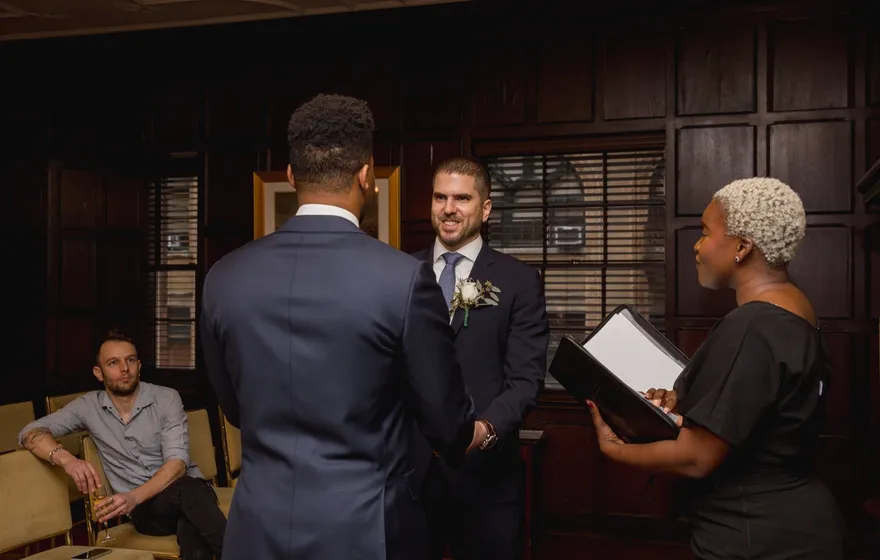
Short works in a club room, a park, or a living room, as long as a witness is there.
Welcome:
“We are here for one reason: [Partner A] and [Partner B] love each other and want to be married. So let’s marry them.”
(Officiant turns to the couple.)
Declaration of intent (required):
“[Partner A], do you take [Partner B] to be your spouse, to love and to stand beside, for as long as you both shall live?”
“I do.”
“[Partner B], do you take [Partner A] to be your spouse, to love and to stand beside, for as long as you both shall live?”
“I do.”
Vows (optional, can be one shared line):
“Repeat after me: I choose you, today and every day after.”
(Both partners repeat.)
Ring exchange:
“With this ring, I marry you.”
(Both partners exchange rings.)
Pronouncement (customary):
“By the power vested in me by the State of [State], it is my joy to pronounce you married. You may kiss.”
That entire ceremony is legitimate and legal. It has the declaration of intent, it has the pronouncement, and in New York it works the moment a witness is present and the license gets signed. Short does not mean less married. For couples eloping in the city, pair this with my base wedding ceremony script, which gives you a few more drop-in lines if you want to stretch it a little.
CHAPTER 06
The religious-lite ceremony script (full, free)
This one is for couples who want a nod to faith or a blessing without a full religious service. One reading, one blessing, secular framing around it. It is one of the styles couples ask me for most, because it honors a family’s tradition without turning the whole ceremony into doctrine.
Welcome:
“Welcome, everyone. We gather today in gratitude, surrounded by the people who love [Partner A] and [Partner B], to celebrate the love they have found and the promises they are about to make.”
Reading or blessing:
“[A reading the couple chose, religious or poetic, kept to one. See the readings linked below for ideas.]”
(Officiant turns to the couple.)
Declaration of intent (required):
“[Partner A], do you take [Partner B] to be your spouse, to love, honor, and cherish, in the sight of all gathered here, for as long as you both shall live?”
“I do.”
“[Partner B], do you take [Partner A] to be your spouse, to love, honor, and cherish, in the sight of all gathered here, for as long as you both shall live?”
“I do.”
Vows:
(Couple reads personal vows.)
Ring exchange:
“Let these rings be a blessing on the promises you have made. [Partner A], repeat: With this ring, I give you my heart and my faithfulness.”
(Repeat for the second partner.)
Blessing over the couple:
“May your home be a place of warmth, your love a steady light, and your years together long and full. Go now, and build a beautiful life.”
Pronouncement (customary):
“By the power vested in me, and with the blessing of all who love you, I pronounce you married. You may kiss.”
If you want readings to drop into the blessing slot, I keep a running collection of non-religious ceremony readings that sit beautifully in a religious-lite ceremony when you want warmth without scripture.
CHAPTER 07
The blended interfaith ceremony script (full, free)
This is where couples get the most nervous, and it is also the style I love writing most. The principle is simple: build on what the two traditions share (love, commitment, family, community) and alternate the distinctive pieces so each side gets equal weight (Universal Life Church). You can use one officiant who is comfortable with interfaith ceremonies, or two co-officiants, one from each tradition.
Welcome:
“Today, two families and two traditions come together as one. [Partner A] and [Partner B] were raised in different faiths, and rather than choose between them, they have chosen to honor both. Everything you witness today carries something from each of their histories.”
First reading or blessing (Tradition One):
“[A reading, prayer, or blessing from the first partner’s tradition.]”
Second reading or blessing (Tradition Two):
“[A reading, prayer, or blessing from the second partner’s tradition.]”
(Officiant turns to the couple.)
Declaration of intent (required):
“[Partner A], do you take [Partner B] to be your spouse, to honor the love and the heritage you both bring, and to build a shared life across all that makes you who you are, for as long as you both shall live?”
“I do.”
“[Partner B], do you take [Partner A], under the same promise, for as long as you both shall live?”
“I do.”
Vows:
(Couple reads personal vows. Can alternate languages or traditions line by line.)
Ring exchange:
“These rings join not only two people, but two lineages. Wear them as a sign that both of your families now share one family.”
Ritual from each tradition:
“[A ritual from each side, given equal weight. For example, a unity candle alongside the breaking of the glass, or a ketubah signing alongside a Christian blessing.]”
Pronouncement (customary):
“By the authority granted to me, and in the presence of both of your families and all who love you, I pronounce you married. You may kiss.”
(If glass-breaking is included, it follows the kiss.)
The move that makes interfaith ceremonies work is balance. Every time one tradition shows up, the other gets a matching moment. No side should feel like a guest at the other one’s wedding. If you want a deeper build, including how to brief two co-officiants and sequence the rituals so nothing feels bolted on, my interfaith wedding ceremony guide walks through the whole thing.
ALSO READ Interfaith Wedding CeremonyCHAPTER 08
The swap sheet: turning one script into another
Here is the part most people leave out. They hand you a script. I want you to see which exact lines change, so you can build your own. These are the swaps I make most often in the room.
| Swap | What changes |
|---|---|
| Traditional to modern | Prayers out, story in |
| Long to short | Cut remarks, short vows |
| Gendered to neutral | Titles, pronouncement |
| One language to two | Alternate sections |
The details for each swap follow, line by line.
Traditional to modern or secular. Cut the prayers and the higher-power references. Soften “holy matrimony” to “marriage” or “partnership.” Make the welcome about the couple’s story instead of the institution of marriage. Keep the declaration of intent and the pronouncement, dropping “before God” if it is in there. About five lines.
Long to short. Cut the remarks-on-marriage paragraph, trim the welcome to two sentences, reduce the vows to a single repeat-after-me line, and shorten the ring exchange to “With this ring, I marry you.” The two core lines stay untouched.
Gendered to gender-neutral. Swap the pronouncement to “I now pronounce you married,” “spouses for life,” “partners in life, for life,” “the grooms,” or “the brides.” Change “bridesmaids and groomsmen” to “wedding party” or “attendants,” and “best man / maid of honor” to “best person” or “person of honor”. The single best move is to ask the couple their exact preferred words and use those.
One language to two. You do not have to repeat every line in both languages, which is the mistake that doubles your runtime. Alternate by section, the welcome in one language and a reading in the other, or have a co-officiant or family member carry one language, or print a side-by-side bilingual program so guests can follow along (All Faith Ministry). Vows can alternate line by line, which sounds lovely when you hear it.
CHAPTER 09
A note on first-time officiants
A growing share of couples now ask a friend or a family member to do this, and from what I see at the front, the number keeps going up. If that is you, holding this page because someone you love asked you to marry them, here is what I tell every first-timer I coach.
The script is not your job. Showing up for these two people is your job.
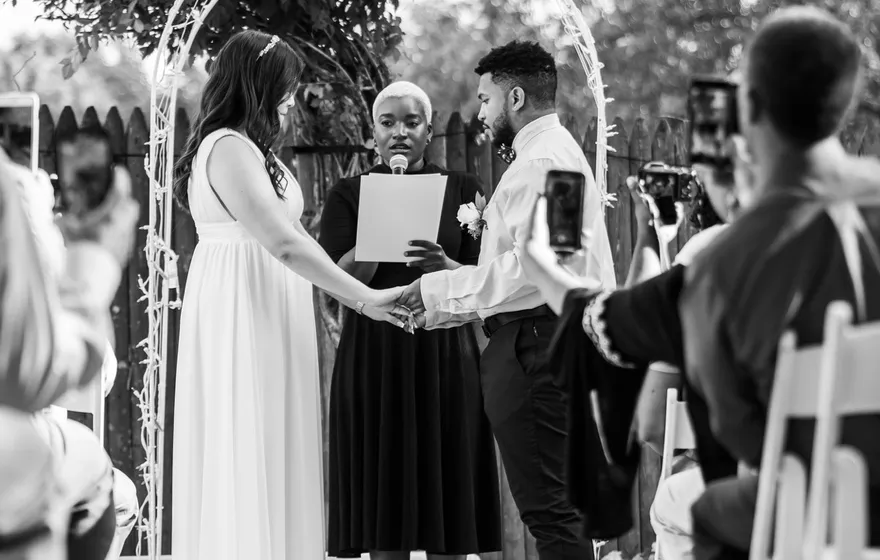
The ways I most often watch new officiants stumble are small and fixable: the head buried in the page, reading word-for-word, which kills every bit of eye contact, and the copy-paste name error from a reused script. Both of those vanish the moment you read the whole thing aloud beforehand and mark your script with a few “(look up)” cues.
You can absolutely use any script on this page. The script does not make the marriage legal. Your authorization to officiate, the couple’s declaration of intent in front of a witness, and a signed marriage license do. Confirm the rules where you are marrying, then breathe.
CHAPTER 10
Make it yours without starting from a blank page
I built the Couple’s Ceremony Kit for exactly the couple, or the friend, who wants these scripts but also wants the guardrails. It hands you the full templates for every style above, the vow-writing prompts that pull real promises out of you instead of generic ones, the readings library, and the printable officiant’s script with the delivery cues already marked, so nobody reads head-down at the altar.
If you would rather build it yourself from this page, please do. That is exactly why the scripts are here in full. If you want the version that is already formatted, personalized, and ready to print, the Couple’s Ceremony Kit is the shortcut. Either way, you walk out with a ceremony that sounds like you and not like a template.
And if you just want one clean, ready-to-edit script to start from tonight, grab the free sample ceremony script and personalize from there.
CHAPTER 11
Frequently asked questions
What do you legally have to say at a wedding ceremony?
In most US states, the spoken part that carries legal weight is the couple’s declaration of intent (a verbal yes, in front of the officiant and witnesses, that they take each other as spouses). The officiant’s pronouncement is the customary close, and most officiants treat it as essential, but the statutes generally don’t require it. There is no required script. New York’s law says it plainly: no particular form or ceremony is required, as long as the couple declares before the officiant and at least one witness that they take each other as spouses. Everything else is yours to write.
What’s the difference between the declaration of intent and the vows?
The declaration of intent is the “Do you take…?” and “I do” exchange, and it is the part that does the legal work of recording consent. The vows are the personal promises you write or choose. They are not the same thing, and most couples want both. When you use both, the declaration of intent usually comes first, then the vows.
How long should a wedding ceremony be?
Most ceremonies run about 15 to 20 minutes, and the spoken portion is best kept around 15 so guests stay with you. A short-and-simple ceremony can finish in 8 to 10 minutes, and a very intimate or virtual one can work in 2 to 3. The scripts here map to those targets so you can choose by runtime, not only by tone.
Can a friend or family member legally officiate, and use one of these scripts?
Yes. A friend or family member can become ordained or, in New York, get a one-day marriage officiant license, then use any of these scripts. The script does not make the marriage legal. The officiant’s authorization, the couple’s declaration of intent in front of a witness, and a signed marriage license do. Confirm the rules in the state and county where you are marrying.
How do I turn a traditional script into a modern or non-religious one?
You don’t rewrite the whole thing. The order stays the same and you swap a handful of lines. Replace the religious references and prayers, soften “holy matrimony” to “marriage” or “partnership,” make the welcome about the couple’s story instead of a higher power, and keep the declaration of intent and pronouncement. It is usually about five lines.
The Officiant Kit
What to say when the ring goes missing, the mic dies or you blank on a name
This post gets you through one part of the ceremony, and the Officiant Kit covers what surrounds it, from the weeks before and the rehearsal to what you do when something goes wrong in front of everyone.
- Eight full ceremony scripts, with names you type once
- The Story Builder, seven steps to the couple’s story
- The Rehearsal Run Sheet, a cue sheet and four pocket cards
- A marriage license reference for all fifty states
CEREMONY SCRIPTS
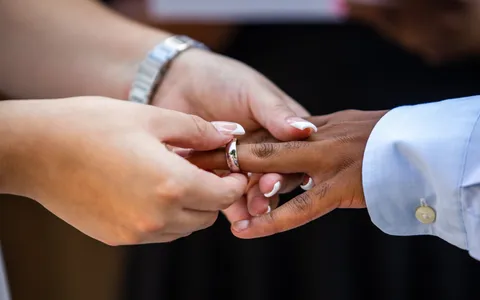
Ring Exchange Wording
A groom once handed me both rings before the ceremony with the kind of relief you give someone holding your wallet at the beach. Twenty minutes later, mid-vow, his hands were.
READ →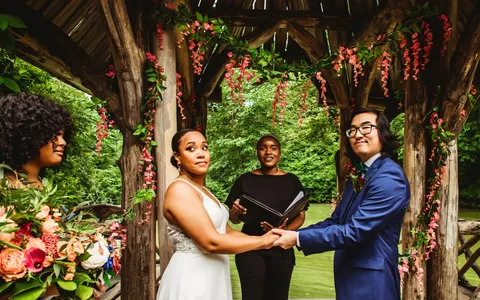
CEREMONY SCRIPTS
DIY Wedding Ceremony: A Full Template You Can Actually Use
Two summers ago I sat in the third row at a friend-officiated wedding. The couple wanted me there as a guest, not a vendor, so I left the clipboard at home. The best man stood up,.
READ →
CEREMONY SCRIPTS
A Complete Wedding Ceremony Script You Can Actually Use (2026)
A full wedding ceremony script you can read or adapt, with the legal wording included and an officiant's notes on where to slow down and look up.
READ →