
CEREMONY SCRIPTS
A Complete Wedding Ceremony Script You Can Actually Use (2026)
A full wedding ceremony script you can read or adapt, with the legal wording included and an officiant's notes on where to slow down and look up.
Most articles about wedding scripts tell you what a script is and then send you off to write one yourself. That’s not much help when the wedding is in three weeks and you’ve never done this.
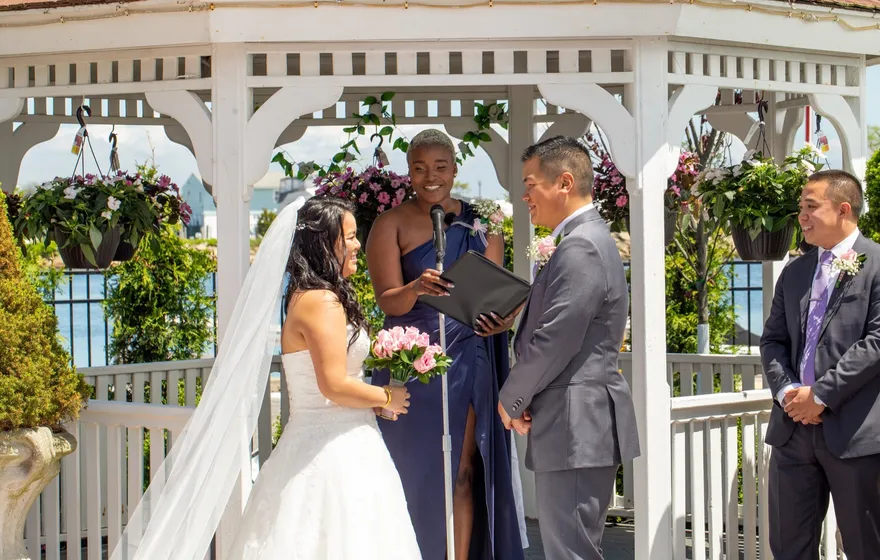
So here’s the whole thing instead: a complete, usable ceremony script, legal lines included, with my notes in the margins on where to slow down and where to make it yours. Read it as written and you have a real ceremony. Swap in the personal parts and you have their ceremony. Either way, you’re not staring at a blank page anymore.
The complete script
Brackets are yours to fill. Everything outside them you can use as-is.
Welcome
“Good evening, everyone, and welcome. We’re here to celebrate [Partner A] and [Partner B], and to witness them promise the rest of their lives to each other. Please, take your seats.”
Opening words
“Weddings are one of the few times we all gather for the single purpose of celebrating love. [Partner A] and [Partner B], look out for a second. Everyone here is here for you.”
The couple’s story
“[Two or three specific, true details: how they met, the moment it got serious, the small thing that’s so them. Keep this to three or four minutes.]”
A reading (optional)
“[Partner A] and [Partner B] have chosen a reading that means something to them, performed by [name].”
The declaration of intent (legal, read as written)
“[Partner A], do you take [Partner B] to be your [husband/wife/partner], to have and to hold from this day forward? … [I do.]”
“[Partner B], do you take [Partner A] to be your [husband/wife/partner], to have and to hold from this day forward? … [I do.]”
The vows
“[Partner A] and [Partner B] have written their own vows.” [Or read traditional vows provided here.]
The ring exchange
“Rings are a circle, with no beginning and no end. [Partner A], place this ring on [Partner B]‘s finger and repeat after me: I give you this ring as a symbol of my love.”
[Repeat for Partner B.]
The pronouncement (customary close, read as written)
“By the power vested in me by the State of [State], it is my joy to pronounce you married. You may kiss.”
My notes on delivering it
The words are only half the job. Here’s where first-timers either soar or stumble.
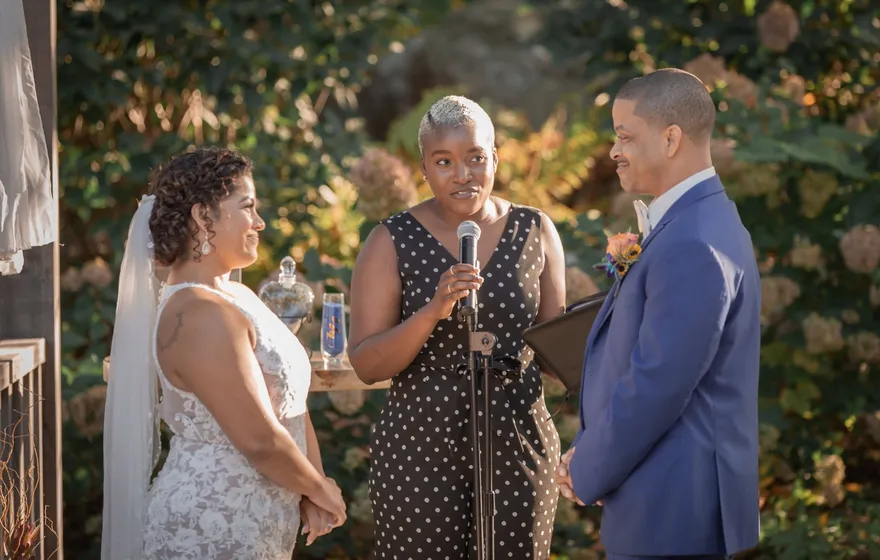
- Slow down at the declaration of intent. This is the legal heart, and nerves make people rush it. Let each “I do” breathe.
- Look up during the story. This is the section to deliver to the couple’s faces, not the page. Eye contact here is what guests remember.
- The pause before the kiss is yours to hold. Don’t rush “you may kiss.” Let the room feel it.
How to make it sound like them, not a template
A script becomes personal in three places: the welcome, the story, and the vows. Spend your effort there.
| Part of the script | Legal? | What to do with it |
|---|---|---|
| Welcome | No | Make it theirs: their names, their people |
| Opening words | No | Use as written or rewrite |
| The couple’s story | No | Make it theirs: two or three specific, true details, three or four minutes |
| A reading | No | Optional; the couple chooses it |
| The declaration of intent | Yes | Read as written |
| The vows | No | Make it theirs: their own vows, or traditional vows |
| The ring exchange | No | Use as written or rewrite |
| The pronouncement | Customary, not required by most statutes | Read as written |
Requirements vary slightly by state, so confirm the legal lines with the local clerk.
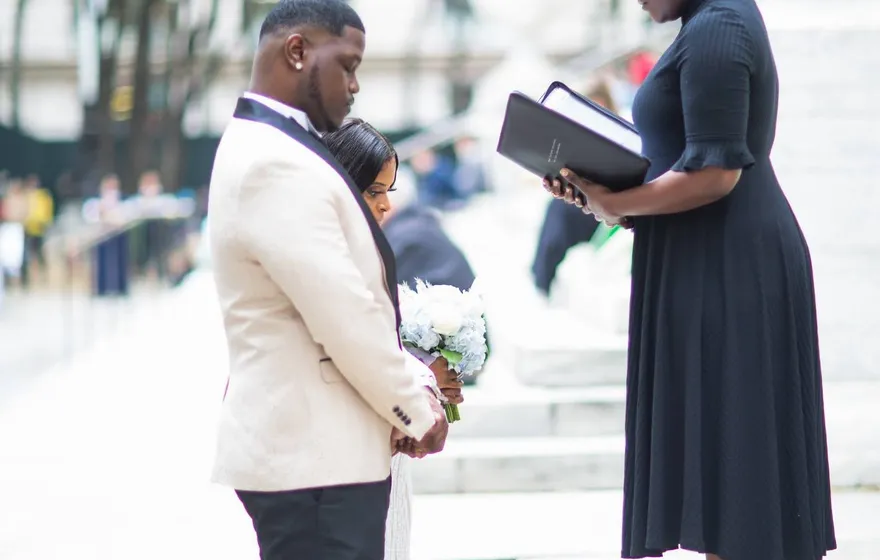
The story is the big one. Skip the generic (“they have a love for the ages”) and go specific (“she still has the receipt from their first coffee”). Specifics are the whole difference between a ceremony that could be anyone’s and one that’s unmistakably theirs.
Want one tuned to the couple?
This script is a strong, simple foundation. Some weddings need a different shape: a religious ceremony, a bilingual one, a blended-family moment that brings kids into the vows.
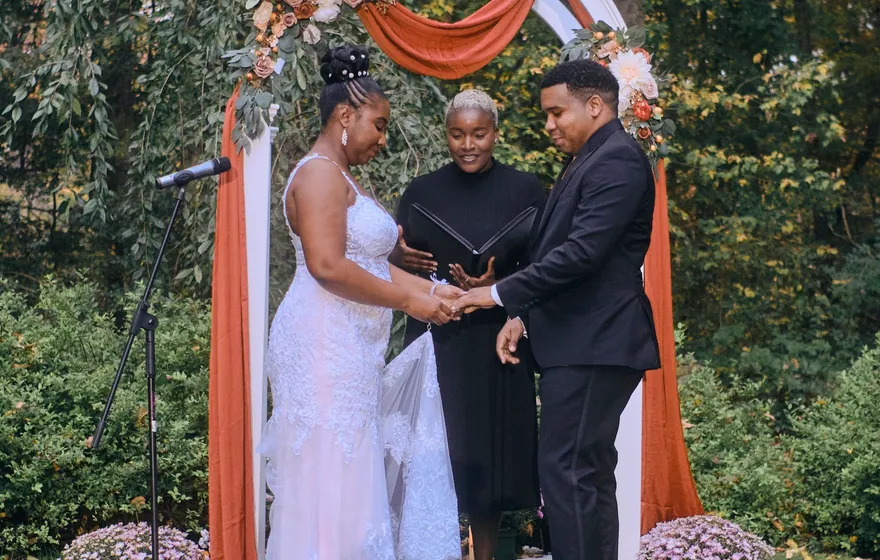
The Officiant Kit has eight full scripts across those styles, each with the same kind of margin notes and the vow prompts to personalize them. If you want more examples first, see wedding ceremony script examples and the building blocks in wedding ceremony readings and ring exchange wording.
The bottom line
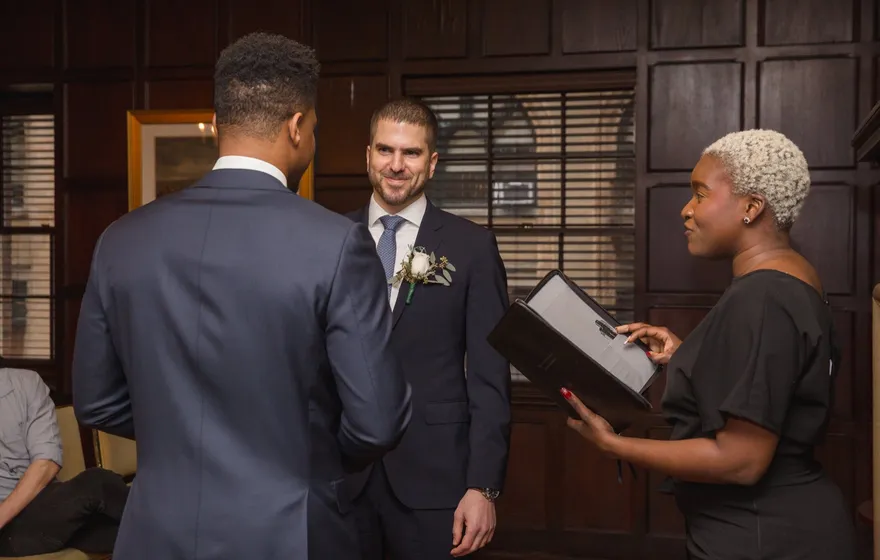
A great ceremony script gives you a reliable structure and the freedom to make the personal parts shine. Use this one as written, or treat it as scaffolding and build the couple into it. Either way, keep the legal lines intact, keep the story specific, and read it out loud before the day. For the full process, start with how to write a ceremony.
The Officiant Kit
What to say when the ring goes missing, the mic dies or you blank on a name
This post gets you through one part of the ceremony, and the Officiant Kit covers what surrounds it, from the weeks before and the rehearsal to what you do when something goes wrong in front of everyone.
- Eight full ceremony scripts, with names you type once
- The Story Builder, seven steps to the couple’s story
- The Rehearsal Run Sheet, a cue sheet and four pocket cards
- A marriage license reference for all fifty states
CEREMONY SCRIPTS
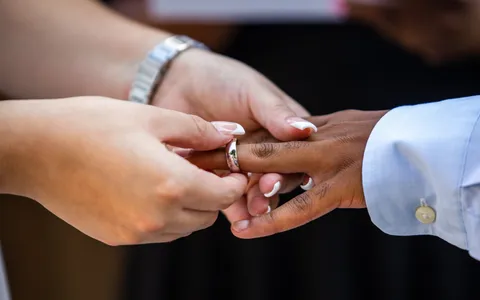
Ring Exchange Wording
A groom once handed me both rings before the ceremony with the kind of relief you give someone holding your wallet at the beach. Twenty minutes later, mid-vow, his hands were.
READ →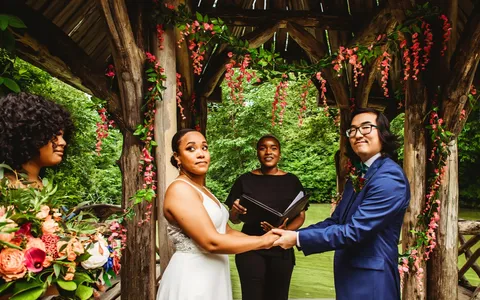
CEREMONY SCRIPTS
DIY Wedding Ceremony: A Full Template You Can Actually Use
Two summers ago I sat in the third row at a friend-officiated wedding. The couple wanted me there as a guest, not a vendor, so I left the clipboard at home. The best man stood up,.
READ →
CEREMONY SCRIPTS
Wedding Ceremony Script Examples: Templates for Every Style
A few years back, a bride's brother stood up to officiate with his script printed in a font so small he had to hold the page at arm's length. He read the whole thing head-down,.
READ →