VOWS
Vow Renewal Ceremony Script, Copy & Customize
A complete, copy-ready vow renewal ceremony script in the full order, with the exact spots to personalize and milestone swaps for 5, 10, 25, and 50 years.
The couple I renewed last fall had been married twenty-six years, and the husband cried before I’d gotten three words out. His wife squeezed his hand and whispered, “We made it,” and the whole tent went still. That’s the thing a renewal does that a wedding can’t. A wedding is a promise you make to a person you’ve decided to trust. A renewal is a receipt.
I’ve written and performed renewals for couples married five years and couples married fifty, and here’s what I want you to know going in: the script for one is not a wedding script with a few words swapped. So I’m going to hand you the whole thing, free, in the order I actually read it out loud. Then I’ll show you exactly where to make it yours and how to shift it for your anniversary year.
The short version: a renewal runs welcome, why we’re here, an optional reading, the vows, an optional ring re-blessing, and a closing blessing. No license, no officiant, no ordination. You’re already married, so anyone can lead it, including the two of you (Wikipedia).
What’s the order of a vow renewal ceremony?
Here’s the full arc, and it’s shorter than people expect:
The order of a vow renewal
-
Welcome and gathering
The officiant opens, names the day, settles the room.
-
Why we're here
A few honest sentences about what these years have held.
-
Optional reading
A friend or family member reads a poem or passage.
-
The renewal of vows
The heart of it. Spoken back and forth.
-
Optional ring re-blessing
Touching the rings you already wear and recommitting to them.
-
Pronouncement and blessing
The close.
Aim for the whole thing to run about 20 to 25 minutes, processional and recessional included. I’ve watched couples try to stretch it past forty-five minutes because they thought longer meant more meaningful. It doesn’t. Past a certain point guests stop feeling and start checking their watches.
The one mistake that flattens a renewal
If you take nothing else from me, take this. The regret I hear most from other officiants is treating a renewal like a wedding redo (American Marriage Ministries). Couples pull up their old wedding vows and read them again, and the words describe a future they’ve already lived past.
The reason is that the emotional center has flipped. At a wedding, you promise things you hope you’ll do. At a renewal, you can point to things you actually did. You stayed when the baby wasn’t sleeping. You moved cities for her job. You sat in that hospital waiting room together. The script should look backward and name real things, not recycle the forward-facing language of a day you’ve already lived past.
So as you read the script below, watch the tense. Where a wedding says “I will,” a renewal says “I have,” or “I still.” That single shift is most of the work.
Where a wedding says “I will,” a renewal says “I have,” or “I still.”
The way to find those “I have” lines is to start from your own history, not from a template.
The complete vow renewal ceremony script
This is a full, copy-ready script. You can read it word for word, or you can keep the bones and drop in your own vows where I’ve marked them. I’ll flag the spots to customize right after.
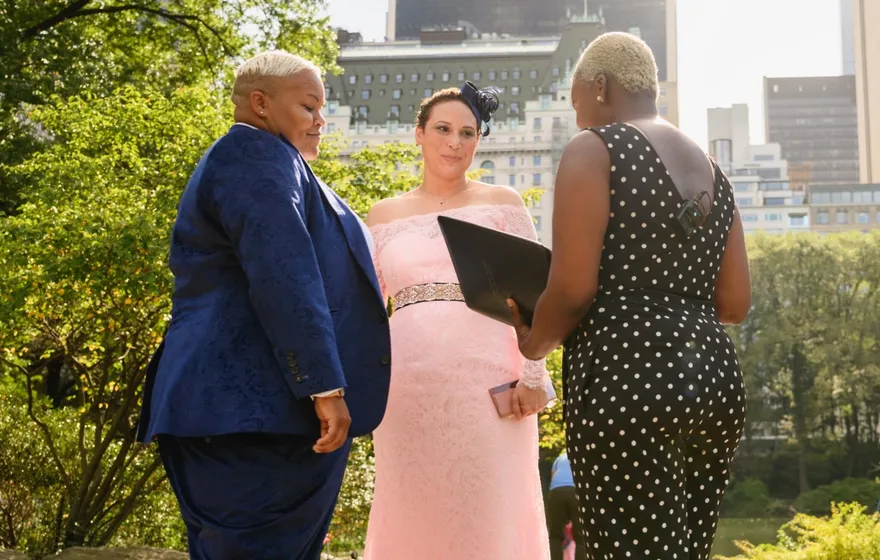
Read it through once out loud before you change anything, so you hear where the pauses fall.
Welcome:
(Officiant faces the couple and the gathered guests.)
“Friends and family, thank you for being here. We haven’t gathered today to start something. We’ve gathered to honor something that already runs deep. [NAME] and [NAME] were married [NUMBER] years ago, and in that time they’ve built a life that most of you have watched up close. Today they want to say, out loud and in front of the people they love, that they’d choose it all again.”
Why we’re here:
“A first wedding is a leap of faith. You promise a whole future to a person you’ve only begun to know. What [NAME] and [NAME] are doing today is different, and in some ways braver. They know exactly what they’re signing up for, because they’ve already lived it. They’ve seen each other tired, scared, stubborn, and at their absolute best. And here they still are.”
(Officiant pauses, looks at the couple.)
“So before we hear them speak, let’s just take a breath and notice what [NUMBER] years actually looks like. It looks like the two of you, standing right there.”
Optional reading:
(Officiant gestures to the reader, who steps forward.)
“[READER NAME] is going to share a few words that [NAME] and [NAME] chose.”
(Reader reads the selected passage, then returns to their seat.)
The renewal of vows:
“[NAME] and [NAME], the first time you made promises to each other, they were predictions. Today they’re proof. [NAME], please speak yours first.”
(Partner A faces Partner B.)
“[NAME], I married you believing we could build a good life. Now I know it, because we did. I’ve kept loving you through [SPECIFIC HARD THING YOU CAME THROUGH], and I’d do it again without thinking twice. I promise to keep choosing you, on the easy days and the ones that aren’t. You are still my favorite decision.”
(Partner B faces Partner A.)
“[NAME], [NUMBER] years ago I didn’t know how much I didn’t know. You’ve shown me. Thank you for [SPECIFIC THING THEY DID OR ARE]. I’m not renewing a promise today so much as confirming one I never broke. I choose you again, and I’ll keep choosing you for as long as I get to.”
Optional ring re-blessing:
(Officiant addresses both.)
“You’ve each worn a ring for [NUMBER] years. It’s seen everything your marriage has seen. We’re not replacing it today. We’re blessing it again.”
(Each partner takes the other’s ring hand and touches the ring.)
“Repeat after me. From this day on, I recommit myself to you, and this ring is a symbol of my pledge.”
(Each partner says the line in turn.)
Pronouncement and blessing:
“[NAME] and [NAME], you’ve stood here and chosen each other one more time, in front of all of us. It’s our honor to witness it. May the years ahead be as full as the ones behind you, and may you always remember this exact feeling. Go on and kiss.”
(The couple kisses. Applause.)
The ring re-blessing line is a clean one to borrow as-is:
“From this day on, I recommit myself to you, and this ring is a symbol of my pledge.”
Repeat after me, in 4 pieces
- From this day on,
- I recommit myself to you,
- and this ring
- is a symbol of my pledge.
I’ve used a version of it for years, and I lifted the recommitment wording from a sample renewal script that does it well.
Where to customize the script
The script above works as written. But the spots in brackets are where it stops being a template and starts being yours. Three of them carry almost all the emotional weight:
The [SPECIFIC HARD THING] line. This is the line that makes the vows yours. Do not write “through thick and thin.” Write the actual thick and the actual thin. The move, the layoff, the loss, the long stretch you almost didn’t survive.
The reading. Renewals lean warm rather than scriptural, though either works. Couples often reach for 1 Corinthians 13, George Eliot’s “What greater thing is there for two human souls,” Shakespeare’s Sonnet 116, or “The Art of Marriage”. If you want a fuller menu, my list of non-religious ceremony readings and the broader wedding ceremony readings collection both work for renewals.
The vows themselves. I gave you full vows you can read straight off the page. Use them if writing your own feels like too much. But I’ll be honest with you about a regret I see: couples default to the officiant’s standard words because they’re scared of sounding sappy, and one planner wrote about a couple still bringing it up eight years later (Provenance). If you have the time, write your own. My guide to writing vow renewal vows walks you through it line by line.
How to swap the script for your anniversary year
Every milestone has a traditional material, and that material is a free hook you can thread into the welcome or the vows. The classic ones run 1st paper, 5th wood, 10th tin, 25th silver, 40th ruby, 50th gold, with silver and gold symbolism documented in Germanic countries since the 1500s (Wikipedia).
| Anniversary | Material |
|---|---|
| 1st | Paper |
| 5th | Wood |
| 10th | Tin |
| 25th | Silver |
| 40th | Ruby |
| 50th | Gold |
Here’s how I shift the tone by year:
5 years. Lighter, funnier, still close to the wedding. The 5th has become a real renewal milestone lately, largely because couples who got a clunky 2020 ceremony are finally throwing the celebration they never had. Five years is no longer too soon. Lean into “we’re just getting started.”
10 years. Old enough to have a real story, young enough to be playful. Name what surprised you. The tin year is about durability, so build the vows around what’s held.
25 years. Silver. This is where it gets emotional. Often there are grown kids in the room, sometimes grandkids. Slow the pacing down and let the welcome breathe.
50 years. Gold. Keep it short and let the years do the talking. At fifty, you barely need a script. The room already knows. Thread a single line of gold imagery into the close and stop there.
Folding in your kids
A renewal can include your children in a way a first wedding never could, because you’re celebrating the family you actually built (American Marriage Ministries). Kids can:
- add their own color to a sand ceremony
- place the cord during a handfasting
- get named directly in your vows
When children take part, the whole meaning of the day shifts from “the two of us” to “look what the two of us made.” If that’s the direction you want, my family involvement ceremony ideas show you how to write children into the script without it feeling staged.
One trap for Catholic couples
If you were married in the Catholic Church, a renewal is just a celebration of a marriage the Church already recognizes. There’s a common mix-up worth flagging, though: a renewal is not a convalidation. A convalidation validates a marriage that happened outside Catholic oversight, like an interfaith ceremony, a secular officiant, or an elopement, and it sometimes has to happen before a renewal can. Couples conflate the two and book the wrong thing. If your original wedding wasn’t in the Church, ask your priest which one you actually need.
A note on doing this yourselves
I want to be clear about the freedom you have here, because most couples don’t realize how much they’ve got. A renewal carries zero legal weight. No license, nothing to sign, nothing filed (Wikipedia). That means you don’t have to hire anyone. Your best friend can read this script. Your twenty-year-old can read this script. The two of you, alone on a beach, can read this script.
If you want help shaping the whole thing, the same backward-looking instincts that make a renewal work also drive a strong first-wedding ceremony. My wedding ceremony script walks the full structure, and my piece on how to write a ceremony covers the craft of it from scratch. For a renewal specifically after a rough chapter, I wrote a separate version: renewing vows after hard times handles the tone you need when the marriage nearly didn’t make it.
And if you want the full set of milestone variations, ritual ideas, and ways to make the day yours, my hub of vow renewal ideas gathers all of it in one place.
Want this without the homework?
If reading a free script and customizing the bracketed parts feels like more than you want to take on right now, that’s exactly who I built the Couple’s Ceremony Kit for. It’s the renewal script above plus the ritual modules, the milestone swaps, and a set of prompts that pull your own words out of you so you’re not staring at a blank page the night before. It’s $79, it’s yours to keep, and it’s the same scaffolding I use with the couples I work with.
If you’d rather get your words flowing first, grab my free vow renewal questions. It’s the short set of prompts I use to draw out the specific, real moments a renewal is built on.
Common questions about vow renewal scripts
Do you need an officiant for a vow renewal?
No. It isn’t legally binding, so you don’t need credentials of any kind. A friend, your adult child, or the two of you can lead it. The script above gives whoever’s leading every word they need.
Do you need a marriage license?
No. You’re already married, so there’s nothing to sign or file. That’s the whole reason you have total freedom over how it runs.
How long should it be?
Around 20 to 25 minutes including the walk in and out. Each person’s spoken vows should run 1 to 3 minutes.
How is a renewal different from a wedding?
A wedding promises a future; a renewal honors a past. Keep the language backward-looking and specific, and don’t recycle your old wedding vows word for word.
Do you exchange new rings?
Usually not. The move is re-blessing the rings you already wear. Borrow the line: “From this day on, I recommit myself to you, and this ring is a symbol of my pledge.”
Is a Catholic renewal the same as a convalidation?
No. A renewal celebrates a marriage the Church already recognizes; a convalidation validates one performed outside Catholic oversight, and it may be required first.
The Couple’s Ceremony Kit
Walk in with a ceremony that sounds like the two of you
This post covers one part of the ceremony, and the Couple’s Ceremony Kit covers the rest, with five full scripts to start from and the prompts I use to help couples write their vows.
- Five full ceremony scripts in five different styles
- The Story Mine, thirty prompts for writing your vows
- Sixteen unity rituals, with the words and what to gather
- Thirty readings, each with my notes on when it fits
VOWS
Best Anniversaries to Renew Vows | Don't Wait
A couple I worked with spent years saying "we'll do it at 25." Then her mother got sick, and waiting four more years for a tidy number suddenly felt absurd. They renewed at year.
READ →
VOWS
Vow Renewal Officiant, How to Ask + What to Send
A couple who'd been married twenty-two years got on a call with me and asked, almost sheepishly, who they were supposed to "get" to make the renewal official. I told them the.
READ →
VOWS
Vow Renewal vs Wedding: The Real Differences
A couple sat across from me last spring, planning what they kept calling their vow renewal. Twenty minutes in, the wife asked me, almost shyly, whether they'd "sign something" at.
READ →