VOWS
Renew Your Vows After Hard Times: Scripts + Guide
Renewing vows after hard times: what to say, what to avoid, and a full copy-ready script that honors the repair without reopening the wound.
A few years ago I stood with a couple in their backyard, twelve folding chairs, the two of them married nineteen years. She had finished chemo eight weeks before. He had spent most of that year sleeping in a hospital recliner. When I asked at our planning call what they wanted me to say about all of it, she went quiet, then said, “Please don’t make today about the cancer. But don’t pretend it didn’t happen either.”
That is the exact tightrope, and I have walked it in rooms after affairs, after the death of a child, after years of two people barely speaking, after one of them got sober. The instinct is to spill everything, or to scrub it clean. Both are wrong.
Here is what officiating these has taught me. The hard chapter does belong in the ceremony, but almost never in the couple’s own spoken vows. It belongs in my part, said once, in the third person, near the top. That one structural choice is the whole difference between a renewal that heals and one that reopens the wound in front of forty guests.
The short answer: name the hard chapter once, early, and let the officiant carry it for you. No details. Then your own vows spend their words entirely on the future you’re choosing. That protects both of you. The one who was hurt is not made to forgive out loud, and the one who caused the hurt is not made to apologize in public.
Why name the hard part at all?
Because the room already knows. The aunt who took your calls at 2 a.m. knows. The friend who drove you to the rehab parking lot and waited knows. If everyone pretends the last few years were sunshine, the ceremony floats above the actual reason you’re standing there, and people feel that hollowness even when they can’t name it.
There is good research behind this. Communication professor Dawn Braithwaite studied couples who renewed and found they weren’t claiming a flawless marriage at all (Psychology Today). The renewal worked as a public signal, especially to the younger relatives watching, that real marriages take work and aren’t flawless. That turns your hard chapter from something to hide into the literal reason the day means anything.
So you name it. You just name it like an adult who has made peace with it, not like someone confessing.
Where the acknowledgment goes (and how long it gets)
Near the top of the ceremony, inside my welcome, in the third person, and it runs about two sentences. Then we move forward and do not go back to it.
The guidance most officiants follow is to nod to the hard seasons while keeping the focus on why the couple is choosing to stay and what it means going forward, rather than reciting the problems. That is right. A recap is a trap. The minute you start explaining what happened, you’ve handed the day to the wound.
What to say: the framing that protects both of you
I draft the acknowledgment for my couples so neither of them has to write it through tears. Here is the actual language I use, adjusted for what they came through. Notice it is always “they,” always shared, never a recap.
Two lines for finding your way back
After almost divorcing or years of distance
“These two will tell you their marriage hasn’t always been easy. There were seasons they grew apart and had to find their way back. That they’re standing here, choosing each other again on purpose, is the whole point of today.”
Best fit Couples who grew apart and worked their way back to each other.
After infidelity
“Trust, once broken, doesn’t repair itself by accident. It gets rebuilt, deliberately, by two people who decided the marriage was worth the work. That work is what we’re honoring today.”
Best fit Couples rebuilding trust. No mention of who did what, ever.
The next three are for illness, recovery and loss. In these I lean harder on what the two of them did together, holding each other up and showing up one day at a time.
Three lines for illness, recovery and loss
After illness
“This past year asked more of them than any year should. They learned what it means to hold each other up. Today isn’t a finish line. It’s a thank-you, said out loud, in front of the people who love them.”
Best fit A year of illness that asked a lot of both of you.
After addiction and recovery
“Recovery is a daily thing, and so is a marriage. These two have chosen, one day at a time, to keep showing up for each other. We’re here to stand behind that choice.”
Best fit Couples where one partner is in recovery and both are rebuilding.
After losing a child
“They have carried a grief most of us can’t imagine, and they carried it together. Today they’re choosing to keep building a life that has room for both their sorrow and their love.”
Best fit Grieving parents who want room for sorrow and love in the same ceremony.
On that last one, I want to put something to rest, because grieving couples carry it like a sentence. The idea that losing a child dooms a marriage is a myth. That inflated 70 to 90 percent figure traces back to a 1977 book that cited no source at all. The actual survey from The Compassionate Friends found a 16 percent divorce rate among bereaved parents, lower than the general rate, with only about 4 percent saying the loss contributed to a split (Grieving Parents Support Network). If that’s your chapter, you are not defying the odds. You’re living the real ones.
What to avoid
This is the part couples get wrong on their own, so I’m direct about it.
Avoid the specifics of the wound. Nobody at the ceremony needs the timeline of the affair or the name of the substance. Specifics turn guests into a jury.
An apology is owed privately, to one person, never performed for an audience who didn’t sign up to absolve anyone.
Avoid the public apology. I have had a partner ask to stand up and say sorry in front of everyone. I steer them away from it every time, gently. An apology is owed privately, to one person, never performed for an audience who didn’t sign up to absolve anyone.
Avoid forcing forgiveness out loud. If the hurt partner has to declare “I forgive you” into a microphone, you’ve made them act out a feeling that may still be in progress. Forgiveness lives in the fact that they’re standing there. It does not need narration.
Avoid promises about time you can’t keep. This matters most with illness, and I’ll come to it.
The one rule that flips for illness
Standard renewals lean future-tense. Forever, the years ahead, growing old together. When one of you is facing serious or terminal illness, that tense turns cruel, because you’re being asked to promise a span of time no one can guarantee.
So you change tense. You stay in the present. The strongest illness renewals I’ve seen center present strength over future promises, with language like “your love has been at the core of your marriage” and rituals such as a hand blessing for the hands that “hold you when fear or grief temporarily comes your way”. That blessing acknowledges the fear honestly without forcing a vow about time. The meaning sits in standing here, now, together, and that is enough.
How a crisis renewal differs from an anniversary one
A milestone renewal celebrates that you made it twenty-five years. A crisis renewal marks a turning point. Different job entirely.
| Anniversary renewal | Renewal after hard times | |
|---|---|---|
| What it marks | That you made it twenty-five years | A turning point |
| The officiant’s welcome | Celebrates the years together | Names the hard chapter once, in the third person, with no details |
| The vows | Future tense: forever, the years ahead | Forward-facing, and in the present tense when illness is part of it |
The most useful frame I’ve found comes from therapist Esther Perel, who tells couples after a betrayal that their first marriage is, in a sense, over, and asks whether they’d like to build a second one together (NPR). A vow renewal is that second marriage made visible. It gives you permission to treat the day as a beginning, not a patch on something that broke.
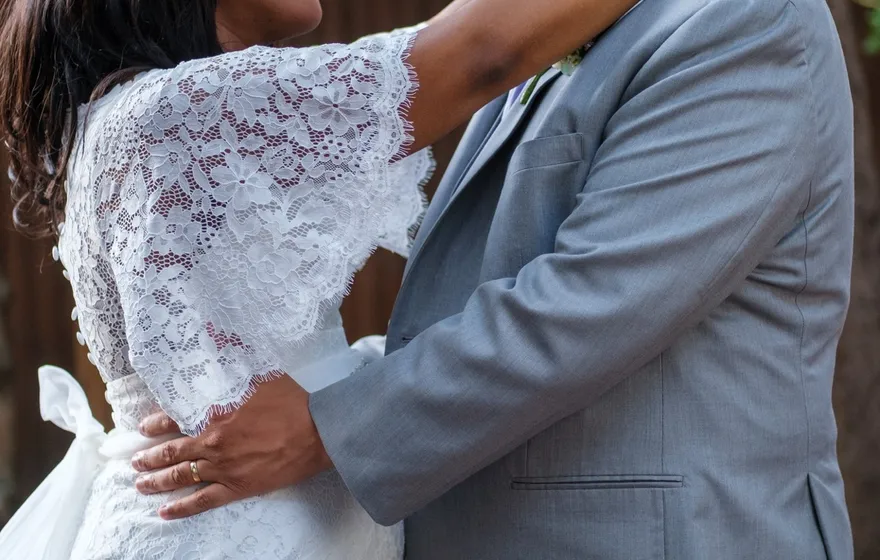
There’s a quiet thing one couple did that I love. After a separation, they had new rings made and engraved both the wedding date and the renewal date inside the bands, where only they’d ever see them (Psychology Today). The wife said she wanted “a ritual about coming back.” The repair got memorialized privately, inside the metal, instead of announced from the front. That is the whole philosophy of this post in one object.
If you’re recovering from addiction, one more honest note. These renewals often fall in a fragile window of best behavior right after sobriety, and the wiser framing is gratitude and recommitment to the rebuilding, not proof the work is finished (Michael’s House). Both of you are still healing. The day can hold that.
A full script you can use
Here is a complete, copy-ready ceremony for a renewal after a hard chapter. I’ve written it so the officiant carries the acknowledgment and the couple’s words stay forward-facing. Hand it to your officiant, swap the bracketed bits, and it works as written.
Welcome:
“Friends and family, thank you for being here. [Name] and [Name] have been married [number] years, and they will be the first to tell you those years were not all easy. There were seasons that tested everything they had. That they’re standing here today, choosing each other again on purpose, is the entire reason we’ve gathered. We’re not here to celebrate a flawless marriage. We’re here to honor a real one.”
(Pause. Let it sit. Then move forward and do not return to it.)
Reflection:
“A marriage isn’t one promise made once. It’s the same promise, remade on the ordinary days and the impossible ones. [Name] and [Name] have done that remaking quietly, away from all of us, and today they’re doing it out loud.”
The renewed vows, Partner A:
(Partner A speaks directly to Partner B.)
“I’m not here to talk about where we’ve been. I’m here because of where we’re going. I choose you, today and forward, with my eyes open. I’ll keep showing up, on the good days and the hard ones, for as long as I have. Thank you for not giving up on us.”
The renewed vows, Partner B:
“I know exactly who you are, and I’m still choosing you. Everything ahead of us, I want to meet it with you next to me. I’ll keep building this with you, one day at a time. You are still my favorite decision.”
Ring blessing (optional, for new or re-engraved rings):
(Officiant holds the rings.)
“These rings have carried you this far. Wear them now as a sign of what you’ve chosen, not once, but again. May they remind you, every ordinary day, that you came back to each other on purpose.”
Pronouncement:
“By the strength of the promise you’ve remade in front of all of us, I’m honored to recognize you, again and forward, as partners for life. You may kiss.”
Read it out loud together a week before, and cut any line the two of you wouldn’t say today.
If you want to shape your own promises before you sit down to write, my guide to writing vow renewal vows that say something real walks through it line by line, and the full vow renewal ceremony script with every section laid out gives you the surrounding structure to drop these words into.
Making it yours without making it heavy
The acknowledgment is the hard part. The rest of the day should breathe. Pick one ritual that quietly nods to the repair, then let the rest be celebration. Any one of these does it:
- A re-engraved ring
- A hand blessing
- A single reading, chosen by the partner who usually stays quiet
For more ways to build a renewal that fits exactly where you’ve been, my collection of vow renewal ideas, from intimate to full ceremony is the place I’d start, and if you’re marking decades rather than a crisis, the anniversary vow renewal guide covers that tone instead.
ALSO READ How to Write Vow Renewal Vows + ExamplesA note on doing this yourself
If you’re using my Couple’s Ceremony Kit to plan this without an officiant, the section on framing is the one to read twice. The kit gives you the welcome scripts, the acknowledgment language by situation, and the prompts to write vows that point forward instead of backward. It’s $79, and it exists because too many couples were standing in their own backyards trying to draft the hardest sentence of their lives through tears.
Before you write a word, it helps to answer a few honest questions about what you actually came through and what you want the day to do. I put the ones I ask every couple into a short set of vow renewal questions you can work through together at the kitchen table. Start there. The words come easier after.
Frequently asked questions
Should we mention the affair (or illness, or addiction) at our vow renewal?
Name the chapter, but let the officiant do it once, near the top, in the third person, with no details. Something like: “These two have come through a season that tested everything, and they chose each other on the other side of it.” That honors the repair without turning the ceremony into a confession or a public apology. Your own spoken vows then stay entirely on the future.
How do we acknowledge hard times without making the whole day sad?
Treat the hardship as shared weather, not one person’s fault, and spend a sentence or two on it before you pivot to the future. Use “we” language (“we navigated it together”), never a recap of who did what. The grief or the breach is the reason the day means something, but it is not the subject of the day.
Is it strange to renew vows after we almost divorced?
No. Communication research on renewals found couples weren’t claiming a flawless marriage at all. They were publicly signaling that real marriages take work, which is exactly the message a renewal after a crisis carries. One couple who had separated quietly had both their wedding date and renewal date engraved inside new rings, a private way to mark the coming-back.
What should we avoid saying in a vow renewal after a hard chapter?
Avoid the specifics of the wound, avoid anything that reads as a public apology or a forced act of forgiveness, and avoid promises about time you can’t actually keep, especially with illness. Don’t make the hurt partner perform forgiveness out loud. Keep the acknowledgment brief, shared, and pointed forward.
How is renewing vows after a crisis different from a regular anniversary renewal?
A crisis renewal has a specific job: to mark a turning point, not just celebrate longevity. Esther Perel’s framing helps here. Your first marriage is, in a sense, over, and this is the second one made visible. With illness, the ceremony also shifts from future-tense promises to present-tense gratitude, because the meaning is in standing here now, together.
The Couple’s Ceremony Kit
Walk in with a ceremony that sounds like the two of you
This post covers one part of the ceremony, and the Couple’s Ceremony Kit covers the rest, with five full scripts to start from and the prompts I use to help couples write their vows.
- Five full ceremony scripts in five different styles
- The Story Mine, thirty prompts for writing your vows
- Sixteen unity rituals, with the words and what to gather
- Thirty readings, each with my notes on when it fits
VOWS
Best Anniversaries to Renew Vows | Don't Wait
A couple I worked with spent years saying "we'll do it at 25." Then her mother got sick, and waiting four more years for a tidy number suddenly felt absurd. They renewed at year.
READ →
VOWS
Vow Renewal Officiant, How to Ask + What to Send
A couple who'd been married twenty-two years got on a call with me and asked, almost sheepishly, who they were supposed to "get" to make the renewal official. I told them the.
READ →
VOWS
Vow Renewal vs Wedding: The Real Differences
A couple sat across from me last spring, planning what they kept calling their vow renewal. Twenty minutes in, the wife asked me, almost shyly, whether they'd "sign something" at.
READ →