VOWS
Vow Renewal vs Wedding: The Real Differences
Vow renewal vs wedding, explained by an NYC officiant: what's legal, who walks, gifts, what to call yourselves, and how to know which one you're planning.
A couple sat across from me last spring, planning what they kept calling their vow renewal. Twenty minutes in, the wife asked me, almost shyly, whether they’d “sign something” at the ceremony. They had eloped years earlier, never filed the paperwork, and had quietly assumed everything was in order. It wasn’t: there was no record of their marriage anywhere. What they needed wasn’t a renewal at all. It was the legal step they’d skipped, and nobody had ever told them the difference.
I see this more than you’d guess. I officiate both, real legal weddings and symbolic vow renewals, and the line between them trips up smart, committed, already-in-love people all the time. So let me draw it clearly for you.
The only difference that’s genuinely fixed is the legal one. A wedding makes you married in the eyes of the state. A vow renewal does not, cannot, and was never meant to. Everything else (gifts, the wedding party, who walks, what you wear, what you call yourselves) flows from that one fact, and almost all of it is yours to bend once you know which ceremony you’re actually planning.
What’s the legal difference between a vow renewal and a wedding?
A wedding is a legal event in a beautiful dress. In New York, to be married you need a marriage license from a city or town clerk, a ceremony performed by someone the state authorizes, and signatures that get filed afterward (NYC Office of the City Clerk). There’s a built-in 24-hour waiting period after the license is issued, which only a judge can waive, and the license expires if you don’t use it within 60 days (USMarriageLaws.com).
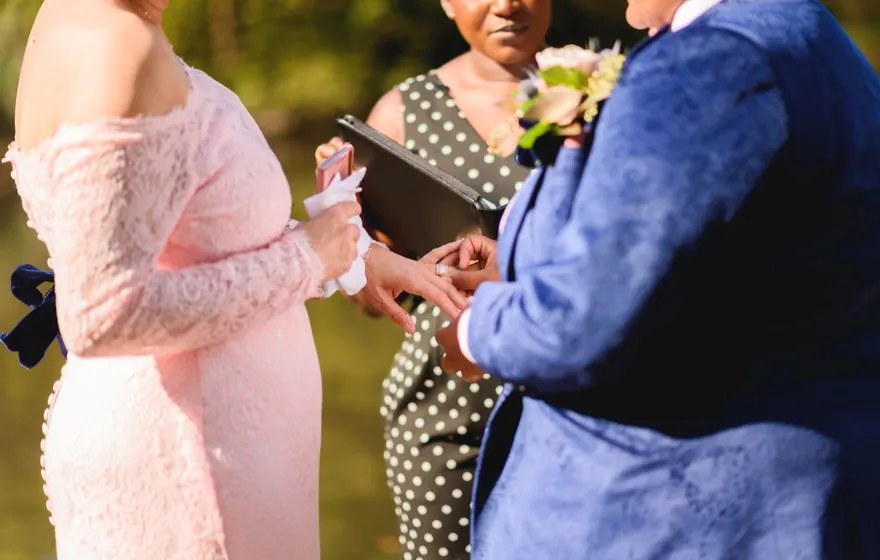
A renewal has none of that. No license, no waiting period, no required witnesses, no filing, no government anywhere near it. You’re already married, so the renewal touches nothing on paper. I say it the same way to every couple who books one: a renewal won’t change your legal status by a single comma.
A renewal won’t change your legal status by a single comma.
That gap, license plus a 24-hour wait on one side and nothing at all on the other, is the cleanest way I’ve found to show couples exactly where the line sits. Here it is side by side for New York:
| Step | Wedding | Renewal |
|---|---|---|
| License | Required | None |
| Waiting period | 24 hours | None |
| Witnesses | At least 1 | None |
| Officiant | Authorized | Anyone |
| Filing | Within 5 days | Nothing to file |
The wedding column comes from New York’s own rules: at least one witness besides the officiant, and the officiant returns the signed license to the clerk within five days (N.Y. Domestic Relations Law 12, section 14).
Can a vow renewal make you married if you never legally were?
No. This is the case most articles skip, and it’s the one I care about most, because I’ve watched couples walk right into it.
If you were never legally married, a renewal will not retroactively marry you. It doesn’t matter that there’s an officiant standing there. It doesn’t matter how heartfelt the vows are. To actually be married in New York you need a license and a ceremony performed by an authorized person (NYC Office of the City Clerk). A symbolic ceremony on its own creates nothing legally.
Couples who skipped the courthouse, eloped abroad without filing, or had a friend run a “spiritual ceremony” sometimes assume a renewal “fixes” it. It doesn’t. Here’s the tell I listen for: the moment someone asks whether the ceremony “counts,” or whether they’ll “sign something,” they almost always want legal weight. And wanting legal weight means you want a wedding.
Do you have to say “I do” at a vow renewal?
You don’t. There’s no legally required “I do” at a renewal because no contract is being formed. At a wedding, that consent is the legal hinge: New York law asks the couple to declare, in front of the officiant and a witness, that they take each other as spouses (N.Y. Domestic Relations Law 12), and the pronouncement that follows is the customary close. At a renewal it’s optional, and most couples skip it entirely.
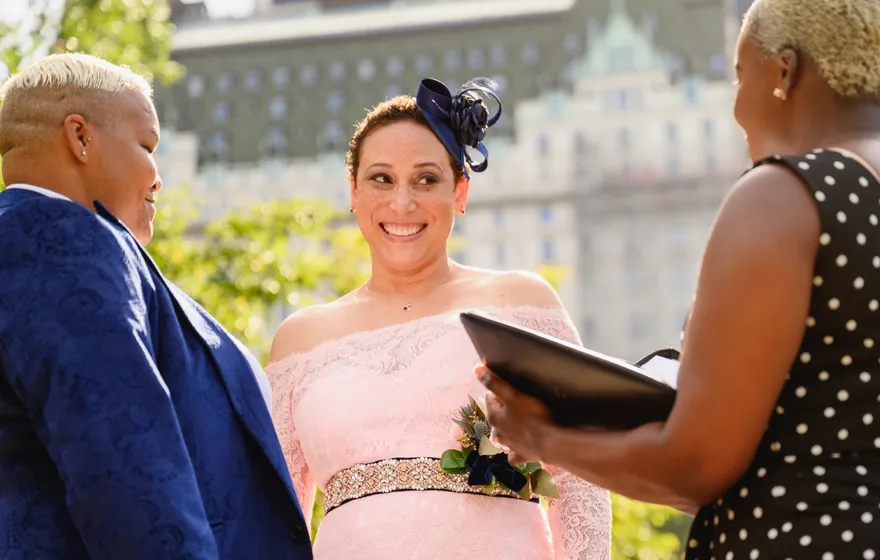
What I see instead, and honestly what I prefer, is longer, more personal vows. The first time around, couples are nervous. Hands shake, voices wobble, half of what they meant to say evaporates on the spot. At a renewal the vows come from somewhere steadier, grounded in years already lived. People tell me a renewal feels more emotional than the original wedding, and I’d agree. The promises mean more because you’ve already kept them through real things (Falkirk Estate).
If you want help shaping those, my full guide to writing vow renewal vows walks through it line by line, and if your years together included a genuinely hard stretch, renewing after hard times covers how to honor that without turning the ceremony into a confessional.
Are you supposed to bring gifts to a vow renewal?
Here the etiquette actually flips. On a wedding invitation, “no gifts please” is considered improper. On a renewal invitation, it’s perfectly fine, because a renewal usually isn’t seen as a gift-giving occasion at all.
Guests aren’t expected to bring anything. Some will anyway, out of love, and that’s a lovely thing. You’re not registering, though, and you’re not putting anyone on the hook. If you want to head the question off, drop a gentle line right on the invitation. How you frame the whole day carries more weight than people expect, and I get into the planning side of it in vow renewal ideas.
Can you have a wedding party and a processional at a renewal?
You can, and the rules here are wonderfully soft. Attendants don’t hold an official role at a renewal, so the etiquette guidance is to invite your former bridesmaids and groomsmen as guests rather than hand them duties again. Plenty of couples ask a few people to stand with them anyway, purely for the sentiment, and that’s completely fine too.
The processional is where the questions pile up, usually some version of “who walks the bride down the aisle?” At a wedding, a father escorting his daughter symbolizes a handoff, a beginning. At a renewal you’re already married, so that handoff doesn’t quite fit, and a father walking the bride tends to feel out of step with the occasion.
What works beautifully instead:
- Walk in together. You arrived at this life as a married couple, so come down the aisle as one.
- Enter from opposite sides and meet in the middle, a quiet picture of two lives that joined a long time ago.
- Have your children or grandchildren escort you. If you’ve built a family in the years since, let them carry you into the room.
That last one is my favorite. I once had a daughter walk both her parents in. The whole front row was reaching for tissues before a single word had been said.
What do you call yourselves at a vow renewal?
Probably not “bride and groom.” You’re already spouses, so that phrasing implies a beginning that already happened. In the renewals I write, the language leans toward husband, wife, spouse, or partner, framed around continuing and recommitting rather than starting over.
It’s a small thing that sets the whole tone. “Do you take this woman” is a question for two strangers about to merge their lives. A renewal asks something richer: do you choose this again, now that you know exactly what you’re choosing? Here’s a short, copy-ready script that holds that distinction.
Officiant:
“We are not here today to begin a marriage. We’re here because one began years ago, and it held.
It held through ordinary mornings and a few hard winters. It held when it would have been easier to let go. And so we gather not to ask whether these two will love each other, but to witness that they already have, and that they intend to keep doing it on purpose.”
(Officiant turns to the couple.)
Officiant:
“[Name] and [Name], you’ve already kept the promise. Today you get to make it again, out loud, with everyone you love watching.”
The Renewal Vows:
(Partner A speaks first.)
“I married you before I knew what I was promising. I know now. I’ve seen you tired, scared, stubborn, and wrong, and I choose you in every one of those. I’d marry you again today, and tomorrow, and after that.”
(Partner B responds.)
“You’re still the easiest yes I’ve ever said. Everything we’ve built, I’d build again from nothing, as long as it was with you. I’m still here. I’m staying here.”
Officiant:
“You came into this room already married. You’ll leave it married still, and chosen again. May the years ahead be as kind to you as you’ve been faithful to each other.”
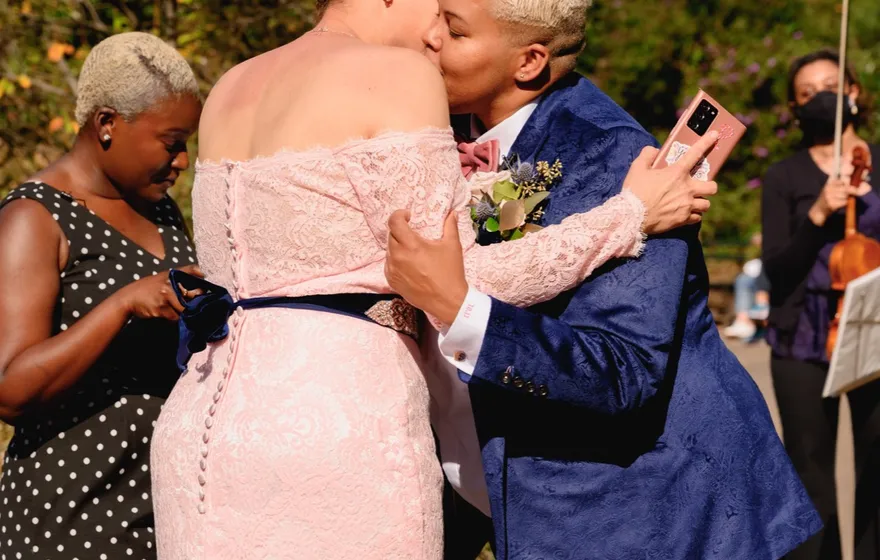
(The couple may share a kiss, a long embrace, or simply hold hands and breathe. There’s no document to sign, and nothing left to make official. It already is.)
How do you decide which one you’re actually planning?
Strip away the dress and the flowers and ask yourself one thing: do you need this to count legally?
If you’re already legally married and you want to celebrate, recommit, or mark an anniversary, that’s a renewal. No paperwork, total flexibility, and you get to throw out any tradition that doesn’t serve you. The timing is loose too, often three to six months of planning, sometimes thrown together in a week because there’s no waiting period to honor (Falkirk Estate).
If you were never legally married, or if you want this specific ceremony to be the one that makes you married, that’s a wedding. It needs a license, an authorized officiant, and signatures. There’s no shortcut, and a renewal can’t stand in for it.
And if you catch yourself hoping the renewal will somehow “count,” listen to that. It’s usually your own answer telling you that what you want is a wedding.
What about cost and scale?
A renewal carries no expectation of wedding-scale spending. The reported ranges run roughly $200 to $3,500 for a small, intimate renewal, and $5,000 to $12,000 or more for a full reception-style event (Revivalist). Treat those as a ballpark, not gospel, because a renewal can be a backyard with ten people and a bottle of good wine, or a black-tie party for two hundred. Both are valid.
The freedom is the whole point. Nobody is waiting for you to “do it right.” There’s no rulebook you’re breaking. You already did the official version. This one is purely for the meaning.
A note on who runs the ceremony
Because there’s no legal process, you don’t need a legally authorized officiant for a renewal. Strictly speaking, you don’t need an officiant at all. Anyone can preside: a close friend, your original best man, your now-grown kid (American Marriage Ministries). That’s the exact opposite of a wedding, where the person who marries you has to be authorized by the state.
Here’s where I’ll be honest about my own role, because the rule matters. When I officiate a wedding, I handle the legal mechanics: license signed and returned inside the state’s window, done right. When I officiate a renewal, I write it knowing it has no legal weight, and I won’t pretend otherwise. If a couple needs it to be legal, I send them to the license first. That candor is the whole job.
If you’re planning a renewal and you want it to feel like a real ceremony instead of a toast that ran long, you don’t have to hire anyone. You need a structure, language that sounds like you, and a few things said in the right order. That’s exactly what I built the Couple’s Ceremony Kit for: the templates, the vow prompts, and the running order, so a friend (or you) can lead a renewal that feels intentional instead of improvised. It’s $79, and it’s the difference between “we said some nice things” and a ceremony with a real opening, middle, and close.
Before you draft a single word, sit down with my free vow renewal questions. They’re the prompts I use in real planning sessions to pull the specific, unrepeatable details out of a couple, the stuff that makes a renewal sound like yours and nobody else’s.
For more on building the day around the ceremony, vow renewal ideas is the hub I’d start from, and if you’re timing yours to a milestone, planning a renewal around your anniversary covers how to make the date carry weight.
Frequently asked questions
Do you need a marriage license for a vow renewal?
No. A vow renewal is symbolic, so there’s no license, no waiting period, no required witnesses, and nothing to file. You’re already legally married, so the ceremony changes nothing on paper. A first legal wedding is the opposite: in New York that means a license from the city clerk, a 24-hour waiting period, and an authorized officiant.
Is a vow renewal legally binding?
No. A renewal carries no legal weight. There’s no required “I do,” nothing to sign, and any “vow renewal certificate” is a framed keepsake rather than a legal document. It confers no rights or responsibilities.
If we never legally married, does a vow renewal make it official?
No, and this is the most important thing to know. A renewal will not retroactively marry you, even with an officiant present. If you were never legally married and want to be, you need an actual license and a real wedding ceremony. Tell your officiant the truth up front so they can point you to the courthouse step first.
Do you say “I do” at a vow renewal?
You don’t have to. There’s no legally required “I do” because no legal contract is being formed. Many couples skip it and read longer, more personal vows grounded in the years they’ve already shared together.
What do you call yourselves at a vow renewal?
Usually not the bride and groom, because you’re already spouses. The language leans toward husband, wife, spouse, or partner, and the ceremony is framed around continuing and recommitting rather than starting fresh. “Bride and groom” implies a beginning that already happened.
The Couple’s Ceremony Kit
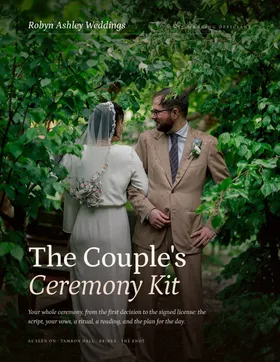
Walk in with a ceremony that sounds like the two of you
This post covers one part of the ceremony, and the Couple’s Ceremony Kit covers the rest, with five full scripts to start from and the prompts I use to help couples write their vows.
- Five full ceremony scripts in five different styles
- The Story Mine, thirty prompts for writing your vows
- Sixteen unity rituals, with the words and what to gather
- Thirty readings, each with my notes on when it fits
VOWS
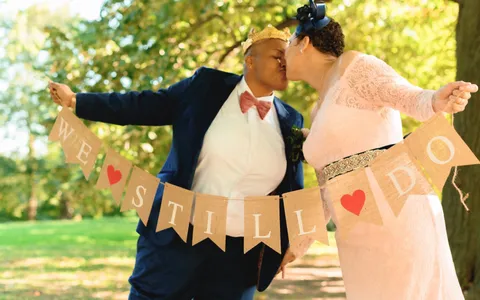
Best Anniversaries to Renew Vows | Don't Wait
A couple I worked with spent years saying "we'll do it at 25." Then her mother got sick, and waiting four more years for a tidy number suddenly felt absurd. They renewed at year.
READ →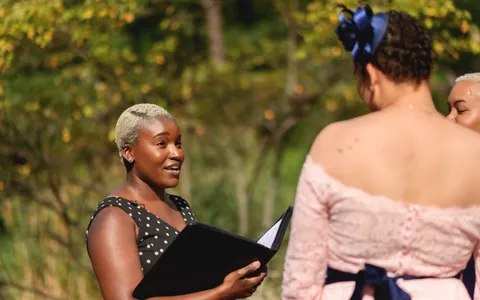
VOWS
Vow Renewal Officiant, How to Ask + What to Send
A couple who'd been married twenty-two years got on a call with me and asked, almost sheepishly, who they were supposed to "get" to make the renewal official. I told them the.
READ →
VOWS
37 Vow Renewal Ideas, Intimate to Big Party
I once officiated a vow renewal that cost more than my first car, and the room stayed dry-eyed the whole way through. Gorgeous florals, a string trio, a couple in second-look.
READ →