CEREMONY
The Best Non-Religious Wedding Ceremony Readings (That Actually Work)
The best non religious wedding readings sorted by tone, with real text, plus the cliches to skip and how to match the reading to the reader.
A best man once stood up at a Brooklyn rooftop wedding holding his phone, scrolled, squinted, and read four minutes of a poem he had clearly found that morning. The screen dimmed on him twice. By the second minute, the bride’s grandmother had quietly started studying the catering. The words were lovely on paper, and they died in the air, because nobody had asked the one question that actually decides these things: does this work out loud, read by a real person, in front of a real crowd?
I’ve stood three feet from the reader for hundreds of ceremonies. I’m the one handing the laminated copy to the shaking groomsman. I’m the one who quietly trimmed a 400-word passage so it wouldn’t sag at minute three. So when a couple asks me for the best non-religious wedding readings, I don’t hand them a list of 75 poems. I tell them the reading is only half the choice. The reader is the other half, and most couples never think about it until it’s too late.
The best non-religious wedding reading is one that works spoken aloud, fits the person delivering it, and sounds like the two of you. That usually means short, secular, and chosen on purpose. Below are the ones that earn their place in the room, sorted by tone, with real text where I can give it to you, plus the ones that have curdled into cliche.
Why a secular reading works or dies in the room
I’ve got a name for what happens when a borrowed, generic reading drops into a ceremony: a record scratch. The momentum you’ve built stalls, because guests leave buzzing about the flower girl, or the partner who cried, or the funny story, and never about a stock passage someone pulled off a listicle.
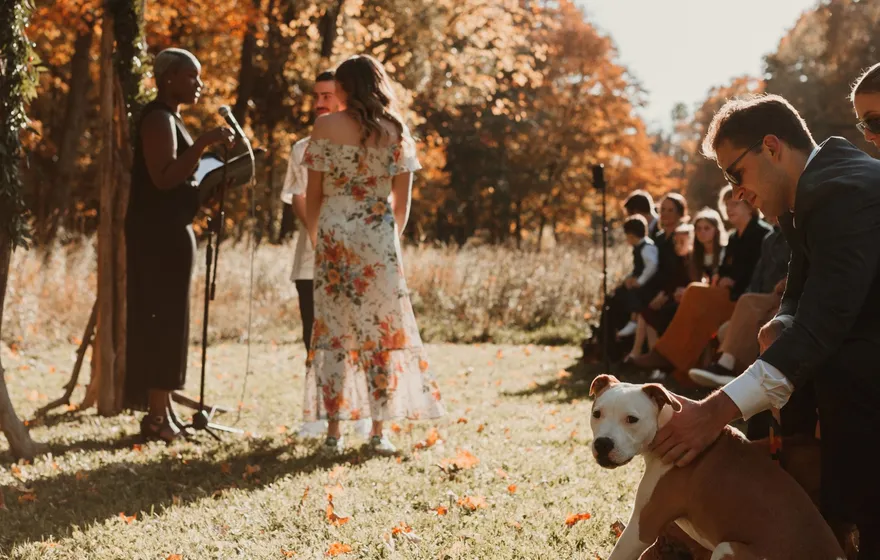
The best counter-example I’ve seen was a bride’s father reading Dr. Seuss’s “Oh, the Places You’ll Go,” her childhood favorite, and it worked better than any poem would have. The text had no literary pedigree. It fit her, and that’s the whole game. Personalization beats prestige every single time.
So before you fall for any passage below, run it through me first. Does it sound right spoken, not just printed? Does it match the actual human who’ll deliver it? And does it say something true about the two of you, instead of reciting the dictionary definition of love?
How long should a reading actually be?
Here’s the number couples never get told. A reading should run about one to three minutes, which is roughly 100 to 275 words (Provenance). Past three minutes, even a gorgeous passage starts to sag, and you can feel the room’s attention slide toward the bar.
I cap the whole readings section near five minutes and keep it to about two readings. More than that and the ceremony loses its shape. If you adore something long, cut it. A good editor’s instinct, finding the 150 words living inside the 400, is worth more to you than any new poem you could go hunting for.
The literary picks that survive being read aloud
These are the secular standards that have stayed in rotation for a reason. They sound like writing, not like a greeting card.
Captain Corelli’s Mandolin
A parent reading this to their own child is the version I like best.
People reach for this as a love passage, but in the novel it’s a father speaking to his daughter about what real love actually is. That makes it a natural pick for a parent reader. Its argument, that love is “what is left over when being in love has burned away,” refuses the giddy-romance framing most readings lean on. That’s exactly why it keeps working at wedding after wedding.
Anything from Mary Oliver or e.e. cummings, used in excerpt. cummings’s “i carry your heart with me” is genuinely beautiful and genuinely everywhere, so if you use it, use a short stretch and hand it to a reader who won’t sing-song the line breaks. The trick with the literary picks is restraint. One strong reader, one tight excerpt, and please, no theatrics.
The big-idea readings that earn their gravitas
Some couples want weight without scripture. Two passages do this better than anything else I get asked about.
Contact
“For small creatures such as we, the vastness is bearable only through love.”
Read it twice in rehearsal and once on the day, slowly.
It’s the workhorse secular awe reading: short, no deity, cosmic without being cold. I once watched a soft-spoken cousin deliver just those lines, and the whole tent went still.
Justice Kennedy’s majority opinion in Obergefell v. Hodges has become a secular reading in its own right:
Obergefell v. Hodges
“No union is more profound than marriage, for it embodies the highest ideals of love, fidelity, devotion, sacrifice, and family… They ask for equal dignity in the eyes of the law. The Constitution grants them that right.”
Source: National Constitution Center
Print the case name at the top of the reader’s page so they can introduce it.
It carries real history, and it hits hardest for LGBTQ couples and anyone who wants the legal weight of the day spoken out loud.
For a fuller walk through tone, structure, and how the readings sit beside the rest of the vows, see my guide to the secular wedding ceremony.
The funny ones (that only work in the right hands)
A deliberate laugh is one of the best gifts a reading can give a ceremony. It also fails harder than anything else when you hand it to the wrong person.
The Princess Bride “mawwiage” bit gets a room laughing, but it needs a confident performer with comic timing, not a sweet aunt who reads it flat. Same with the Priest’s speech from Fleabag (“Love is awful. It’s painful… but it’s the best thing we do”), which is funny and then suddenly isn’t, so your reader has to handle the turn without flinching.
The other rule with comedy: it has to be true to you. A bit that makes your friends say “oh, that’s so them” works. A joke you borrowed because it killed at someone else’s wedding will feel like a rerun, and people can tell.
The modern picks from screen and song
This is where secular readings have moved in the last couple of years, away from the dictionary definition of love and toward honest, slightly bruised framings of partnership (OurVows). Monologues now hold up as full readings:
- David Rose, Schitt’s Creek. “I have never liked a smile as much as I like yours.” Plain, warm, instantly his voice.
- Ted Mosby, How I Met Your Mother. “Love is the best thing we do.” A clean, hopeful close.
- The Priest, Fleabag. For couples who want honesty over sweetness.
One fair warning, because I’d want it myself. These read fresh right now, and they’re on a fast track to becoming the next cliche. If you choose one, choose it because it’s genuinely yours, not because it’s currently the safe modern answer. The test never changes. Does it read well out loud, and does it sound like you?
The readings I’d quietly talk you out of
Every officiant has a tired list, and 1 Corinthians 13 (“Love is patient, love is kind”) sits at the top of all of them (OurVows). For a secular ceremony it fails twice over. It’s a religious text, so it’s off-theme, and it’s the single most overused reading there is. That’s a clean reason to skip it without an ounce of guilt.
I’d also retire “The Art of Marriage” and most of the anonymous “love is…” poems that float around the wedding boards. They’re warm and they’re weightless, and a real crowd can feel the difference between something written about you and something written about marriage in general.
This matters more now than it used to, because so many secular ceremonies are run by a friend or family member rather than clergy. Researchers have been tracking the rise of friends and relatives getting ordained online to officiate for years (Secularism and Nonreligion), and a homemade ceremony is exactly where a stock reading stands out as the one borrowed beat in an otherwise personal day.
Coaching your reader so the words actually arrive
The text is decided. Now you protect the delivery. Pick someone reliable and genuinely comfortable speaking to a crowd, and if a friend tells you they’d be too nervous, believe them and choose someone else. Line up a quiet understudy too, in case your reader bows out on the morning of.
Don’t ask anyone to memorize. The words stay in their hand so a memory-blank can’t freeze them. And tell your reader to go slower than feels natural, because nervous readers race, and “too slow” in your head sounds like exactly the right pace out in the room.
Here’s the structure I give couples for where a reading actually sits inside the ceremony, so your reader knows the moment they’re up.
Officiant (after the welcome, before the vows):
“Before [Name] and [Name] speak their promises, they’ve asked someone who knows them well to share a few words about what brought them here. [Reader’s name].”
(Reader walks up. They take a beat, look at the couple, then begin. No rushing.)
Reader:
“[The chosen passage, one to three minutes. Read slowly. Let the last line breathe before you stop.]”
(Reader returns to their seat. Officiant gives the room a moment to settle.)
Officiant (bridging back):
“Thank you, [Reader’s name]. [Name] and [Name], that’s the love these people see in you. Now let’s hear what you’ll promise each other.”
That bridge line at the end matters as much as the reading itself. A reading that just stops leaves a small hole in the room. Two sentences from the officiant catch it and carry the ceremony forward.
Where the reading fits in the larger ceremony
A reading is one moment inside a sequence. If you’re building the whole thing from scratch, it helps to see how the pieces connect, from the welcome to the vows to the pronouncement. I walk through that full structure in my guide to writing a wedding ceremony script, and you can browse more options in the full collection of non-religious wedding ceremony readings and where to place them.
If you want a faster way to choose, I keep a free set of vetted non-religious readings, sorted by tone the way this post is, that you can pull from without the doomscrolling. Grab those over on the wedding readings page.
A little help building the ceremony around it
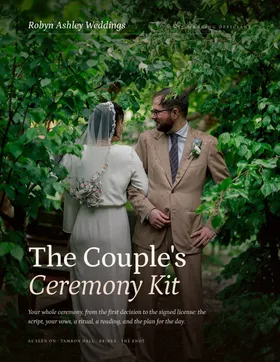
The reading is one beat. The rest of the ceremony, the welcome and the vows and the ring exchange and the pronouncement, is where most couples freeze, especially when a friend is officiating and nobody quite knows the order or the words. That’s exactly what I built The Couple’s Ceremony Kit for.
It’s the templates I actually use myself: a full secular ceremony you can edit, vow prompts that pull real answers out of you, ring-exchange wording, and the small stage directions that keep a homemade ceremony from feeling improvised. You drop your chosen reading into a structure that already works, instead of stitching one together from a dozen browser tabs. See what’s inside on the ceremony kit page.
Frequently asked questions
What is a good non-religious wedding reading that isn’t cheesy?
Skip 1 Corinthians 13, which is both a religious text and the most overused reading there is. For something secular and grounded, try the Captain Corelli’s Mandolin passage by Louis de Bernieres, which calls love “what is left over when being in love has burned away,” or Carl Sagan’s line from Contact: “For small creatures such as we, the vastness is bearable only through love.” Both are short, have no mention of god, and earn their emotion instead of reaching for it.
How long should a wedding reading be?
Aim for one to three minutes, roughly 100 to 275 words. Past three minutes a reading starts to sag and the room’s attention drops, so edit a longer passage down or pick a different one. Keep the whole readings section to about two readings and under five minutes total.
Who should read at a non-religious wedding ceremony?
Pick the person before you pick the passage. Choose someone genuinely comfortable speaking in front of a crowd, and if they tell you they’d be too nervous, believe them and ask someone else. Match the reading to the reader, since a funny pop-culture bit needs a confident performer while a tender literary passage suits a calmer voice. Line up a backup reader in case yours bows out on the day.
What are the most overused wedding readings to avoid?
1 Corinthians 13 tops every officiant’s tired list, and since it’s a religious text it doesn’t even fit a secular ceremony. Some modern picks are heading the same way from overuse, including the Princess Bride “mawwiage” bit and a few TV monologues. They still work, but choose them on purpose, not by default.
Can I use a movie quote, song lyric, or TV monologue as a wedding reading?
Yes, and many of the strongest modern secular readings come from screen and song: the Priest’s speech from Fleabag, David Rose from Schitt’s Creek, Ted Mosby from How I Met Your Mother. The test is whether it reads well out loud and sounds like the two of you, not whether it has a literary pedigree. Print it cleanly, never read it off a phone, and have the reader rehearse it aloud first.
The Couple’s Ceremony Kit
Walk in with a ceremony that sounds like the two of you
This post covers one part of the ceremony, and the Couple’s Ceremony Kit covers the rest, with five full scripts to start from and the prompts I use to help couples write their vows.
- Five full ceremony scripts in five different styles
- The Story Mine, thirty prompts for writing your vows
- Sixteen unity rituals, with the words and what to gather
- Thirty readings, each with my notes on when it fits
CEREMONY
Caribbean Wedding Traditions Worth Keeping
A couple sat in my office in Crown Heights, both second-generation, one side Guyanese and one side Trinidadian, and the bride said, "We want it to feel Caribbean, but we don't.
READ →
CEREMONY
What Is a Unity Ceremony? The Complete Guide
What a unity ceremony is, where it fits in your wedding, and how to choose the right ritual, from an officiant who's performed them at 300+ weddings.
READ →
CEREMONY
African Wedding Traditions, Explained With Respect
African wedding traditions by people and region: the Akan knocking, the Yoruba engagement, the Igbo kola and wine-carrying, libation, aso ebi and the broom, with how to include one or two without flattening them.
READ →