CEREMONY
An LGBTQ+ Wedding Ceremony, Written to Fit You (Not a Swapped-Pronoun Template)
An affirming lgbtq wedding ceremony guide: language beyond husband and wife, pronouncement and processional options, and finding officiants who get it.
Two brides stood at the back of a garden in Brooklyn and neither of them moved. Both of their dads were waiting to walk them up, and nobody had decided who would go first, because nothing in either of their lives had ever told them. We’d talked about it at the rehearsal, they’d left it open, and now there was a small, loving traffic jam at the top of the aisle while a string trio played the same eight bars for the third time.
So I did what I’d quietly planned for. I caught their eyes, nodded once, and both dads started walking at the same moment, down the same aisle, the two brides arriving side by side. The room exhaled. One of their mothers laughed out loud, the good kind.
Here’s what I’ve learned officiating queer weddings in a state where this has been legal since 2011 (Wikipedia): the hard part is almost never the pronouns. Swapping “husband and wife” for “spouses” takes a minute. The work that actually matters is structural. When there’s no inherited script for who walks, who stands where, who “gives” whom away, every choice becomes something you decide on purpose. That can feel like a burden. It’s the whole gift.
Here’s the short version. Write your ceremony from your relationship, not from a template with the gender words find-and-replaced. Decide what you want to be called. Decide how you’ll enter when there’s no default. Keep the traditions that mean something and rewrite the ones built on roles that don’t fit you. And book vendors who ask about you instead of assuming.
Start with the part most guides skip.
Why “swap the pronouns” isn’t enough
Most articles on inclusive ceremony language stop at the level of nouns. Change the words, you’re done. I get the appeal. It’s tidy and it’s fast.
The trouble is that a swapped-pronoun script still carries the bones of a ceremony designed around one bride and one groom with fixed jobs. The bride is received. The groom waits. One person acts, one is acted upon. You can change every gendered word in that script and the shape of it still whispers the old roles.
I’ve watched couples import a stereotype they never meant to. One bride described being “given away” by her father and only realizing later that she felt she’d handed her wife “too much power,” a kind of femme-and-butch dynamic neither of them had ever signed up for. The words were fine. The structure said something she didn’t mean.
So before I write a word for a couple, I ask the structural questions. What do you want to be called, out loud, at the most public moment of your lives? How do you want to enter, and what does that say about the two of you? Whose presence do you want named, and in what language? If you want to start from those questions yourself, my walk-through on how to write a ceremony from scratch takes you through the same order I use.
What do you say instead of “husband and wife”?
This is the question I get first, every time, so let’s settle it. You have range, and there’s no single correct answer. There’s only the one that’s true for you.
Pronouncement options I’ve actually used at the altar:
Pronouncements without husband and wife
Equal partners
“I now pronounce you equal partners, joined in marriage.”
Best fit Couples who want the equality said out loud.
Spouses
“I pronounce you spouses for life.”
Best fit A short, gender-neutral close.
Partners
“I now pronounce you partners for life.”
Best fit Couples who already call each other partner.
Love and the law
“You are now married, in the eyes of love and the law.”
Best fit Couples who want the legal weight named.
If you want role words, the same line works as “I now pronounce you wife and wife.” / “husbands, together.”
The move underneath all of these is to ask the couple, well before the ceremony, whether they even want bride, groom, spouse, or partner language at all. I’ve had two grooms who proudly wanted “husbands.” I’ve had a couple who wanted no role words anywhere, just their names. Both were right, because they were chosen.
The same logic applies to the kiss. “You may now kiss the bride” assigns a passive partner and an active one, which is exactly the trap. Cleaner options:
The kiss, with no kisser and no kissed
Shortest
“You may now kiss”
Best fit Couples who want the cue and nothing else.
Sealed
“You may seal your marriage with a kiss”
Best fit A slightly more formal close.
An invitation
“I invite you to start your marriage with a kiss”
Best fit Couples who like the moment framed as a beginning.
Nobody is the kisser and nobody is the kissed. You’re two people doing the same beautiful thing at once.
How do two grooms or two brides walk down the aisle?
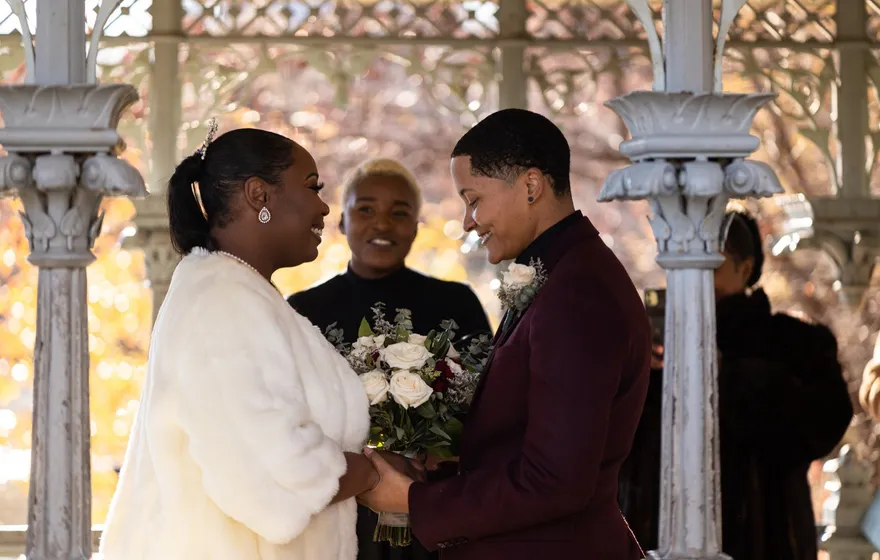
Here’s where “no default” stops being abstract and gets real, fast. There’s no majority practice here to fall in line with, so the shape of the entrance is genuinely yours to decide.
Your real options, the ones I’ve staged in parks and lofts and one very windy rooftop:
- One partner enters first, the other follows. Classic shape, and it works if you want a “reveal” moment. Decide together who, and why, so it isn’t an accident.
- You walk in together. Side by side, no first and second. Simple and quietly radical.
- Two aisles, simultaneous. Both of you enter at the same time from opposite sides and meet in the center. It’s genuinely lovely when the space allows it.
- Both escorted by one or both parents. Your people walk you up, on your terms, with no ownership implied. This is the one my Brooklyn brides chose, with both dads walking them down the same aisle at the same moment.
- One stops halfway and waits. Your partner comes to you, and you take the final steps together. The aisle becomes a meeting, not a delivery.
Because there’s no inherited rule about who stands where or who processes when, your full processional is its own design problem. I lay out the standard orders and how to bend them in my guide to building a processional order. Steal the structure, ignore the gender assumptions baked into the traditional version.
And the “giving away” moment deserves its own rethink. The tradition comes from property transfer, one family handing a daughter to a husband. You can keep the warmth and lose the ownership by reframing it around support:
“Who supports these two in their marriage?”
That replaces “who gives this woman.” One version I love has each partner say a line like this one:
“I give myself, with the support of my family”
Or you cut the segment entirely and nobody misses it.
Which traditions should you keep, and which should you rewrite?
My rule is simple. Keep the rituals that carry real meaning for you, and drop or rewrite the ones built on roles that don’t fit. A ritual isn’t sacred because it’s old. It’s meaningful because it says something true about you two.
The good news is that almost every unity ritual has an egalitarian version that’s frankly better:
- Breaking the glass. Historically only the groom did it. Both partners can break a glass together, side by side.
- Handfasting. Tie your hands with a rainbow ribbon, or with cords that mean something to you. There’s no gendered role in a knot. If you want the full how-to, see my handfasting walk-through.
- Sand or candle unity. Instead of one person pouring into another’s vessel, both of you pour at the same time into a shared one. No giver, no receiver, just two streams becoming one.
If you and your partner come from different faiths or no faith at all, you’ve got even more freedom to mix and rebuild. My guide to secular wedding ceremonies covers ceremonies with no religious frame, which is where a lot of my queer couples end up, and it pairs well with the structural thinking here.
A full ceremony script you can use
Here’s a complete, copy-ready ceremony written the way I write them, with no fixed roles and language you can adjust to your titles. I’ve kept the directions neutral so it reads cleanly for two brides, two grooms, two partners, or any configuration of the two of you. Swap “partners” for “wives,” “husbands,” or “spouses” wherever you like, just keep it consistent.
Welcome:
(Officiant stands center. The couple stands together, facing each other or facing out, their choice.)
“Friends and family, welcome. We’re here in this room because [Name One] and [Name Two] decided that what they have is worth saying out loud, in front of all of you. There’s no script that came before them for this. They wrote it themselves, the way they’ve built everything else. So let’s begin the way they chose to begin.”
On choosing each other:
“Some people are handed a path and they walk it. [Name One] and [Name Two] didn’t get a path. They got each other, and they made the road as they went. Every choice that brought them here was exactly that, a choice. That’s what makes today honest. Nothing about this is automatic. All of it is on purpose.”
Declaration of intent:
(Officiant turns to the first partner.)
“[Name One], do you take [Name Two] to be your [partner], to stand beside, to choose again on the easy days and the hard ones, for as long as you both shall live?”
( “I do.”)
(Officiant turns to the second partner.)
“[Name Two], do you take [Name One] to be your [partner], to stand beside, to choose again on the easy days and the hard ones, for as long as you both shall live?”
( “I do.”)
Vows:
(Couple exchange personal vows, or repeat after the officiant. If repeating:)
“I take you, exactly as you are. I’ll keep choosing you out loud and in private. I’ll make room for who you’re still becoming. And whatever the road asks of us, I’m walking it with you.”
Ring exchange:
(Partners face each other. Rings are presented.)
“These rings have no front and no back, no beginning and no end. They don’t say who leads. They say you’re equal, and you’re joined. [Name One], place this ring on [Name Two] and say: I give you this ring as a sign of my love that has no end.”
(Repeat for the second partner.)
Pronouncement:
(Officiant addresses everyone.)
“By the power vested in me, and by the witness of everyone in this room, it is my honor to pronounce you married, equal partners for life. You may seal your marriage with a kiss.”
Recessional:
“Family and friends, it’s my joy to introduce, for the first time, the married couple, [Name One] and [Name Two].”
If you want more spoken-word structure to borrow from, my collection of wedding ceremony script examples is the hub for every style I write, religious to fully secular, and it’s a good place to mix and match openings, vows, and pronouncements until the whole thing sounds like you.
How to find an officiant and vendors who actually get it
You can write the most affirming script in the world and still watch a vendor flatten it by running you through a template. So vet hard, and trust your gut on the small signals.
What I’d treat as red flags:
- “I also do LGBTQ+ weddings.” That little “also” tells you you’re an add-on, not the work.
- Contact forms hard-coded with “Bride” and “Groom” fields. Small thing, loud message. If they never updated the form, they never thought about you.
- No queer couples anywhere in the portfolio. A welcome statement is words. The gallery is proof.
- A rigid, one-size script that assigns roles without asking you a single question about who you are.
What tells you someone’s the real deal: an explicit welcome on the page, a portfolio with actual queer couples in it, and a vendor who asks about your identities and your story before they pitch you anything. The single best practice I follow, and the one couples tell me they notice, is confirming pronouns and titles before the rehearsal instead of guessing at the altar (American Marriage Ministries). People say it over and over: they’d rather be asked than have someone assume and get it wrong in front of everyone.
They’d rather be asked than have someone assume and get it wrong in front of everyone.
Ask your officiant three direct questions:
- Have you officiated queer weddings before?
- How do you keep the language affirming throughout?
- Will you customize the script to us, or do you work from a fixed one?
A good answer is specific and a little excited. A vague one is your sign to keep looking.
One more option worth knowing: you don’t have to hire a stranger at all. Plenty of my favorite ceremonies were led by someone who already loves the couple. If that’s your instinct, here’s how a friend can officiate your wedding, including the legal steps and how to coach them so they don’t freeze at the front.
Where the Couple’s Ceremony Kit fits
If you’re writing your own ceremony, and I hope you are, the hardest part is staring at a blank page knowing there’s no default to fall back on. That’s exactly what the Couple’s Ceremony Kit is built for.
It’s the structure I use with my own couples: a fill-in-the-blanks ceremony framework, affirming language options for every section, pronouncement and processional choices that don’t assume roles, and the vow-writing prompts that get the real stuff out of you instead of the Pinterest version. You assemble a ceremony that sounds like the two of you, without paying for a custom officiant package if you don’t want one.
Want to feel the writing first? You can grab a free sample ceremony script and see whether the voice and structure fit before you commit to anything.
Frequently asked questions
What do you say instead of “husband and wife” at a same-sex wedding?
You have a lot of options, and the right one is whatever you actually want to hear. Common pronouncements include “I pronounce you equal partners joined in marriage,” “spouses for life,” “wife and wife,” “husbands together,” or “married in the eyes of love and the law.” The real step is deciding ahead of time whether you even want to be called bride, groom, spouse, or partners, rather than letting an officiant assume.
Who walks down the aisle first at a gay or lesbian wedding?
There’s no default, which makes it an open choice. Roughly half of LGBTQ+ couples have one partner walk first, and about a third walk separately at the same time. Other options include walking in together, using two aisles so you enter simultaneously and meet in the center, being escorted by one or both parents, or one partner stopping halfway so you take the last steps together.
How do I find a wedding officiant who genuinely gets LGBTQ+ couples?
Look past “love is love” on the homepage. Affirming officiants show queer couples in their actual portfolio, make an explicit welcome statement, and ask about your story instead of running a template. Red flags: “I also do LGBTQ+ weddings” framing, contact forms hard-coded with “bride” and “groom,” and a rigid script that assumes roles. Ask directly whether they’ve officiated queer weddings and will customize the language to you.
Which wedding traditions should same-sex couples keep or change?
Keep the rituals that carry real meaning for you and rewrite the ones built on roles that don’t fit. Many couples make rituals egalitarian: both partners break the glass together, handfasting with a rainbow ribbon, or pouring sand at the same time instead of in a giver and receiver order. The “giving away” moment can be reframed around who supports you, or dropped entirely.
How should an officiant handle our names, pronouns, and titles?
They should ask, not guess, and they should ask before the rehearsal. That means confirming your pronouns, whether you want to be called bride, groom, spouse, partner, or Mx., and how you want to be introduced at the end. A good officiant will also use your names in place of pronouns where it reads more naturally and keep your language consistent the whole way through.
ALSO READ Secular Wedding Ceremony: Scripts & Ideas (No Religion, All Heart)The Couple’s Ceremony Kit
Walk in with a ceremony that sounds like the two of you
This post covers one part of the ceremony, and the Couple’s Ceremony Kit covers the rest, with five full scripts to start from and the prompts I use to help couples write their vows.
- Five full ceremony scripts in five different styles
- The Story Mine, thirty prompts for writing your vows
- Sixteen unity rituals, with the words and what to gather
- Thirty readings, each with my notes on when it fits
CEREMONY
Caribbean Wedding Traditions Worth Keeping
A couple sat in my office in Crown Heights, both second-generation, one side Guyanese and one side Trinidadian, and the bride said, "We want it to feel Caribbean, but we don't.
READ →
CEREMONY
What Is a Unity Ceremony? The Complete Guide
What a unity ceremony is, where it fits in your wedding, and how to choose the right ritual, from an officiant who's performed them at 300+ weddings.
READ →
CEREMONY
African Wedding Traditions, Explained With Respect
African wedding traditions by people and region: the Akan knocking, the Yoruba engagement, the Igbo kola and wine-carrying, libation, aso ebi and the broom, with how to include one or two without flattening them.
READ →