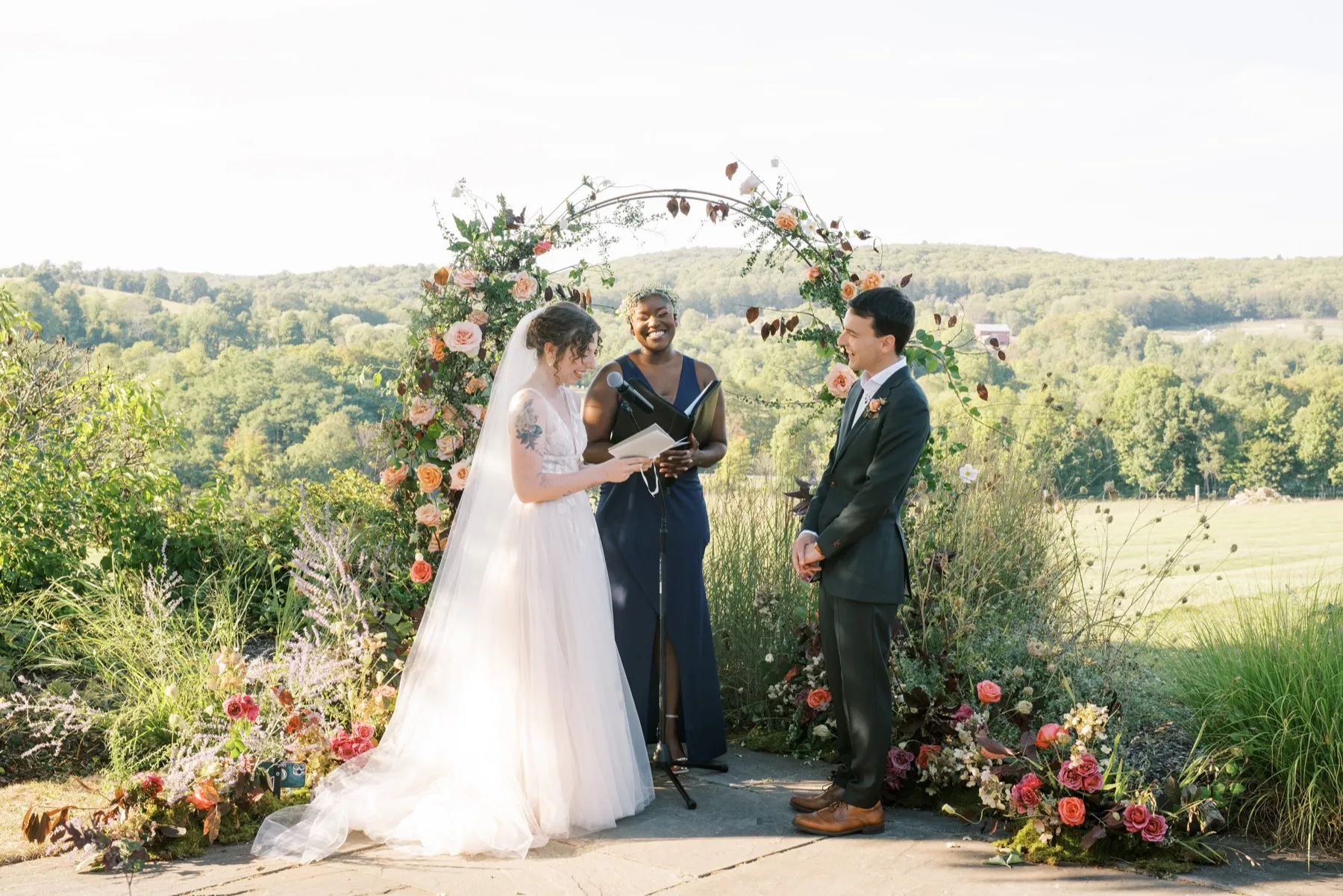
CEREMONY
Secular Wedding Ceremony: Scripts & Ideas (No Religion, All Heart)
A complete secular wedding ceremony script with non-religious swaps for every God-language moment, plus unity ideas that feel meaningful. Free to use.
A few years ago a couple sat across from me and one of them said, almost apologizing, “We don’t want any God stuff, but we also don’t want it to feel like the DMV.” I’ve thought about that line at nearly every secular ceremony I’ve written since. That fear is the real one. Couples almost never object to the word God. What they object to is a ceremony so generic it could be read over any two strangers.
So let me settle the worry first, then hand you the whole script.
A secular wedding ceremony works by swapping each religious beat for a non-religious one that does the same emotional job. The invocation becomes a welcome that names why these specific people are in the room. The blessing becomes a benediction of well-wishes. The pronouncement borrows its authority from the law and the guests instead of a deity. Nothing is lost. The gravity stays. You just stop renting it from scripture and start building it from the couple’s own story.
I write and perform secular and interfaith ceremonies for a living, and I’ve coached plenty of first-time friend-officiants through the exact God-language swaps below. None of this is theory. It comes from ceremonies I’ve stood up and read.
Is a secular wedding ceremony even legal?
Yes, and it’s easier than most couples think. The law asks for almost nothing.
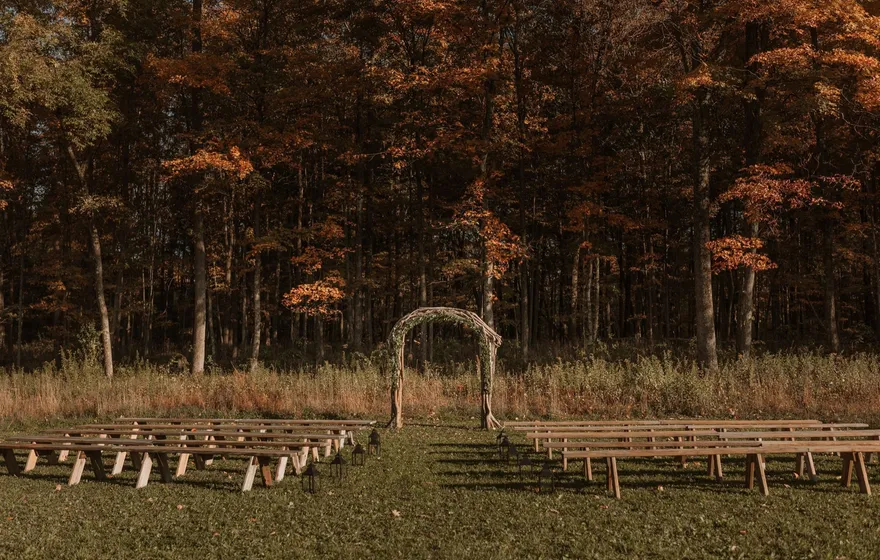
In New York, Domestic Relations Law section 12 says outright that “no particular form or ceremony is required” (NY State Senate). The only thing that legally has to happen is the declaration of intent: the couple solemnly declaring, in front of the officiant and at least one witness, that they take each other as spouses.
That’s it. The invocation, the readings, the blessing, even the famous pronouncement wording, all of it is optional and fully rewritable. Only that one declaration carries any legal weight. (Check your own state’s statute, since the language varies, but the principle holds nearly everywhere: religion is never a legal requirement.)
And if you’re worried this makes you an outlier, it doesn’t. Among adults 18 to 34, nearly half (48%) had a secular ceremony, and just 36% of married adults in that age bracket were married by a religious leader in a religious setting, against 60% of those 65 and older (Survey Center on American Life). For younger couples, secular is the default now. You’re in good company.
What do you say instead of the religious parts?
Here’s where the craft lives. Each traditionally religious moment has a clean secular replacement. Think of it as a swap table.
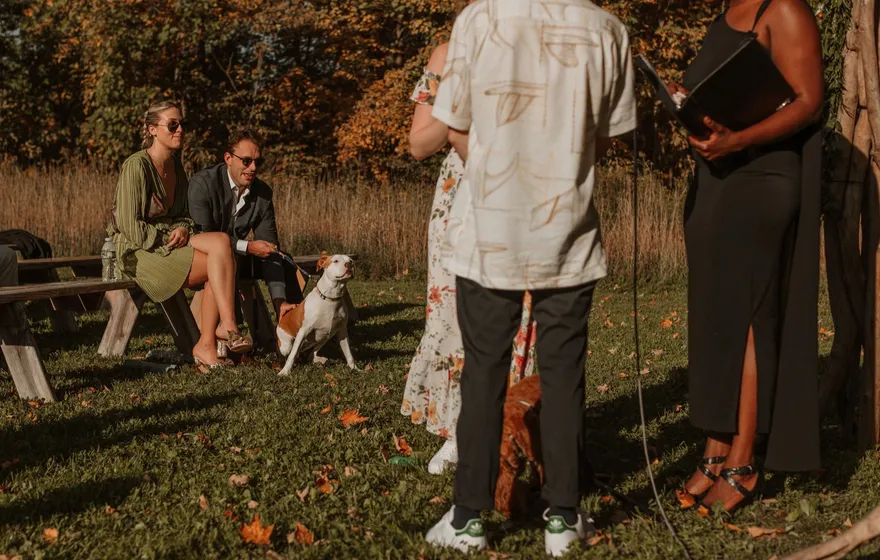
The invocation. The old version opens “We are gathered here in the sight of God.” The secular version is a gathering, not a prayer. You name why these guests, specifically, are here:
“We’re here to witness the marriage of these two people we love.”
That’s all an invocation ever really did, point the room’s attention at the couple and tell everyone why they came.
The reading. Scripture gets replaced by poetry or prose the couple actually loves. Pablo Neruda and Mary Oliver are the two poets I’m asked for most (American Marriage Ministries). Neruda’s “I love you without knowing how, or when, or from where” makes the room go quiet every single time. I keep a longer list of non-religious options in my guide to secular and non-religious ceremony readings if you want to browse before you choose.
The blessing. A religious blessing asks a deity to bless the couple. A secular one is a benediction, a handful of well-wishes, and it works best as repetition: “May you… May you… May you…” More on that below, because it’s the moment couples underestimate most.
The pronouncement. The classic “by the power vested in me by God” becomes the line below (Universal Life Church). Same cadence, same authority, sourced from the law and the people instead of the heavens.
“by the power vested in me by the State of New York, and by the love in this room”
Swap in your own state’s name if you’re marrying them somewhere else.
How do you make it feel meaningful, not flat?
This is the part most “here’s a script” posts skip, so I’ll be plain about it.
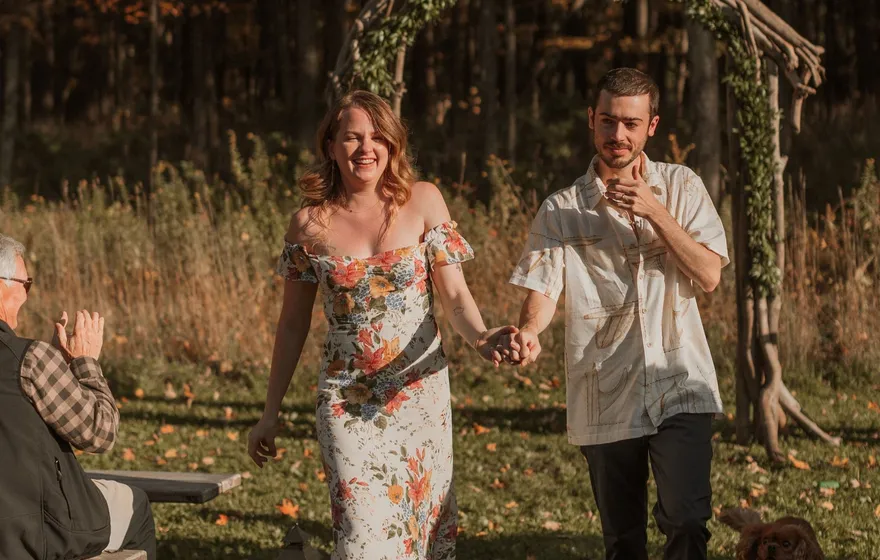
The fear of the DMV ceremony is real, and the fix isn’t adding more flowery language. The fix is specificity. A religious ceremony borrows its meaning from a text everyone in the room already reveres. When you remove that text, you have to replace its authority with something, and the only thing strong enough is the couple’s actual story.
So the secular ceremony does what generic religious framing can’t: it gets specific. How they met. The terrible first date that somehow worked. The year one of them was sick and the other never left. The promise they’re making that no one else in the world would make in quite those words.
When I write a secular ceremony, I spend most of my prep time on that story, not on the structure. The structure is easy. The story is the whole point.
Two tools make a non-religious ceremony feel grounded without a single mention of God. The first is the shared moment of silence, a clean swap for a prayer: invite everyone to take a breath and hold a private wish for the couple. Religious guests can pray inside it, secular ones can simply hope, and the room goes still together. The second is the benediction, built on anaphora, the “May you” repetition. Said slowly, it has the rhythm people associate with something sacred, while asking nothing of any deity.
One more practical note from doing this a lot: keep it to about 12 to 15 minutes. Long enough to feel grounded, short enough that the room stays with you (American Marriage Ministries). The script below runs right around there.
The full secular wedding ceremony script (free to use)
Here’s a complete one. Read it, fill the brackets, cut what you don’t want. The structure follows the same bones as my standard wedding ceremony script, with every religious beat already swapped out. If you’ve never built one of these from scratch, my walkthrough on how to write a ceremony from a blank page pairs with this nicely.
Processional
(Guests are seated. The couple takes their places facing each other. The officiant waits for the room to settle, then begins.)
Welcome (the secular invocation)
“Good evening, everyone. We’re here for the simplest and best of reasons: to witness [Partner A] and [Partner B] marry each other.
No higher power summoned us tonight. You did. Every one of you is in this room because at some point you chose to love these two, and they chose to love you back. That’s the only authority this ceremony needs, and honestly, it’s the strongest one I know.
So let’s begin by looking at them, and letting them feel how many people showed up.”
(Pause. Let the room settle on the couple.)
Their story
“[Partner A] and [Partner B] met [where/how, the real version]. [One specific, true detail only these two would recognize.] What I want you to know is this: [the thing they survived, built, or decided together that makes their love specific rather than general].
That’s not a story you could tell about anyone else. And that’s the whole point of standing here tonight.”
A reading
(A chosen friend or family member reads. Suggested: Pablo Neruda, “100 Love Sonnets, XVII,” or a passage the couple loves.)
The declaration of intent (the legally required line)
“[Partner A], do you take [Partner B] to be your spouse, to share your life with, from this day forward?”
“I do.”
“[Partner B], do you take [Partner A] to be your spouse, to share your life with, from this day forward?”
“I do.”
The vows
(Couple exchanges personal vows, or repeats after the officiant.)
“I promise to keep choosing you. To be honest when it’s hard, gentle when it counts, and on your side when the rest of the world isn’t. I’m yours.”
Ring exchange
(Officiant holds the rings up briefly.)
“These rings have no power on their own. They’re circles of metal. What gives them meaning is that every time you catch sight of yours, you’ll remember the promise you made out loud tonight, in front of all these people.
[Partner A], place the ring on [Partner B]‘s finger and say: ‘This is my promise.’”
(Repeat for Partner B.)
A shared moment of silence (the secular blessing, part one)
“Before I make this official, I want to give everyone here one job. Take a breath with me. And in the quiet, hold a single wish for [Partner A] and [Partner B]. Pray it if you pray, hope it if you don’t. Just send it their way.”
(Hold the silence for a slow eight to ten seconds.)
The benediction (the secular blessing, part two)
“Here is mine.
May you keep choosing each other, especially on the days it’s harder than tonight. May your home be loud with the people you love. May you argue fair, forgive fast, and laugh more than anyone expects two married people to. And may you always be each other’s safest place.”
The pronouncement
“Then by the power vested in me by the State of New York, and by the love in this room, it is my joy to pronounce you married. You may kiss.”
(They kiss.)
Presentation
“Everyone, for the very first time: the married couple.”
(Recessional.)
If you want more variations in this style before you commit to one, I keep a fuller library in my wedding ceremony script examples, the hub where all the different ceremony styles live.
Which unity ceremony fits a non-religious wedding?
Worth knowing where unity rituals even came from: they grew popular in part because couples started removing religious elements and needed something to fill the ceremony time those elements used to take (American Marriage Ministries). So a unity moment is the most natural thing in the world to add to a secular script. The trick is matching it to the couple instead of to a trend.
Sand is the most requested. Two colors pour into one vessel and can never be separated again. It’s the obvious pick for blended families, because every kid can add a color and watch themselves become part of the whole.
Handfasting binds the couple’s hands together with cords. It’s the literal origin of the phrase “tying the knot,” and it reads ancient and ceremonial without carrying any religious meaning. I steer couples here when they want gravity and a little old-world theater.
A wine-box time capsule is the most personal of the three. The couple seals love letters and a bottle of wine inside a box, then opens it on a chosen future anniversary. It suits the couples who care more about the marriage than the wedding-day spectacle.
I’ve broken down more options, with the exact words to say during each, in my roundup of secular unity ceremony ideas. Pick the one whose symbolism actually matches your relationship, and the moment will carry itself.
A note on building your own
Everything above is yours to use, free, today. If you’d rather not assemble a whole ceremony from parts, that’s exactly what I built the Couple’s Ceremony Kit for. It hands you a structured secular script you fill in like a worksheet, plus the swap-ready wording for every religious moment and a set of unity scripts you can read as written. It’s the same craft I’d bring to writing yours, packaged so you can do it at your kitchen table on a Tuesday night.
If you just want one clean script to start from, grab my free sample ceremony script and edit from there.
ALSO READ The Best Non-Religious Wedding Ceremony Readings (That Actually Work)Frequently asked questions
What can you say instead of “by the power vested in me by God” at a wedding?
Source the authority from the law and the people: “By the power vested in me by the State of New York, and by the love in this room, I now pronounce you married.” It keeps the weight and cadence guests expect while staying fully secular. In New York, the pronouncement wording isn’t legally required anyway, so phrase it however fits the couple.
Is a secular wedding ceremony legally valid?
Yes. In New York, Domestic Relations Law section 12 says “no particular form or ceremony is required.” The only line that legally has to happen is the declaration of intent, the couple declaring in front of the officiant and at least one witness that they take each other as spouses. Everything else is optional and yours to write. Religion is never a legal requirement.
How do you make a non-religious wedding feel meaningful without mentioning God?
Meaning comes from specificity, not scripture. Replace the borrowed authority of a religious text with the couple’s own story: how they met, what they survived, what they promise. Swap a prayer for a shared moment of silence, use a benediction built on “May you” repetition, and pick a unity ritual that reflects the actual relationship. The ceremony should feel like it could only be read over these two people.
What’s a good secular replacement for the invocation and the blessing?
For the invocation, open with a gathering instead of a prayer: name why these guests are here and what the day means. For the blessing, use a secular benediction, a few well-wishes phrased as repetition: “May you keep choosing each other. May your home be loud with the people you love. May you always be each other’s safest place.” No deity required, same emotional weight.
What unity ceremony works best for a non-religious wedding?
Match it to the couple. Sand suits blended families, since each kid can add a color. Handfasting, the literal origin of “tying the knot,” reads ceremonial without being religious. A wine-box time capsule, sealing letters and a bottle to open on a future anniversary, is the most personal and fits couples who care more about the marriage than the spectacle.
The Couple’s Ceremony Kit
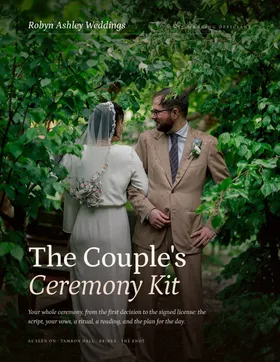
Walk in with a ceremony that sounds like the two of you
This post covers one part of the ceremony, and the Couple’s Ceremony Kit covers the rest, with five full scripts to start from and the prompts I use to help couples write their vows.
- Five full ceremony scripts in five different styles
- The Story Mine, thirty prompts for writing your vows
- Sixteen unity rituals, with the words and what to gather
- Thirty readings, each with my notes on when it fits
CEREMONY
Caribbean Wedding Traditions Worth Keeping
A couple sat in my office in Crown Heights, both second-generation, one side Guyanese and one side Trinidadian, and the bride said, "We want it to feel Caribbean, but we don't.
READ →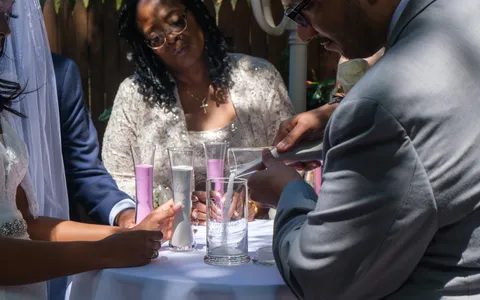
CEREMONY
What Is a Unity Ceremony? The Complete Guide
What a unity ceremony is, where it fits in your wedding, and how to choose the right ritual, from an officiant who's performed them at 300+ weddings.
READ →
CEREMONY
African Wedding Traditions, Explained With Respect
African wedding traditions by people and region: the Akan knocking, the Yoruba engagement, the Igbo kola and wine-carrying, libation, aso ebi and the broom, with how to include one or two without flattening them.
READ →