CEREMONY SCRIPTS
DIY Wedding Ceremony: A Full Template You Can Actually Use
Write your own DIY wedding ceremony with a free full script, the legal must-says, a realistic writing timeline, and the running order for the ceremony.
Two summers ago I sat in the third row at a friend-officiated wedding. The couple wanted me there as a guest, not a vendor, so I left the clipboard at home. The best man stood up, faced two hundred people, and opened with a joke about the bride’s ex. The bride’s mother stopped clapping. I watched a good ceremony nearly tip over in the first thirty seconds, all because nobody had told him the thing every officiant learns fast: the front row is not your audience. The couple is.
A DIY wedding ceremony can be the warmest, most personal half hour of your whole day. I have coached first-time officiants and couples writing their own ceremonies, and the ones that work all run on a simple truth the internet keeps burying under a thousand “ideas” lists.
One moment in your ceremony is legally load-bearing, and one more is the customary close. Everything else is yours to write, cut, or skip. Get those two right, build a clean spine around them, and you do not need to hire anyone. Below you get the structure, the legal language you cannot leave out, a realistic timeline, and a full script you can copy and use as-is.
If you only remember one row of that box, make it the first one.
What makes a DIY ceremony actually legal?
This is the part most national template posts go fuzzy on, so let me be exact.
In most US states, the part of the ceremony the law cares about is the declaration of intent: the couple stating, in front of the officiant and the witnesses, that they take each other as spouses (N.Y. Domestic Relations Law 12). The pronouncement (the officiant declaring you married) is how officiants close that moment. Statutes generally don’t require it, but most officiants, me included, treat it as essential. Vows, readings, unity rituals, a parent’s blessing, all of it is emotionally central and legally optional.
That reframes the whole thing. When couples ask me “what can we cut for time,” the answer is almost anything except those two. When they ask “what can’t we mess up,” same answer, flipped.
| Moment | Legally required? |
|---|---|
| Declaration of intent | Yes |
| Pronouncement | Customary, keep it |
| Vows | No |
| Readings, rituals | No |
Everything in the bottom two rows is there for you and your guests, so keep what you love and cut the rest without worrying about the paperwork.
There are no mandated magic words for the declaration in most states. You can rewrite “I do” however you like. What you cannot do is leave consent implied. In New York, each partner has to state it out loud, in front of the officiant and at least one witness, that they take the other as their spouse (New York State).
The license rules that quietly sink DIY couples
The ceremony is one thing. The paperwork around it is where I watch DIY couples actually get hurt.
In New York you have a mandatory 24-hour waiting period between getting your marriage license and the ceremony, and the license is only good for 60 calendar days, 180 for active military (New York State). Grab it too early and it expires. Grab it the morning of and you are not legally allowed to marry that afternoon. I have seen couples cut this dangerously close.
Marrying inside New York City adds one more trap. Getting your friend ordained online through American Marriage Ministries or Universal Life Church does not cut it on its own. They have to separately register with the NYC City Clerk before they can legally sign your license, in person if they live in the city and by notarized mail if they don’t (NYC Office of the City Clerk). Outside the five boroughs, New York has no registration step at all.
There’s a bigger reason I steer friends away from online ordination in New York: the state’s courts have voided marriages performed by online-ordained ministers. The cleaner route is a one-day marriage officiant license. It costs $25, needs no ordination, and your friend applies at the same clerk’s office that issued your marriage license, after you have it and before the ceremony (N.Y. Domestic Relations Law 11-d). The full local walk-through lives in my NYC marriage license guide, and the friend side of it sits in how to have a friend officiate your wedding.
The five-part spine every ceremony hangs on
Strip away the personality and almost every modern ceremony, religious or not, follows the same skeleton. Learn this and you can build any ceremony you want on top of it.
The five-part spine
-
Welcome and opening
The officiant greets everyone and names why they are here.
-
The couple's story
A short, specific account of who these two are together.
-
The declaration of intent
Legally required
The “do you take” exchange.
-
Vows and ring exchange
Optional but expected
Personal promises, then the rings.
-
The pronouncement and the kiss
Customary, and expected
The officiant declares them married.
That is the whole thing. A unity ritual, a reading, a moment of silence, those slot in between steps four and five if you want them. For why this order works and where to flex it, see my piece on the order of a wedding ceremony. If you want to study finished examples in different tones, the wedding ceremony script examples collection is the hub I point couples to most.
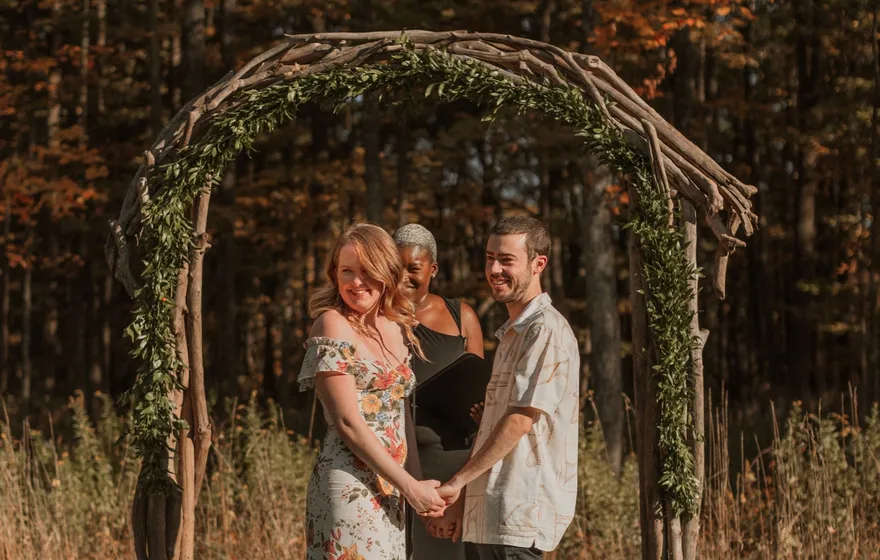
The spine works at any size, from a field with forty guests to a living room with six.
How long should it be, and when do I start writing?
Two questions, two concrete answers.
Length. Write a ceremony that runs about 15 minutes of spoken words, 20 at the absolute most. That keeps the full event, processional to recessional, in the 30-to-45-minute range. Ask any officiant who has done hundreds of weddings and you get the same line: no guest has ever complained that a ceremony was too short. Read your draft aloud, time it on your phone, and cut whatever pushes past 20.
Timeline. Here is the writing schedule I give couples.
Your writing timeline
-
Start drafting
3 to 4 months out
Get the spine down and fill in the parts you already know.
-
Have a finished draft
Two weeks out
My rule: if the ceremony happened tomorrow, it would already be great.
-
Read it aloud, daily
The last two weeks
Read from your printed copy instead of a screen.
That daily reading is the difference between a script that sounds read and one that sounds meant.
If you are writing each section from scratch, my walk-through on how to write a wedding ceremony takes the spine above and shows you exactly what to put in each part.
The mistakes I watch friend-officiants make
I have stood at the front and I have sat in the rows, and the same failure modes keep showing up.
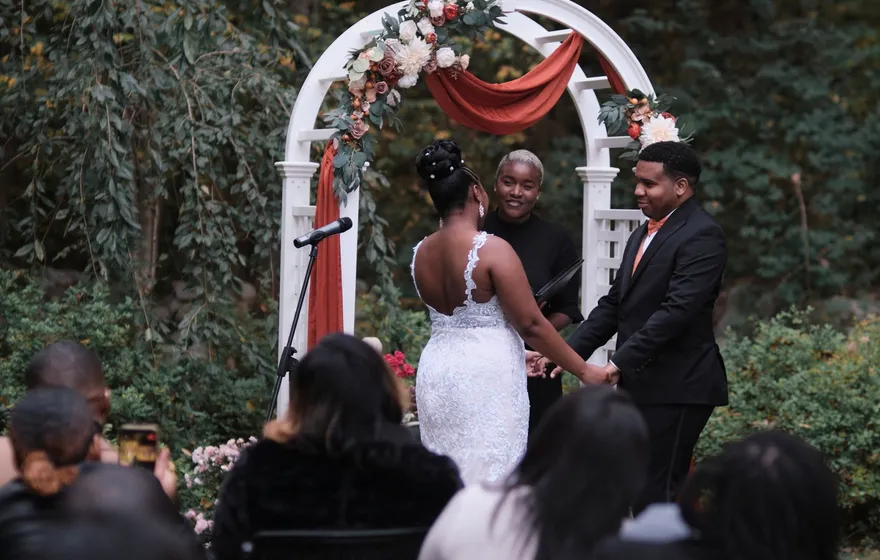
The biggest one is making the ceremony about the officiant. A nervous friend fills silence with jokes, name-drops inside references half the room does not get, or reads a generic script so flatly it sounds like a terms-of-service agreement. The fix is not charisma. It is preparation, plus one rule: the couple sees the full script in advance, no surprises. I once heard of a minister who opened with a line about the couple coming “to ask forgiveness for living in sin,” and the bride’s face fell in front of everyone. That is what happens when nobody reads it first.
The second mistake is logistical, and the fixes are all things you can sort out the week before:
- Use a lavalier or stand mic, not a handheld, so the officiant keeps both hands free to turn pages. In my experience, the handheld is what wobbles a script and traps the page-flipping.
- Print the script big, in a binder.
- Keep a physical backup of the couple’s vows, because someone always leaves theirs in the hotel room.
The scariest second for any first-timer is the moment you turn to face the crowd. Beat it by opening like a person, not a podium, with a real smile and a warm line:
“We made it, are we ready?”
It gets the room answering you, and it settles your own nerves at the same time.
A full DIY ceremony script you can use
Here is a complete, non-religious, copy-ready ceremony. It runs about 14 minutes spoken. The legally required moment and the customary close are marked. Swap the bracketed names, keep or cut the rest, and it is yours.
Welcome and opening
(Officiant faces the guests, smiles, waits for the room to settle.)
“Good evening, everyone. Thank you for being here. I mean that. Some of you flew across the country, some of you just crossed town, and all of you are part of why [NAME] and [NAME] wanted to do this in front of people who love them, instead of quietly at a desk somewhere.
We are here for something simple and enormous at the same time: two people deciding, out loud and on purpose, to build a life together.”
The couple’s story
“[NAME] and [NAME] met [HOW THEY MET, one sentence]. What I know about them is this: [ONE SPECIFIC, TRUE THING THEY DO FOR EACH OTHER]. And [ONE MORE, slightly funny if you can].
A wedding is not the start of their story. It is the moment they put their name to a chapter that has already been the best part of both their lives.”
Reading or pause (optional)
(If you have a reader, they come up now. Otherwise the officiant continues.)
The declaration of intent (REQUIRED)
(Officiant turns to the couple.)
“[NAME], do you take [NAME] to be your spouse, to love and to honor, in the good days and the hard ones, for as long as you both shall live?”
(Partner answers.)
“I do.”
“And [NAME], do you take [NAME] to be your spouse, to love and to honor, in the good days and the hard ones, for as long as you both shall live?”
(Partner answers.)
“I do.”
Personal vows (optional)
(Officiant invites the couple to share their vows. If they are not writing vows, skip straight to the rings.)
“[NAME] and [NAME] have written their own promises. [NAME], whenever you are ready.”
(Each partner reads their vows.)
Ring exchange
(Officiant holds out a hand for the rings, or the ring bearer steps up.)
“A ring is a small thing to carry something this big. Every time you catch sight of it, let it remind you of this exact moment and the people standing here. [NAME], place the ring on [NAME]‘s finger and repeat after me: I give you this ring as a sign of my love, today and every day after.”
(Partner repeats. Repeat for the second partner.)
The pronouncement (customary close)
(Officiant addresses the couple, then the room.)
“By the power vested in me, and with every person in this room as witness, it is my joy to pronounce you married. You may kiss.”
(They kiss. Wait for the cheer to peak before the next line.)
“Friends, it is my honor to introduce, for the very first time, the married [COUPLE’S NEW NAME / FULL NAMES].”
(Recessional.)
Read it aloud once with a timer before you change a word. Most couples end up cutting more than they add.
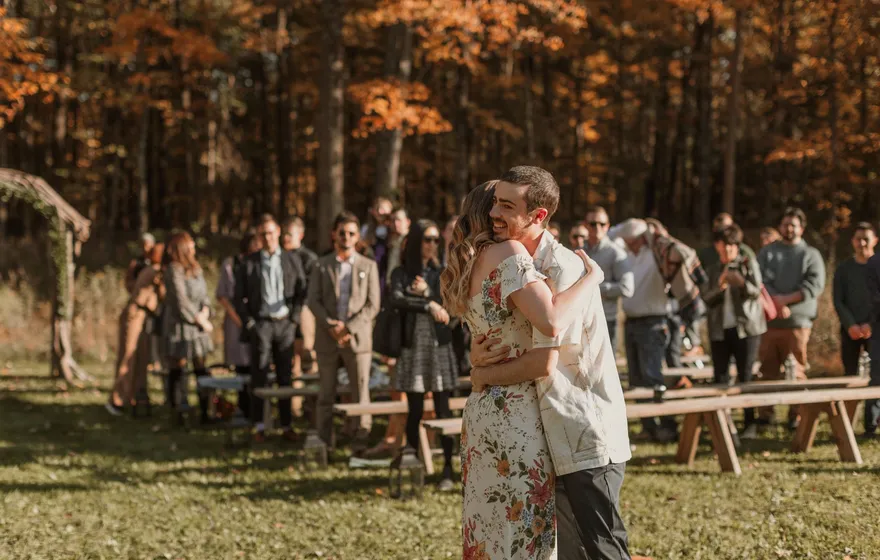
Once the recessional starts, the officiant’s last job is the license, signed before anyone wanders off.
Want a non-religious version, or to flex the declaration?
The script above is deliberately secular, so it works for most couples as written. If you want to go further in that direction, with no spiritual language at all and readings to match, my guide to the secular wedding ceremony gives you the full structure and wording.
You can also rewrite the declaration of intent entirely. The traditional “Do you, [NAME], take…” is one option. A joint declaration, where the officiant asks both partners the question at the same time and they answer together, is another, and it reads beautifully for couples who want symmetry (American Marriage Ministries).
Two ways to ask it
One at a time
“[NAME], do you take [NAME] to be your spouse, to love and to honor, in the good days and the hard ones, for as long as you both shall live?”
Best fit Asked once to each partner, each answering I do. The version in the script above.
Together
“[NAME] and [NAME], do you take each other as spouses, to love and to honor, in the good days and the hard ones, for as long as you both shall live?”
Best fit Couples who want symmetry. They answer together: We do.
The only rule: a version of the consent question gets asked, and it gets answered out loud.
If you would rather not start from a blank page
Writing your own ceremony is genuinely worth doing. It is also a lot of decisions for two people already planning a wedding, and I will not pretend otherwise.
If you want the structure above with the writing already done for you, the Couple’s Ceremony Kit is exactly that: ready-to-use ceremony scripts in several tones, the legal language marked so you cannot accidentally skip it, vow prompts, and the order laid out so your friend-officiant just reads and delivers. It is the done-for-you version of this whole post. If you only want to test-drive one full script first, grab a free sample ceremony script and see how it reads aloud before you commit to anything.
Either way, you now have the spine, the legal moment, the timeline, and a complete script. That is more than most couples start with. Go write the thing.
Frequently asked questions
Is a DIY wedding ceremony legally valid?
Yes, as long as a legally authorized officiant performs it and it includes the part that carries legal weight: the declaration of intent (the couple verbally consenting, the classic “I do”). The pronouncement (the officiant declaring you married) is the customary close, and most officiants treat it as essential. In New York you also need a marriage license obtained at least 24 hours before the ceremony and used within 60 days, plus at least one witness. Vows, readings, and unity rituals are meaningful but not legally required.
Can a friend officiate my wedding?
In most of the US, yes, if they get ordained online through a body like American Marriage Ministries or Universal Life Church. New York needs more care. Its courts have voided marriages performed by online-ordained ministers, so the safer route for a friend there is a one-day marriage officiant license ($25) from the clerk who issued your marriage license. An ordained friend marrying you in New York City must also register with the City Clerk before the ceremony; elsewhere in New York there is no registration step. Always confirm the rule for the exact place you are marrying.
What does the officiant legally have to say?
There are no mandated magic words in most states, but consent has to happen out loud: each partner declares, in front of the officiant and witnesses, that they take the other as spouse (a version of “I do” in answer to a declaration of intent). Officiants then close with a pronouncement. You can rewrite both in your own language. You just cannot skip the declaration or leave consent implied.
How long should a DIY wedding ceremony be?
Aim for about 15 minutes of spoken ceremony, 20 at the outside, which puts the whole thing from processional to recessional around 30 to 45 minutes. Officiants who have done hundreds of weddings agree on one thing: no guest has ever complained that a ceremony was too short. Write it, read it aloud, time it, and cut whatever runs long.
What’s the difference between the declaration of intent and the vows?
The declaration of intent is the legal confirmation that you both want to marry, the “Do you take…” and “I do” exchange, and a version of it is required. Vows are your personal promises and are optional. You can have a ceremony with no written vows at all, but you cannot have a legal one with no declaration of intent.
ALSO READ Wedding Ceremony Script Examples: Templates for Every StyleThe Couple’s Ceremony Kit
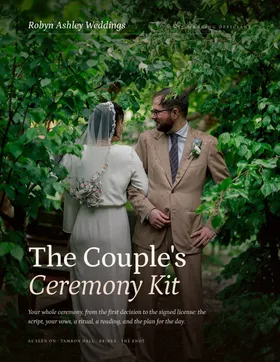
Walk in with a ceremony that sounds like the two of you
This post covers one part of the ceremony, and the Couple’s Ceremony Kit covers the rest, with five full scripts to start from and the prompts I use to help couples write their vows.
- Five full ceremony scripts in five different styles
- The Story Mine, thirty prompts for writing your vows
- Sixteen unity rituals, with the words and what to gather
- Thirty readings, each with my notes on when it fits
CEREMONY SCRIPTS
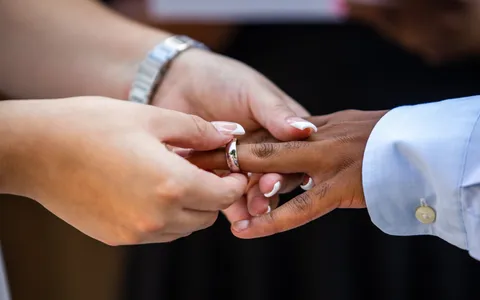
Ring Exchange Wording
A groom once handed me both rings before the ceremony with the kind of relief you give someone holding your wallet at the beach. Twenty minutes later, mid-vow, his hands were.
READ →
CEREMONY SCRIPTS
A Complete Wedding Ceremony Script You Can Actually Use (2026)
A full wedding ceremony script you can read or adapt, with the legal wording included and an officiant's notes on where to slow down and look up.
READ →
CEREMONY SCRIPTS
Wedding Ceremony Script Examples: Templates for Every Style
A few years back, a bride's brother stood up to officiate with his script printed in a font so small he had to hold the page at arm's length. He read the whole thing head-down,.
READ →