CEREMONY
Wine Ceremony: Unity Wine, Wine Blending, and the Script That Won't Taste Like Vinegar
What a wine ceremony is, how wine blending works, the two main versions, how to keep the blend from tasting awful, non-alcoholic options, and a full script. From an officiant who runs them.
A couple once handed me their two ceremony wines an hour before the ceremony and told me they’d never actually tasted them together. We poured a splash backstage. It was rough. Pinot Noir into Pinot Grigio, and the blend came out thin and slightly sour, the kind of thing you smile through on camera and don’t sip twice.
We fixed it in five minutes by keeping the ceremony pour tiny and saving the real glass for the reception. No guest knew. But it taught me the one thing nobody tells couples about the wine ceremony: the symbolism is gorgeous and the logistics are easy, and the taste is the part that quietly goes wrong.
So let me give you the whole thing. What it is, the two versions people confuse, how to pick wines that won’t betray you, the pour quantities that actually look right on camera, what to do if you don’t drink, and full scripts for both versions you can use as written.
What is a wine ceremony?
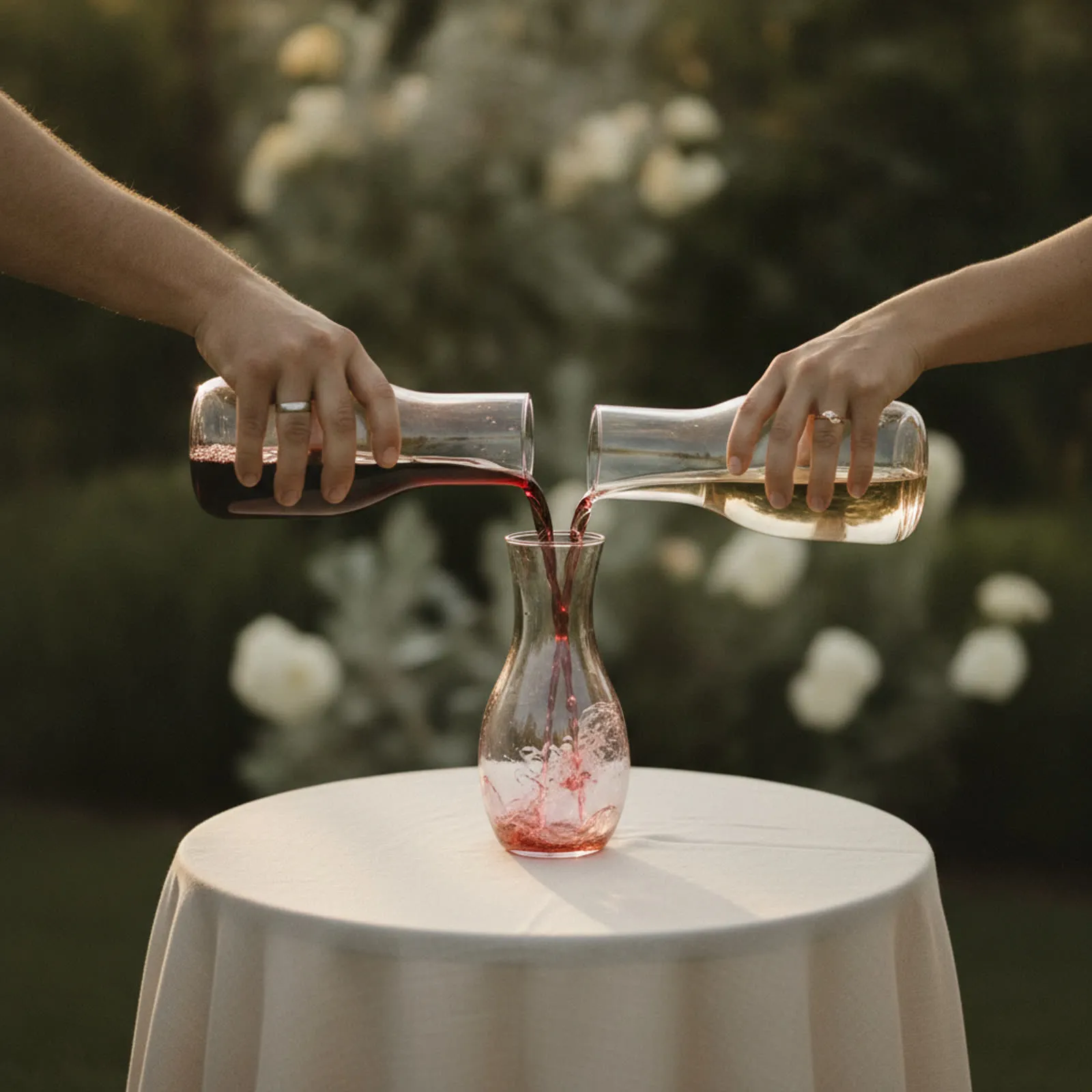
A wine ceremony is a unity ritual where the couple blends two wines, usually one red and one white, into a single vessel to symbolize two lives becoming one. You each pour, you mix, you share the result. It usually happens after the vows and rings, and it adds about five minutes to the ceremony.
Part of why couples pick it: wine carries both sweet and bitter notes, so it stands in for a real life together, the good stretches and the hard ones, rather than a tidy fairy tale.
One thing to clear up immediately, because couples mix these two up constantly.
Wine ceremony vs. wine box ceremony: which one do you mean?
These are different rituals.
| Detail | Ceremony | Wine box |
|---|---|---|
| You drink | That day | An anniversary |
| Vessel | One carafe | A sealed box |
| At the altar | Pour, sip | No pouring |
A wine ceremony is immediate. You blend the wine and drink it during the ceremony.
A wine box ceremony is a time capsule. You seal a bottle of wine, two glasses, and a love letter to each other inside a box, then open it on a future anniversary, often the fifth or tenth. Nothing gets poured at the wedding.
You can absolutely do both. Blend and sip a small wine during the ceremony, then nail a separate bottle into the box for later. But if someone offers you a “wine ceremony,” ask which one they mean before you buy anything.
ALSO READ Wine Box Ceremony: How It Works, the Letters, and the Full ScriptThe two versions of the wine ceremony
Most couples assume a wine ceremony means blending. It’s actually two distinct rituals with different meanings, and choosing deliberately keeps the symbol and the words pointing the same direction.
| Version | Setup | Meaning |
|---|---|---|
| Blended | 2 carafes to 1 | Two become one |
| Bitter-sweet | 2 cups each | Both seasons |
1. Blended wine (two become one)
This is the common one. Each partner pours a wine into a shared carafe, the colors mix, and you both drink from the blend. The metaphor is fusion: two separate things becoming a single new thing that’s yours.
The standard setup is two carafes, one red and one white, beside a larger empty one. You each pour into the big carafe, then one of you fills a glass and offers it to the other, who drinks and returns the gesture.
2. Bitter and sweet (two stay separate)
Here you don’t blend at all. You set out one sweet wine and one bitter wine, and each of you tastes both. The meaning flips: instead of fusion, it’s a promise to take the sweet seasons and the bitter ones together, as they come.
I love this version for couples who’ve already weathered something hard. It’s honest in a way the blend isn’t, and it photographs as two people sharing two cups rather than mixing one. Setup is two small glasses or cups per person, one poured from the sweet bottle and one from the bitter, set in front of each of you before you step up. You’ll find a full script for it further down, right after the blended one.
Once you know which story you’re telling, the rest of the planning follows from it.
The symbol and the script should agree.
Where does the wine ceremony go in the timeline?
The traditional spot is after the vows and rings, near the end, as the seal on what you’ve just promised. Many couples also toast three times here, once to the past, once to the present, once to the future.
But you have a less obvious option. Some officiants open the ceremony with it (source) instead, using the pour and a quick toast to set a loose, warm mood before the vows. I do this when a couple is nervous or when the crowd is small enough to feel like a dinner party. I use the wine to break the tension early, before anyone has to say anything personal.
That five minutes is mostly the walk to the table and the officiant’s framing words; the actual pour and sip take under a minute. To keep it tight, pre-fill the two carafes so nobody opens a bottle live, and tell your photographer in advance that the pour is the shot. Ask them to be at the table before you step up so they’re not scrambling for the angle while wine is already falling.
Both placements work. Just decide before the day so your officiant scripts the transition cleanly.
How a wine blending ceremony works, step by step
A wine blending ceremony
-
Set the table
Before guests arrive
Two filled carafes (one red, one white) and one larger empty carafe or decanter. Use a roughly 750ml (one full wine bottle) empty vessel so the finished blend fills it most of the way; a big two-liter decanter left a third full looks awkward on camera. One glass each, or a single shared glass.
-
Pre-pour the carafes
Put about three to four ounces of wine in each pouring carafe, enough for a clean stream and a shared sip with a little to spare. You don’t need a full bottle each.
-
The officiant frames the moment
A sentence or two while you step to the table.
-
You each pour
Your carafe into the large empty one. Pour slowly; it photographs better and you won’t splash.
-
The colors blend
If you’ve planned for a rosé, you’ll see it shift toward pink.
-
Fill the glass and share
About an ounce
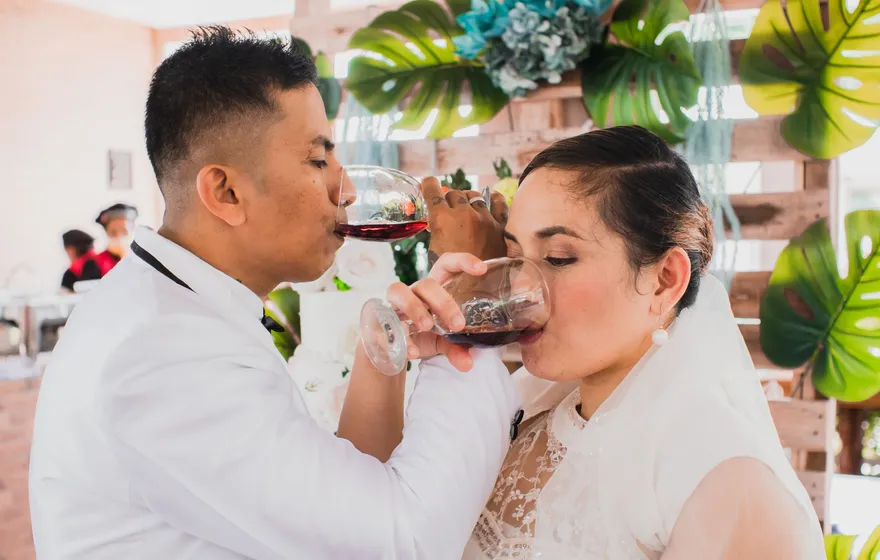
One partner pours from the blend, offers it, the other drinks, then it’s returned. A ceremonial sip is small, about an ounce, just enough to be real on camera.
-
The officiant closes
The officiant closes the moment and moves on.
The pour and the sip together take under a minute, so tell your photographer exactly when it’s coming.
The other thing that trips couples up is the bottles themselves.
How to keep the wine from tasting terrible
This is the real work, and almost nobody does it. Blended wine can taste genuinely bad, and you find out at the altar if you skip the homework.
Here’s the process I give my couples:
- Test at least two or three combinations at home, weeks ahead. Don’t taste once and commit. The first try is rarely the keeper.
- Borrow from commercial blends. If a winery already sells a red-white blend you like, those grapes are proven to play together. If a winery thought the blend was good enough to bottle and sell, it’ll probably work for you too.
- Choose wines that mean something, not wines that win awards. Wine Spectator’s advice for ceremony blends is to pick wines that reflect you (source), by flavor or by name, and have fun. The red from your first-date restaurant and the white from the winery you visited on vacation will mean more than anything a sommelier picks.
- If it still worries you, sip small. Take a ceremonial taste, about an ounce, and save the full glass for the reception. No guest can tell the difference, and you’ve protected the moment.
What ratio makes a rosé?
If you want the blend to turn a soft blush on camera, pour more white than red. Red pigment is strong, so an even split usually gives you a muddy light red, not a clean pink. Start around two parts white to one part red, then dial it in during your test pour.
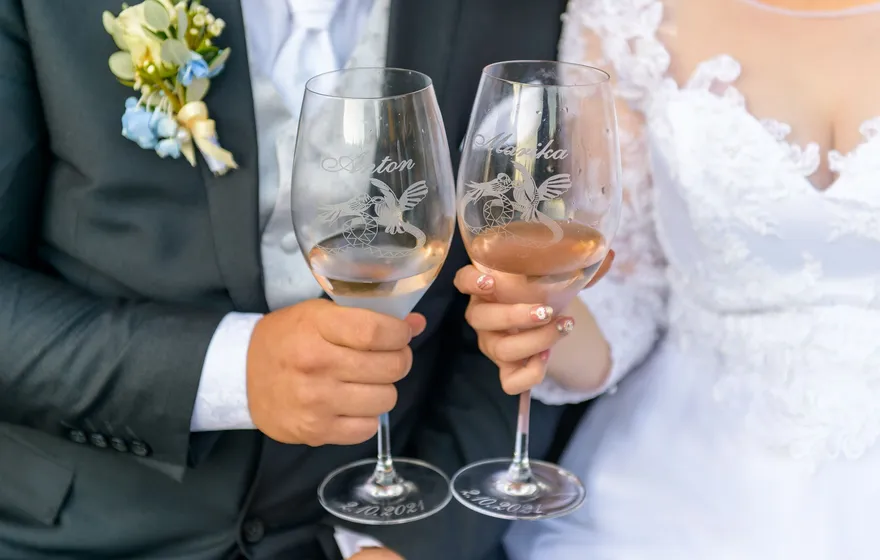
Bottle choice matters as much as ratio. A lighter-bodied red like Pinot Noir or Gamay blushes into a clean rose pink, while an inky Cabernet, Syrah, or Malbec tends to go brown or muddy no matter how little you use. On the white side, a pale crisp wine like Pinot Grigio or Sauvignon Blanc keeps the color clear; a deep oaked Chardonnay can dull the pink toward peach. So if a true blush is the goal, reach for a light red and a pale white before you even touch the ratio.
| Wine | Result |
|---|---|
| Pinot Noir, Gamay | Clean pink |
| Cabernet, Syrah, Malbec | Muddy |
| Pinot Grigio | Keeps it clear |
| Oaked Chardonnay | Dulls to peach |
Can you do a wine ceremony without alcohol?
Yes, and you shouldn’t treat it as a downgrade. Swap in grape juice, sparkling cider, non-alcoholic wine, or even ginger beer. The symbolism lives in the pouring and the sharing, not in the alcohol.
This matters for more couples than people admit. If either of you is sober, if you’ve got kids in the wedding party, or if family members don’t drink for religious reasons, a non-alcoholic blend lets everyone take part without anyone feeling singled out.
A few real gotchas to plan around, though:
- Taste-test it anyway. Non-alcoholic red and white still need the same taste test as the real thing; some NA reds run sweet and clash with a dry NA white, so try the combo at home first.
- One fizzy pour at most. Skip pouring two sparkling options (cider, NA sparkling wine, ginger beer) into the same vessel at once, because the combined fizz can foam right over the rim mid-pour.
- Watch opacity. Dark grape juice can read as one solid color on camera, hiding the blend you came to show, so a lighter juice or a clear-ish NA white lets the colors actually mix in view.
Get those three right and the non-alcoholic version runs exactly like the real one.
The cultural roots worth knowing
Wine has been part of marriage rites for thousands of years (source), so the modern blending ceremony sits on top of some deep traditions. A few are worth understanding before you borrow from them.
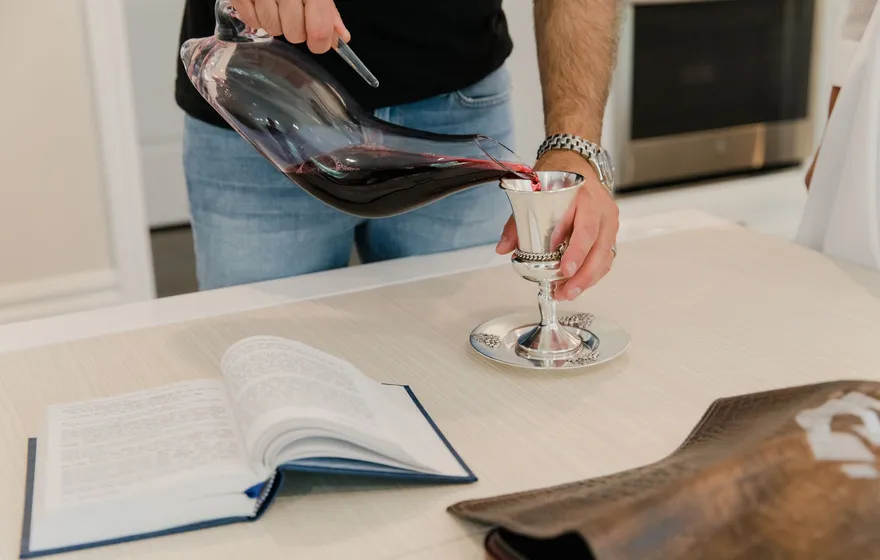
The Greek Orthodox Common Cup is not a blending ritual. The couple takes three sips from a single cup of sweet red wine, the three representing the Holy Trinity, signifying that from now on they share everything: their joys doubled, their sorrows halved. If you’re marrying in the Greek Orthodox tradition, this is a specific religious rite with real theology behind it, not a symbol you mix and match.
You’ll also see the ritual under older names: the Loving Cup, the French Coupe de Mariage, “Laying Down Wine,” and “Fruits of Creation.” Same family, different lineage. If a name resonates, use it; it adds a thread of history to a young ritual.
Ways to personalize the wine ceremony
The ritual takes customization well. A few of my favorites:
- Pick wines tied to your story. The red from a favorite restaurant, the white from a vacation winery. Then your officiant can name them, which turns a generic pour into your specific history.
- Include your parents. In a family version, a representative from each side brings their own wine and pours it in too, then the parents drink from the blend to mark the joining of two families. Lovely for blended or multicultural weddings.
- Use a meaningful vessel. An heirloom decanter, a glass from a grandparent, a piece you’ll keep on a shelf afterward.
- Combine it with a wine box. Blend and sip during the ceremony, then seal a separate bottle in a box to open on your fifth anniversary.
If you want a drink ritual you seal away instead of sharing now, see the wine box ceremony or the whiskey unity ceremony. To see how this sits next to candles, sand, handfasting, and the rest, the unity ceremony ideas guide compares them all.
Common worries, handled
“What if I spill?” Pour slowly into a wide carafe over a tray or runner. Spills happen at the rim of narrow glasses, not into a roomy decanter.
“What if I blank on my lines?” You don’t have lines. The officiant carries the words; you pour and drink. That’s the beauty of this ritual versus, say, writing your own vows.
“What if guests don’t drink?” Covered above. Non-alcoholic blend, taste-tested and scripted the same way.
“When shouldn’t we do it?” Skip it if neither of you cares about wine and you’re only doing it because it’s expected. A ritual that doesn’t mean anything to you reads as filler. Pick something that’s actually yours.
The full wine ceremony script (blended)
This is the blended version, placed after the vows and rings. Swap the bracketed details and you’re ready.
OFFICIANT:
[Partner A] and [Partner B] have chosen two wines for this moment. [Partner A] brings a [red, name it: a Cabernet from the restaurant where they met]. [Partner B] brings a [white, name it: the wine from the vineyard they visited]. Each one came from its own place, its own story, complete on its own.
[The couple each pour their wine into the shared carafe.]
But today they’re choosing something new. As these two wines become one, they can never be separated back into what they were. That’s the promise of a marriage: not that you give up who you are, but that you become part of something neither of you could be alone.
Wine carries the sweet and the bitter both, and so will the years ahead. [Partner A] and [Partner B], may you take all of it together.
[One partner fills the glass, offers it to the other, who drinks, then returns the gesture.]
Drink, and let this be the first thing you share as a married couple.
[They share the glass.]
What you’ve blended here, you’ll carry forward. Together, and undivided.
The full wine ceremony script (bitter and sweet)
This is the version where the wines stay separate. Each of you has a sweet wine and a bitter wine set in front of you, two small cups apiece. Use it when your story is about weathering the hard seasons together, not melting into one.
OFFICIANT:
In front of [Partner A] and [Partner B] are two wines. One is sweet. One is bitter. Together they hold the truth of any life shared: there will be seasons of each, and you rarely get to choose the order they come in.
First, the sweet. [Partner A] and [Partner B], drink to the joy you already know and the joy still ahead, the easy mornings and the celebrations and the days that need no work at all.
[Both partners drink from the sweet cup.]
Now, the bitter. Drink to the seasons that ask more of you, the losses and the hard stretches and the years that test what you’ve built. You will face those too, and you choose to face them side by side.
[Both partners drink from the bitter cup.]
[Partner A] and [Partner B], you have tasted both today on purpose. You are not promising only the sweet. You are promising to stay through the bitter, and to keep reaching for each other across all of it.
[The couple join hands.]
Take the sweet seasons and the bitter ones together, as they come, for the rest of your lives.
Both scripts run about the same length, so pick the one whose words match your story and you’re done.
Get every script, version, and variation
The two scripts above are yours to use. If you want the full set, the Couple’s Ceremony Kit has both of these plus the family-inclusive pour and fifteen other rituals, each with the delivery cues I actually use and a setup checklist so nothing gets fumbled on the day.
Unsure the wine ceremony is your match? Take the free Unity Ceremony Quiz. Two minutes, and it points you to the ritual that fits your story instead of the one that’s trending.
Frequently asked questions
Wine ceremony or wine box?
Wine ceremony is blend-and-drink now. Wine box is a sealed time capsule for a future anniversary. You can do both.
Will the blend taste bad?
It can. Test two or three combinations ahead of time, or borrow a proven commercial blend. Sip small if you’re unsure.
No alcohol?
Use juice, cider, non-alcoholic wine, or ginger beer. Taste-test the swap and keep the script the same.
What ratio makes pink?
More white than red, and a lighter red. Start around two parts white to one part red, using a Pinot Noir or Gamay rather than a Cabernet.
Where in the ceremony?
Usually after vows and rings, but opening with it works for a looser mood.
The Couple’s Ceremony Kit
Walk in with a ceremony that sounds like the two of you
This post covers one part of the ceremony, and the Couple’s Ceremony Kit covers the rest, with five full scripts to start from and the prompts I use to help couples write their vows.
- Five full ceremony scripts in five different styles
- The Story Mine, thirty prompts for writing your vows
- Sixteen unity rituals, with the words and what to gather
- Thirty readings, each with my notes on when it fits
CEREMONY
Caribbean Wedding Traditions Worth Keeping
A couple sat in my office in Crown Heights, both second-generation, one side Guyanese and one side Trinidadian, and the bride said, "We want it to feel Caribbean, but we don't.
READ →
CEREMONY
What Is a Unity Ceremony? The Complete Guide
What a unity ceremony is, where it fits in your wedding, and how to choose the right ritual, from an officiant who's performed them at 300+ weddings.
READ →
CEREMONY
African Wedding Traditions, Explained With Respect
African wedding traditions by people and region: the Akan knocking, the Yoruba engagement, the Igbo kola and wine-carrying, libation, aso ebi and the broom, with how to include one or two without flattening them.
READ →