PLANNING
Microwedding Guide: How to Plan a Small NYC Wedding
What a microwedding really is, the guest-count range, an honest NYC budget, and how to plan one where the ceremony carries the day.
A couple booked me last spring for nineteen guests in a SoHo loft. Halfway through their vows, the groom’s grandmother, who had flown in from Kingston and barely knew a soul in the room, started crying so openly that the bride stopped, walked three steps off her mark, and held her hand for the rest of the reading. Nobody minded. There was no timeline barreling toward a 200-person dinner seating, so the day just made room for it.
Here is what nobody tells you about a small wedding. When the guest count drops, the ceremony stops being the part everyone waits through and becomes the actual event. I have stood at the front of plenty of these rooms, and the intimacy people want does not come from the small space. It comes from what gets said inside it.
So let me give you the real picture: what a microwedding actually is, how it differs from the two terms people mix it up with, what it costs in this city, and how to plan one where twenty people feels like more than enough.
The definitions come first, because the label you pick changes what you plan.
What is a microwedding, exactly?
A microwedding is a real wedding, scaled down. You keep the ceremony, the meal, the toasts, the cake, the first dance, all of it. You just cap the guest list, usually around fifty people, and most couples I work with end up somewhere between twenty and fifty (WedSociety).
The word “micro” throws people. They picture something stripped down to almost nothing. It is closer to the opposite. You are running a full wedding with fewer chairs, which means every chair holds someone who genuinely matters.
Microwedding vs minimony vs elopement
These three terms get used as if they mean the same thing. They do not, and the difference matters, because it changes how you plan and what you spend.
An elopement is the couple, full stop. Maybe one or two witnesses, sometimes a tiny group of up to ten, but the whole point is that it is just you two. If you want the long version of that path, I wrote a full NYC elopement guide and a step-by-step on how to elope in NYC.
A minimony is the one people get wrong most often. It is a small present-day ceremony, roughly eleven to twenty-five people, with no meal served. The food is the dividing line. A minimony skips the dinner and works as a placeholder, a real ceremony now with the big celebration pushed to later. A lot of couples did exactly this during the 2020 stretch and never realized it had a name.
A microwedding keeps the meal. That is the whole distinction in one word. Ceremony, dinner, toasts, cake, the works, scaled to fifty or fewer (WedSociety).
| Format | Guests | Meal |
|---|---|---|
| Elopement | Up to about 10 | Optional |
| Minimony | About 11 to 25 | No |
| Microwedding | 20 to 50 | Yes |
The meal column is the one that decides it.
That’s also why the cost question looks different for each of the three.
How many guests is a microwedding?
Most run between twenty and fifty, and fifty is the usual ceiling. Drop below ten and you are functionally eloping. Sit in the eleven-to-twenty-five range with no dinner and you have a minimony.
I will be honest about something that range hides. The number is the easy part. The cut is the hard part.
In almost every small-wedding conversation I have, the guest list is where couples actually struggle, and it is rarely about money. It is about who gets left out and how that goes over with family. Couples on the wedding forums say the same thing again and again: the budget was never the painful part. The cut was.
The couples who handle it well do the same two things. They build priority tiers, an A-list of people the day cannot happen without, then a B-list, and they hold one consistent rule for who makes the cut. “Only people we have spoken to in the last year.” “No plus-ones for anyone we have not met.” Whatever the rule is, it has to apply to everyone, because the second you make one exception, the whole list unravels and you are back to 120 people.
How much does a microwedding cost?
This is the part people come for, so let me give you real numbers instead of a shrug.
Nationally, guest count is the single biggest lever on what a wedding costs, because catering, rentals, invitations, and favors are all priced per head. Cut the list, cut the cost. That math is reliable.
Now the part that surprises everyone. Couples who go micro routinely spend more per guest than couples at traditional weddings. The savings do not get pocketed. They get redirected. Better food, real photography, florals that show up in every photo because there are fewer tables to spread them across.
In NYC, the format you choose moves the number more than anything else.
At the floor is City Hall. A Manhattan Marriage Bureau ceremony is $60 total, a $35 license plus a $25 ceremony fee, performed by a clerk in under two minutes, by appointment only, with room for one witness and no other guests. That is the legal minimum to be married in this city.
At the other end is a restaurant or loft buyout, and this is where couples get blindsided. NYC venues like these almost never charge a flat fee. They charge a food-and-beverage minimum spend, and it swings hard by day and time. A weekend evening buyout can run well into five figures, while the same room for a daytime event or an off-peak brunch often costs a fraction of that. Ask for the minimum on three or four different days before you compare venues.
The lesson buried in all of this: move your wedding off Saturday night. A Friday lunch, a Sunday brunch, a weekday afternoon, any of them can cut your venue spend by half or more for the exact same room.
How to plan a microwedding in NYC
Here is the order I would actually do it in.
Planning a microwedding, in order
-
Lock the guest count first
It decides everything downstream: the venue, the budget, the format. Pick the number before you fall for a space, not after.
-
Get the legal piece moving
Apply together for your NYC marriage license, in person or by virtual appointment; it’s $35 and valid for 60 days, counted from the day after it’s issued. Then plan around the rule that catches people every time: New York has a mandatory 24-hour waiting period between when the license is issued and when you can legally marry. Only a judge can waive it (NYC Office of the City Clerk). You also legally need just one witness besides your officiant. I walk couples through the full paperwork in my getting married in NYC guide, which is the hub for everything legal in this city.
-
Pick a space with built-in character
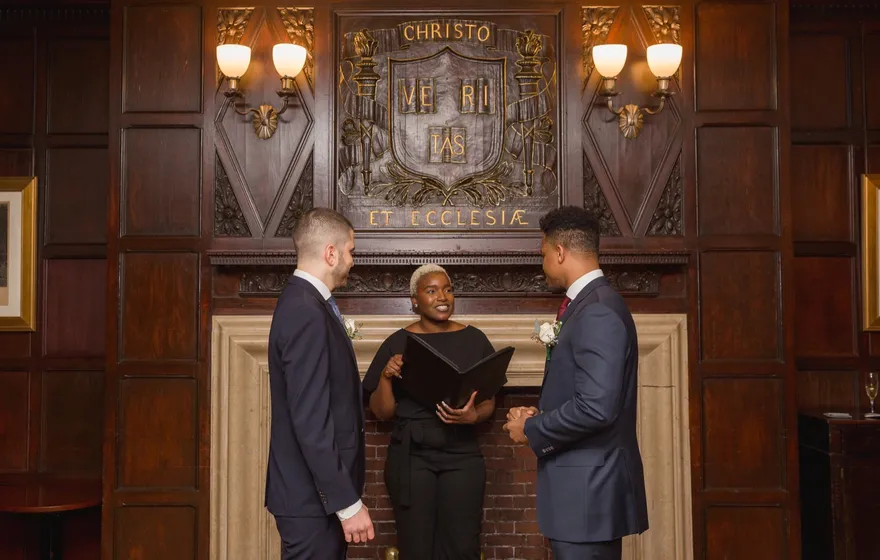
The NYC microwedding trend has moved away from ballrooms toward rooms that already look like something. With fewer tables to dress, your budget goes further on candlelight, linens, and high-impact florals. If you want a running list of small rooms that work for this, I keep one in my roundup of intimate wedding venues in NYC.
-
Confirm the pricing model
Flat fee, or minimum spend? This one question changes your whole budget, so ask it on the first call.
-
Put the savings into the ceremony
This is the step couples skip, and it is the one that decides whether twenty people feels rich or sparse.
For step three, these are the kinds of rooms I see couples choose most:
- SoHo lofts
- Penthouses with skyline views
- Rooftops
- Gardens
- Restaurant private rooms
Whichever room you pick, ask how many people it seats for dinner, not just for the ceremony.
If you want help narrowing the list, the venue roundup below is where I’d start.
ALSO READ 20 Intimate NYC Wedding Venue IdeasWhy the ceremony carries a small wedding
At a 200-person wedding, the ceremony is a formality the crowd sits through on the way to cocktails. At a twenty-person microwedding, the ceremony is the event, and there is nowhere for a thin, generic, downloaded-off-the-internet script to hide.
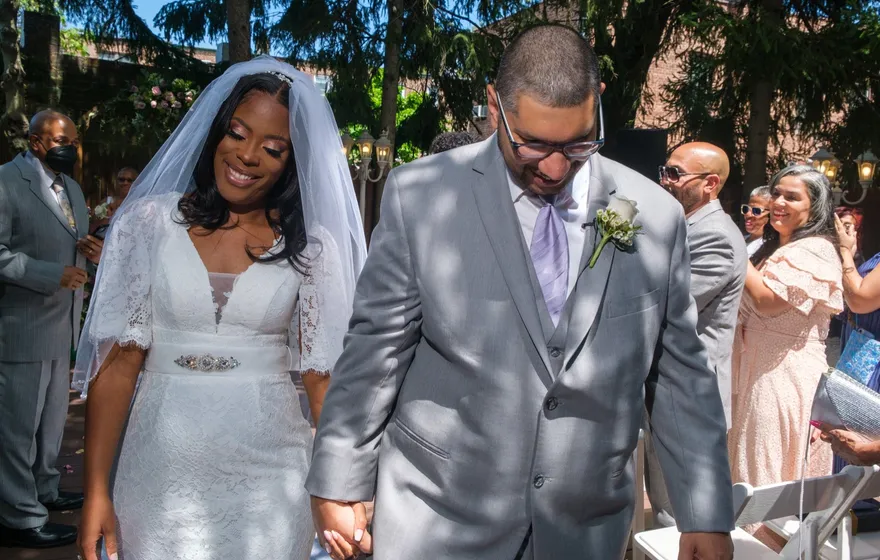
I can always feel it when I am standing up there. In a big room, a flat line in the script gets swallowed by the sheer size of the crowd. In a small room, every word carries to every face, and a generic one falls flat in a way everyone notices, even if they could not tell you why.
So the writing has to do more, and here is the good news: with twenty guests, it can. There is no reception clock forcing a rushed service, so the ceremony can breathe for a relaxed twenty to thirty minutes. And the moves that make a small group feel held are specific, and you can learn them.
Address guests by name. Name why each person made the cut, because at this size, you genuinely can. Work in a detail only that room would know. When I officiate these, I will sometimes say, out loud, that the reason there are only nineteen people here is that these are the nineteen who have actually held this couple through something. I say it because it is true, and everyone in that room knows it.
Here is a real, copy-ready piece you can hand to whoever is officiating, the kind of opening I use to make a small group feel addressed instead of observed.
Officiant, to the guests:
“Before we begin, look around this room. There are not many of you here, and that is the entire point.
[Couple] could have invited two hundred people. They chose you. Every person in these chairs is here because, at some point, you held one or both of them through something that mattered. You are not the audience today. You are the reason the day looks like this.
(pause, let it sit)
So this will not be a ceremony you watch. It is one you are inside of. When I ask you, later, to keep these two in your lives the way you have kept them in this room, I am going to mean it, and I am going to be looking right at you when I say it.”
Officiant, turning to the couple:
“[Partner A] and [Partner B], you built a small wedding because you wanted a real one. Let’s give it to you.”
(transition to vows or reading)
Do people regret a small wedding?
I will not pretend everyone walks away thrilled. The honest answer, from real couples, is that it is split.
Plenty of people who cut to around seventeen guests describe a stress-free, ten-out-of-ten day, the kind where they got to actually talk to every single person who came. Others say it went by too fast, or that afterward it did not quite feel like they got married, even with the paperwork signed.
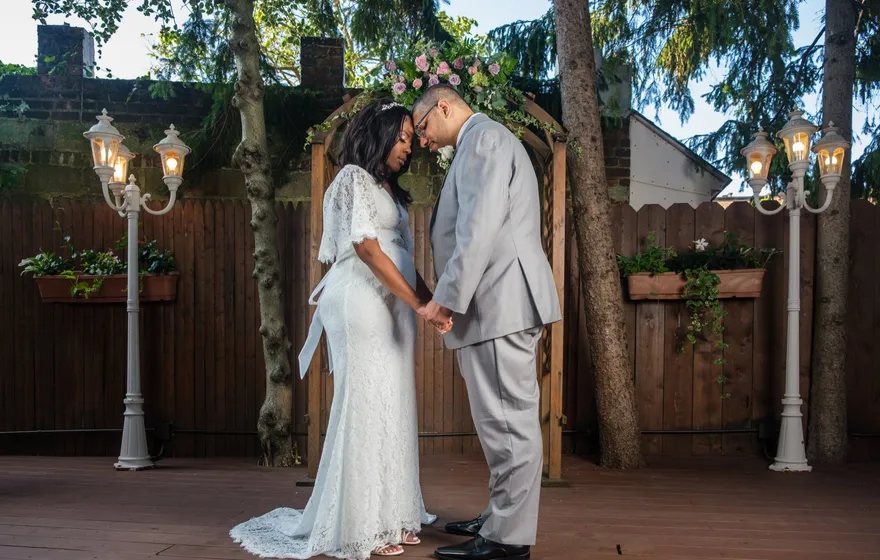
When I read that split, I do not see a coin flip. I see the difference between couples who treated the ceremony as the main event and couples who treated it as the part before lunch. The day that felt too fast and forgettable was usually a day where nothing was built to hold weight. The day people called the best of their lives had a ceremony with something in it worth slowing down for.
That is the whole game. A small wedding does not protect you from a forgettable one. A well-built ceremony does.
A small word on getting the ceremony right
If you are planning a microwedding in NYC and you want the ceremony to actually carry the day, this is the part I do for a living. I write and perform ceremonies for small rooms across the city, and the work is specific: a script that names your people, paces for an intimate group, and speaks to twenty guests directly instead of performing at them. If that is what you are after, you can tell me about your day and check my date.
If you are writing it yourselves, or a friend is officiating, that is a real and good choice too. Start with my walkthrough on how to write a ceremony, grab a free sample ceremony script to work from, and if you want the full set of templates, vows, and a ceremony order you can adapt to your guest count, that is exactly what the Couple’s Ceremony Kit is built for.
Microwedding FAQ
What is the difference between a microwedding, a minimony, and an elopement?
An elopement is the couple alone or with one or two witnesses, up to about ten people. A minimony is a small present-day ceremony of roughly eleven to twenty-five people with no meal served, usually with a bigger celebration planned for later. A microwedding is a full wedding scaled down to fifty guests or fewer, most often twenty to fifty, that keeps the ceremony, dinner, toasts, and traditional moments intact.
How many guests is a microwedding?
Most microweddings run twenty to fifty guests, with fifty as the usual ceiling. Below about ten you are closer to an elopement. In the eleven-to-twenty-five range with no meal served, it reads as a minimony instead.
How much does a microwedding cost?
Guest count is the biggest lever on what any wedding costs, so a microwedding usually comes in well under a full-size one. In NYC it swings hard by format: a City Hall ceremony is $60 total, while a restaurant or loft microwedding is priced on a food-and-beverage minimum that runs far higher on a Saturday evening than at a daytime event, before a service charge that can approach 30 percent, tax, and card fees.
Is a microwedding worth it, or will I regret a small guest list?
Couples are genuinely split. Many who cut to fifteen or twenty guests describe a relaxed day where they actually spent real time with everyone. A minority say the day felt too fast or did not feel like a wedding. The deciding factor is rarely the headcount. It is whether the ceremony was built to carry the day, and the hardest part for most couples is the guest-list cut itself, not the budget.
How long is a microwedding ceremony and how do you make it meaningful?
Without a large reception clock forcing a rushed two-minute service, a microwedding ceremony can run a relaxed twenty to thirty minutes. The intimacy comes from the writing, not the room. Personal vows, a friend or family member reading or blessing the rings, and an officiant who addresses guests by name and says why each one is there will do more than any centerpiece.
BOOK YOUR CEREMONY
Need help with your ceremony?
Tell me about your day. I will write back the same week.
AVAILABLE 2026 + 2027
PLANNING
Where to Elope in NYC: Best Spots, Costs & Packages
Last spring I married a couple at Wagner Cove on a Saturday in May, peak season, the lake full of rowboats. They'd braced for chaos. We tucked under that little wooden gazebo, the.
READ →
PLANNING
Wedding Processional Order
At a rehearsal in Central Park last spring, the bride's divorced parents hadn't been in the same room in eleven years. We had ninety seconds of aisle to get through, and the whole.
READ →
PLANNING
NYC Marriage License: Step-by-Step Guide (2026)
A couple once called me from a hotel lobby an hour before their rooftop ceremony, panicked. They'd picked up their license at 4 PM the day before, and the rooftop slot was 3 PM..
READ →