CEREMONY
How to Write a Unity Ceremony Script: The 5-Step Formula I Use for Every Ritual
The exact 5-step formula I use to write unity ceremony scripts that don't read like greeting cards, plus movement cues, personalization questions, and how to script around wind, fire, and awkward silence.
The first unity ceremony I ever botched was a candle lighting on a rooftop in Long Island City. I’d written a gorgeous explanation, two full paragraphs about flame and warmth and two lives joining. Then I stopped talking and let the couple light the candle. In silence.
It took maybe forty seconds. It felt like four minutes. The bride’s hands started shaking under everyone’s stare, the wick wouldn’t catch in the breeze, and a hundred guests held their breath while two people fumbled with a lighter and no one said a word. By the time the flame took, the moment was gone.
I’ve performed more than 300 ceremonies since, and I’ve folded a unity ritual into most of them. That rooftop taught me the lesson that changed how I write every script: the ritual is just an action. Pouring sand, lighting a candle, tying a cord. The script is what turns that action into a moment, and the script has to keep moving while the couple’s hands are busy.
This is the exact formula I use, the questions I ask before I write a word, and the failure modes that will sink you if you don’t script around them.
Here’s how each piece works.
What is a unity ceremony script?
A unity ceremony script is the officiant’s spoken words for a symbolic ritual that represents two lives becoming one. The script does three jobs at once: it tells guests what they’re watching, it tells them what to feel, and it gives the couple something to listen to so they’re not performing in silence.
The ritual itself can be almost anything. There are at least sixteen distinct types of unity ceremony in common use, from sand and candles to handfasting, wine boxes, and tree planting. The action changes. The way you write the words around it doesn’t.
A good unity script runs two to three minutes from first word to final cue. That’s the average duration when you include both the officiant’s words and the couple’s movements. In words you can actually count, that’s roughly 250 to 350 spoken words. Short enough to keep the ceremony’s pacing, long enough to let the ritual breathe.
The 5-step formula for writing a unity ceremony script
Every unity script I write follows the same five steps, in this order. I didn’t invent it. It’s the officiant’s formula (source) that works for any ritual, and once you internalize it you can write a script for a ceremony type you’ve never done before in about fifteen minutes.
Step 1: Explain the significance
Before anything moves, tell guests why this matters. Don’t name the ritual yet. Set the emotional frame first.
This is one or two sentences on what the act represents. Two lives joining, two families merging, something permanent being made from two separate things. Guests need to know what to feel before they’re told what to watch.
Step 2: Name and describe the ritual
Now tell them exactly what’s about to happen. Plainly. Don’t assume your guests know what a handfasting or a sand pour is, because many of them don’t.
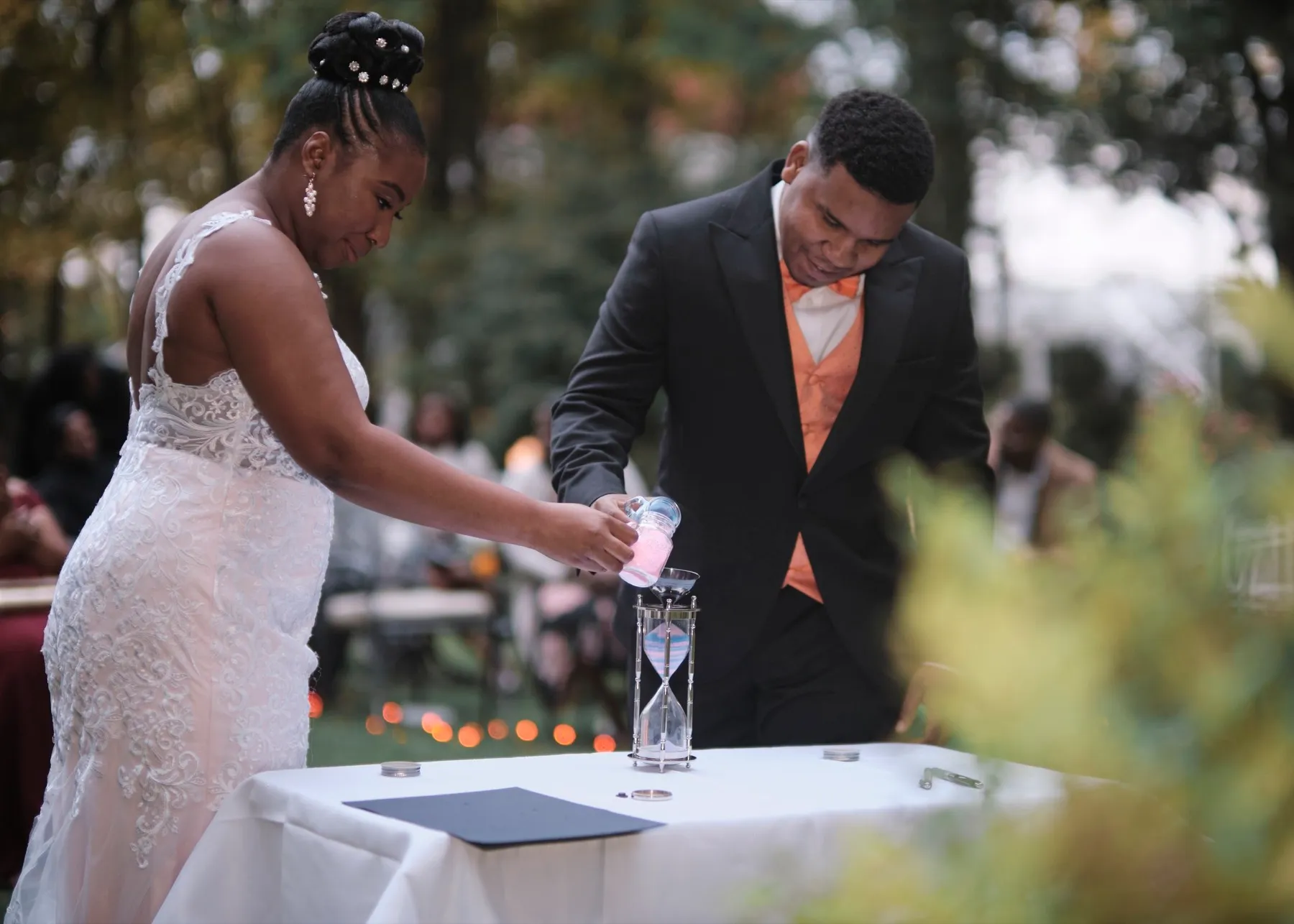
“In a moment, [Name] and [Name] will each pour a different color of sand into this single vase.”
That’s it. Clear, literal, no mystery. Confused guests can’t be moved guests.
Step 3: Set it in motion
This is the step that saves you from my rooftop disaster. As the couple begins to move, you keep talking. Your words cover their actions so there’s never a beat of silence.
You narrate gently while they pour or light or tie. Skip the play-by-play. Keep it a continuation of the meaning, timed to their hands. The moment they pick up the sand, you should already be mid-sentence about what those separate colors mean.
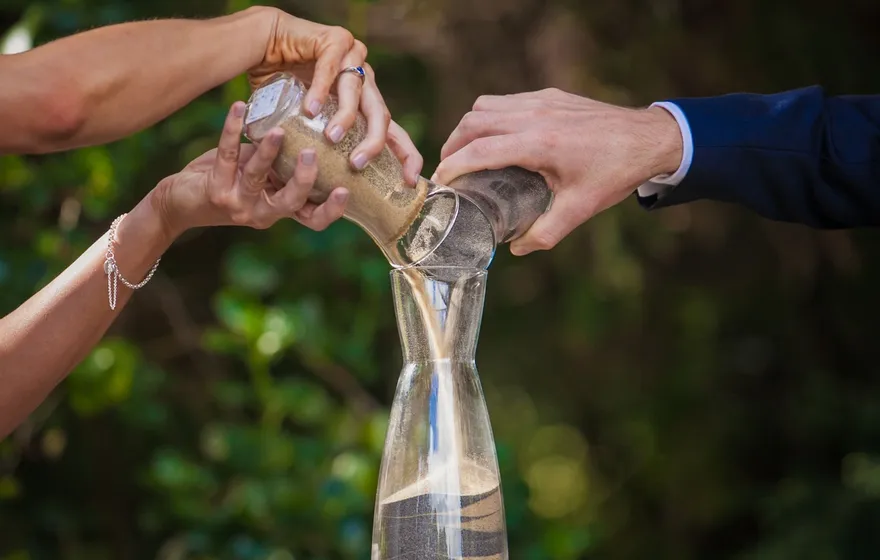
Time the pour at rehearsal, then write enough narration to cover it with a few seconds to spare.
Step 4: Add personal context
This is the step most free templates skip, and it’s exactly why most free templates feel flat. After you’ve explained and named and narrated, you tie the ritual to this specific couple. One real detail about the people standing in front of you does more emotional work than three paragraphs of borrowed poetry.
This is the hardest step to do well, so it gets its own section below, with the exact questions I ask and a before-and-after that shows the difference.
Step 5: Plan the return
When the ritual is done, the couple needs to know what happens next. Do they step back to where they stood? Does a child rejoin the parents? Does the officiant pick up the vase?
Write the transition. A single line that resolves the moment and moves the ceremony forward. Without it, you get that little shuffle where the couple looks at you, then at each other, then at their feet, waiting for permission to move.
How to choose the right unity ritual for the couple
You can’t write a good script for the wrong ritual. Match the ritual to the couple and the venue before you write anything.
Here’s the quick version before the detail.
| If they want | Ritual |
|---|---|
| A shelf keepsake | Sand ceremony |
| Candlelit, indoors | Unity candle |
| Ancient roots | Handfasting or the lazo |
| A payoff years later | Wine box time capsule |
| No open flame | Sand or handfasting |
Here’s how I steer couples, based on what they actually care about.
- They want something that photographs and sits on a shelf. Sand ceremony. The layered vase is a keepsake, and it’s nearly impossible to ruin. See my full unity sand ceremony script for the word-for-word version.
- They want classic and candlelit, indoors. Unity candle. Just know it’s a recent tradition, not an ancient one, which matters for the next group.
- They want ancient roots and real history. Handfasting. It’s the oldest unity ritual we have, a braided cord tied around the couple’s hands, dating back roughly 2,000 years to Celtic tradition. For Catholic Latinx or Filipino couples, the lazo (a cord looped around both partners) dates to the seventh century.
- They’re romantics who think long-term. Wine box time capsule. The couple seals love letters and a bottle of wine in a wooden box during the ceremony and agrees to open it on a future anniversary. It’s a delayed-gratification ritual that keeps paying off years later.
- They’re outdoors in wind or have a no-flame venue. Anything but a candle. Sand, handfasting, tree planting, or a puzzle ceremony are the weather-resistant options (source) that work in any conditions.
If a couple tells me they want something “traditional,” I always mention that the unity candle is actually quite young (source). It became popular in the 1970s and 80s and spiked after a 1981 soap-opera wedding. It has no biblical or apostolic origin. Couples who want genuine depth often light up when I offer handfasting or the lazo instead.
Where does the unity ceremony go in the script?
Standard placement is after the vows and ring exchange, before the pronouncement. There’s a reason that’s the default.
By that point the couple has already spoken their vows and exchanged rings, so the emotional buildup is there. The ritual breaks up the standing, adds visual interest, and gives the photographer a different frame, all without disrupting the ceremony’s flow. It’s the recommended position (source) for exactly these reasons.
The exception is a complex outdoor setup. If the ritual needs a fire to catch or a tree to be planted with shovels, sometimes I move it earlier so any fumbling happens before the emotional peak rather than during it. Religious tradition can also dictate placement, so ask first.
How to script the movement, not just the words
A script that’s all dialogue and no stage direction will fall apart the second the couple has to actually do something. I write the movement cues right into the script, in italics, so I’m reading both at once.
Think through every micro-decision before the day. Where do they stand? Whose container do they pick up first? If parents lit taper candles, do they step away after, and when? What happens if someone drops the lighter or the cork rolls off the table? The goal is that the couple never has to guess, because every move is one they’ve already heard you cue.
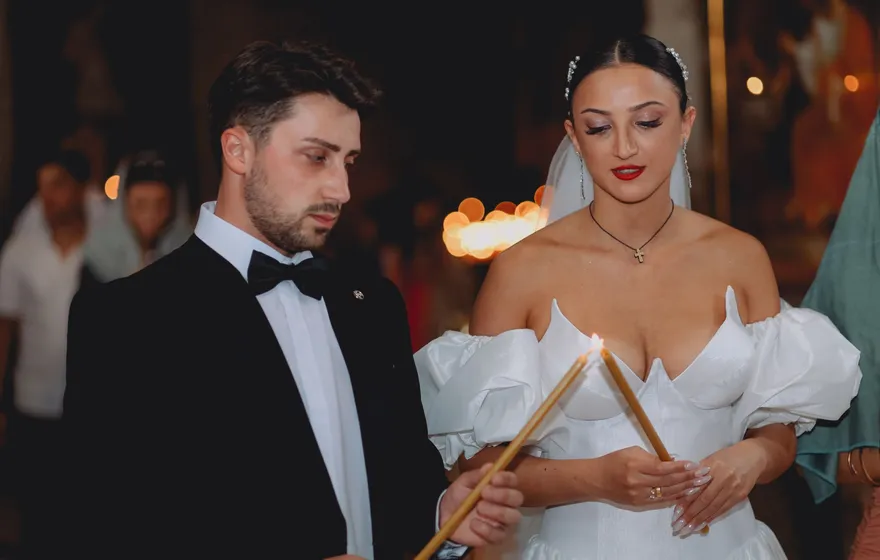
Here’s what that looks like on the page. This is a short handfasting passage written the way I’d actually run it, words and movement braided together.
OFFICIANT:
[Name] and [Name] have chosen to bind their hands in the oldest of these traditions. For thousands of years, couples have tied their hands together to make a promise visible, where everyone can see it. This is where we get the phrase “tying the knot.”
[Officiant gestures for the couple to face each other and join their right hands.]
Please join your right hands. These are the hands that will hold each other through everything that’s coming, the ordinary mornings and the hard nights and all the years you can’t picture yet.
[Officiant drapes the cord across the couple’s joined hands and begins to wrap.]
As I wrap this cord, know that the binding isn’t what keeps you together. The cord will come off in a few minutes. What holds is the choice you’re making, freely, to keep choosing each other.
[Officiant ties the final knot, then rests both hands briefly over the couple’s.]
The knot is tied. You may lower your hands, and we’ll leave the cord in place for the rest of the ceremony.
Notice that there’s never a silent stretch. While the cord is being wrapped, the words are still going. That’s step three doing its job.
How to make a unity ceremony script personal
All of step four comes down to the questions you ask before you write a word. Get the answers and the personal lines write themselves. Skip the interview and you’re back to borrowed poetry. The difference between a script guests forget and one they bring up at dinner (source) is usually one good answer to one of these questions.
Here’s my actual pre-script questionnaire:
- Why did you choose this particular ritual? (The answer is always more interesting than the generic symbolism.)
- Do the colors or objects mean anything? A grandmother’s vase, a favorite color, sand from a beach that matters?
- What’s one milestone that defines your relationship? First date, the move-in, the trip where you knew?
- Is there a hobby, place, or inside reference that shows up everywhere in your life together?
- Anyone else who should be part of this, like kids or parents?
Then I take one or two answers and write them into step four. Watch what that does.
Generic, skip it: “The unity candle represents two lives becoming one.”
Personal, do this:
“[Name] and [Name] chose a candle because fire has been part of their story from the start. Their first date had candles on every table. They got engaged by a fire pit on the beach. Tonight the flame they light together is the same warm light their whole relationship has happened in.”
Same ritual. Same thirty seconds. One of them is a greeting card and the other one makes the groom’s mother cry. The difference is two questions I asked over coffee three weeks earlier.
How to script around the things that go wrong
Most unity ceremony disasters are predictable, which means they’re scriptable. Here are the ones I plan for every time.
The script is what turns that action into a moment, and the script has to keep moving while the couple’s hands are busy.
Wind and open flame. If there’s any chance of breeze, I don’t write a candle script at all. I ask about the venue and weather upfront and pick a windproof ritual before I write. Discovering the wind problem at rehearsal means rewriting the script the night before, and that’s a bad night.
Guest confusion. Half your guests have never seen a lazo or a handfasting. Step two of the formula handles this. Name and describe the ritual plainly before it starts, and nobody’s whispering “what are they doing?” during the most tender part of your ceremony.
The dropped object. Sand spills and corks roll off the table, and lighters give out at the worst possible second. I keep my narration general enough that a small fumble doesn’t break the spoken thread. If I’m mid-sentence about what the cord means when the bride drops her end, the words keep the moment alive while she picks it up.
Religious requirements. Ask about these first, always. The Catholic Church doesn’t officially permit unity candles in its ceremonies, though plenty of Catholic couples include them anyway (source). Interfaith and culturally specific ceremonies may have their own rules about cord placement or timing. You can’t script around a requirement you didn’t know existed.
When a couple wants a ritual their tradition won’t allow, I don’t just say no. I offer the closest meaning in a permitted form. For a Catholic couple set on a candle, I suggest the lazo or a flower exchange, then frame the swap so it feels like an upgrade, not a denial:
“Your church asks us to skip the unity candle, but there’s an older tradition that fits your faith and says the same thing. We’ll loop the lazo around both of you to show two becoming one household.”
Same symbolism, inside the rules, and the couple usually prefers the version with deeper roots once they hear it.
ALSO READ 23 Unity Ceremony Ideas, Ranked by an Officiant Who's Performed Them AllCan you combine more than one unity ritual?
You can, and sometimes it’s the right call, especially for blended families or couples honoring two cultures. But layering rituals is where pacing goes to die.
Each ritual you add is another two to three minutes. Two rituals back to back can push your unity moment past six minutes, which is long enough that guests start shifting in their seats. If a couple wants two, I push them to pick the one that carries the most meaning and do it well, rather than rushing through both.
When combining genuinely matters, I write them as one continuous passage with a single transition between them, never as two separate scripts stapled together. The words have to flow from one ritual into the next, or the second one feels like an encore nobody asked for.
The transition is one bridging line that closes the first ritual and opens the second on the same idea. Say a couple does sand, then handfasting. Don’t end the sand pour, pause, and start a new speech. Carry the meaning across:
[The couple sets down the empty sand vessels.]
“Those two colors will never separate again. And to make that promise something you can feel, not just see, we’re going to bind the hands that will keep it.”
[Officiant lifts the cord and gestures for them to join hands.]
One sentence does the work. It names what just finished, then hands the emotion straight to what’s next, so the two rituals read as one moment instead of two.
Get the full scripts, or find your ritual first
I give away the formula because the formula is the part you can learn. What takes longer to build is a library of full, ready-to-customize scripts for every ritual, with the movement cues already mapped and the personalization prompts built in.
That’s what the Couple’s Ceremony Kit is. Word-for-word scripts for sand, candle, handfasting, wine box, and more, each one written in this five-step structure with the stage directions already in place. You fill in your story and your names, and you have a ceremony that sounds like a 300-ceremony officiant wrote it. It’s $79, which is roughly what most couples spend on the sand and the vase.
If you’re not sure which ritual fits you yet, start with the free Unity Ceremony Quiz. Four questions, and it points you to the ritual that matches your style, your venue, and your story. Take the quiz, then come back and write the script.
Write the moment, not the action
The action is the easy part. Anyone can pour sand or light a candle. What a guest still repeats at the dinner table a year later is the script wrapped around it: the explanation that sets the feeling, the words that cover every move, and the one true detail about the couple that no template could ever guess.
Use the five steps. Script the choreography first. Ask the couple the questions. And whatever you do, don’t stop talking while their hands are busy.
The Couple’s Ceremony Kit
Walk in with a ceremony that sounds like the two of you
This post covers one part of the ceremony, and the Couple’s Ceremony Kit covers the rest, with five full scripts to start from and the prompts I use to help couples write their vows.
- Five full ceremony scripts in five different styles
- The Story Mine, thirty prompts for writing your vows
- Sixteen unity rituals, with the words and what to gather
- Thirty readings, each with my notes on when it fits
CEREMONY
Caribbean Wedding Traditions Worth Keeping
A couple sat in my office in Crown Heights, both second-generation, one side Guyanese and one side Trinidadian, and the bride said, "We want it to feel Caribbean, but we don't.
READ →
CEREMONY
What Is a Unity Ceremony? The Complete Guide
What a unity ceremony is, where it fits in your wedding, and how to choose the right ritual, from an officiant who's performed them at 300+ weddings.
READ →
CEREMONY
African Wedding Traditions, Explained With Respect
African wedding traditions by people and region: the Akan knocking, the Yoruba engagement, the Igbo kola and wine-carrying, libation, aso ebi and the broom, with how to include one or two without flattening them.
READ →