
OFFICIANT
Do You Need an Officiant to Get Married? (State-by-State)
Do you need an officiant to get married? Mostly yes, but a few states let you marry yourself. The honest state-by-state answer from an NYC officiant.
A few summers ago a groom pulled me aside ten minutes before his ceremony, gray in the face, and whispered, “My cousin was supposed to get ordained online and marry us, but he never filled out the form. Are we even allowed to do this?” I had them married and the license signed inside the hour, because I was registered with the City Clerk and his cousin was not. That gap, the one nobody sees until the day itself, is the whole reason this question matters.
So here is the honest version, before the romance and after it.
In most US states you do legally need an officiant. Your marriage is not official until an authorized person solemnizes the ceremony and signs your marriage license. A small number of states let couples marry themselves with no officiant at all. Which group you fall into comes down to where you stand when you say “I do.”
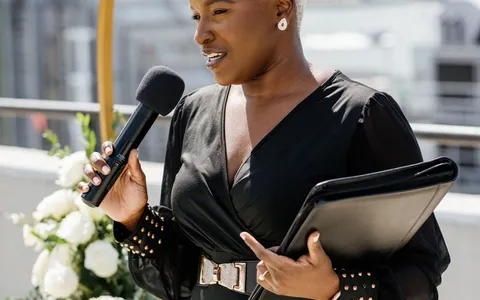
I’ve solemnized hundreds of weddings, and I’ve walked plenty of nervous first-time officiants, the friends and the siblings, through getting registered and signing the license correctly. I’ve also watched quiet paperwork failures throw a marriage’s legality into question years after the party ended. Let me save you that headache.
What does the officiant actually do that makes a marriage legal?
The vows are not the legal event. I know that stings a little, because the vows feel like the main event.
The legally operative moment is much plainer. The officiant has to be authorized in that jurisdiction, lead you both in declaring that you take each other as spouses in front of whatever witnesses the state requires, and then correctly complete and return your signed marriage license to the issuing clerk by the deadline. That return step is the one couples never think about, and it is the one I have watched go wrong most.
In several states the officiant also has to register with the county or state before the wedding, not just hold ordination. New York City (though no other part of New York State), New Jersey, Nevada, Maine, Minnesota, Arkansas, Louisiana, West Virginia, and Delaware all sit in that camp (The PCO). Skipping that pre-registration is one of the most common ways a well-meaning friend’s wedding gets challenged later. If you want the full breakdown of the role, I wrote a deeper piece on everything a wedding officiant is actually responsible for.
Which states let you get married without an officiant?
Here is the part most articles get vague about, so let me be specific. Self-marriage goes by two names you will see on official paperwork: self-uniting and self-solemnizing. They mean the couple, not a third party, legally marries themselves.
Here is the whole map at a glance, and the detail on each group follows.
| Where | Self-marriage |
|---|---|
| Colorado | Yes, no witnesses |
| Washington DC | Yes, no witnesses |
| Pennsylvania | Yes, two witnesses |
| California | Religious route only |
| Wisconsin | Religious route only |
| Kansas | Religious route only |
| Illinois | Religious route only |
| Nevada | Quakers and Friends |
| Maine | Quakers, Friends, Baha’i |
| New York | Quakers and Friends |
| Everywhere else | No |
Colorado and Washington DC are the two most permissive places in the country. Colorado asks for no officiant, no witnesses, no special application, and no religious affiliation. DC lets you officiate your own wedding with no one else present at all (Wikipedia). If marrying just the two of you, on your own terms, is the dream, those two are the easiest doors in the country.
Pennsylvania is the famous one. Its self-uniting marriage license traces back to 17th-century Quaker practice, the Religious Society of Friends marrying without clergy. Here is what people get wrong about it: it is open to every couple regardless of religion, but it asks for two witnesses to sign in place of an officiant. It also costs more than a standard license, and the price swings by county (Burgh Brides).
Then there is a third group where self-marriage exists, but only through a religious channel. Wisconsin, California, Kansas, and Illinois permit it when it follows the customs of a recognized religious society. Nevada and Maine carve out exemptions specifically for Quakers and Friends, with Maine also recognizing the Baha’i faith. California even issues a separate non-clergy marriage license, and it still requires two witness signatures (Wikipedia).
So here is the rule of thumb I give couples who ask.
Can a friend just get ordained online and marry us?
This is the route most couples reach for, and I love it when it works, because there is nothing like being married by someone who actually knows you. I coach friends and relatives through it constantly.
The catch is that online ordination is not accepted everywhere. A marriage performed by an online-ordained minister can be invalid or legally unclear in certain jurisdictions, historically including parts of Virginia and certain counties in New York and Pennsylvania (FindLaw). The cruel part is the timing. Couples almost never find out at the wedding. They find out years later at a divorce, a death, a bankruptcy, or a green-card interview, when fixing it is hard or impossible.
This is not a settled, sleepy area of law either. In 2019 Tennessee tried to ban online-ordained officiants outright. The Universal Life Church sued in federal court, won a restraining order within days, and the state finally settled in August 2023, agreeing never to prosecute a ULC minister (Universal Life Church). People are still arguing this in real courtrooms.
Couples almost never find out at the wedding. They find out years later at a divorce, a death, a bankruptcy, or a green-card interview.
So if a friend is going to do it, there are two things you cannot skip:
- Confirm with the clerk in the county where the wedding happens that online ordination is accepted there.
- If that county also requires pre-registration, get it done well ahead of the date.
My full walkthroughs on how a friend can legally officiate your wedding and the step-by-step of actually officiating cover the paperwork in detail.
Do you need an officiant to get married in New York?
Yes, and I get asked this weekly. New York does not allow secular self-solemnization, so marrying yourselves with no third party is off the table here.
The law, Domestic Relations Law Section 12, keeps it simple but firm: the marriage has to be solemnized by an authorized officiant, the two of you have to declare that you take each other as spouses, and at least one witness besides the officiant has to be present (Justia). No particular wording is required, which is why I can write you something personal instead of reciting a statute. New York does still recognize Quaker and Friends self-uniting marriages performed in that society’s traditional manner, so the one historical exception survives.
Here is the part that saves people: if you want a friend or relative to marry you in NYC, you do not have to gamble on online ordination at all. New York has a One-Day Marriage Officiant License. For $25, anyone 18 or older can legally perform one wedding without being clergy or a judge. The officiant does not have to be a New York resident and applies at the same town or city clerk’s office that issued the couple’s license, after the couple has it. For any NYC license that is the Manhattan office at 141 Worth Street, in person by appointment or by mail with a notarized application (NYC Office of the City Clerk). It is the clean, legitimate version of “have my brother marry us,” with none of the gray area. For the full picture of marrying in the five boroughs, license timing and all, see my guide to getting married in NYC.
What happens if the officiant was not actually authorized?
This is the nightmare scenario, so let me take the fear out of it with facts.
There are really two separate failures, and people blur them. One is an officiant who was never authorized in the first place. The other is an authorized officiant who simply never returns the signed license. These are not the same problem.
| Failure | Result |
|---|---|
| Never authorized | May be invalid |
| License not returned | Valid, unrecorded |
On the second one, the news is better than couples fear. In most states the marriage itself stays valid even if the license comes back late, and courts in California and Tennessee have held that an officiant’s failure to return the license on time does not by itself void the marriage (Church Law and Tax). New York works the same way: state law says even a missing license does not void a marriage between adults (N.Y. Domestic Relations Law 25). The catch is that “valid” and “officially recorded” are two different things. Until the completed license is filed, your state may have no record that you married, which is its own slow-motion problem for name changes, benefits, and proof of marriage.
So ask your officiant one direct question before the wedding:
“Are you registered or authorized in this exact county, and when will the signed license get back to the clerk?”
A real pro will answer both in one breath. Hesitation is your warning.
So, hire a pro or do it yourself?
Both are right answers. They are right for different couples.
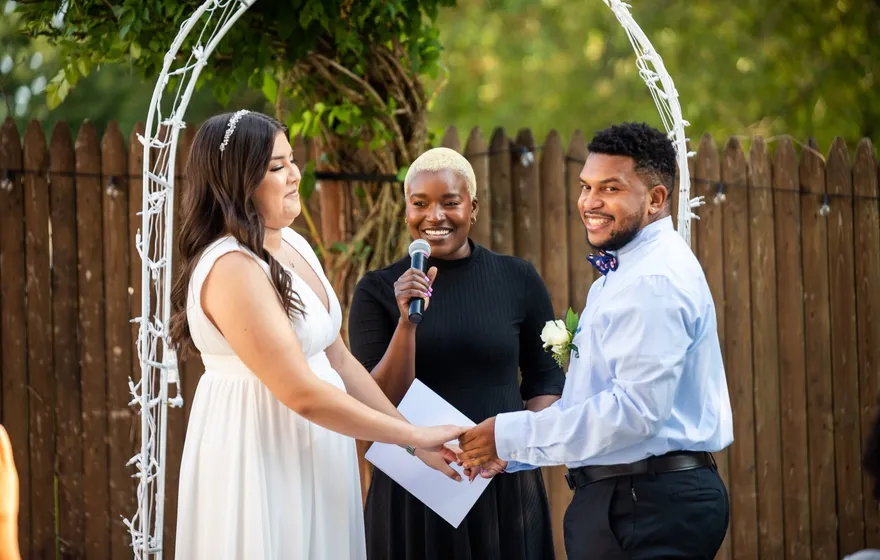
Go the self-uniting or friend-officiant route if:
- you are in a state that allows it
- you want the ceremony to feel homemade and personal
- you are willing to own the paperwork yourself
It is genuinely beautiful when the person marrying you has known you for twenty years. Just respect the rules of your specific county, because the romance does not survive a clerk’s rejection.
Hire a professional if:
- you want the legal side handled without a single second of worry
- your venue or family expects a certain polish
- nobody close to you wants the responsibility of getting the words and the license exactly right
The reason I exist is so that the couple, and everyone who loves them, gets to just be present that day.
You can still write the ceremony yourself
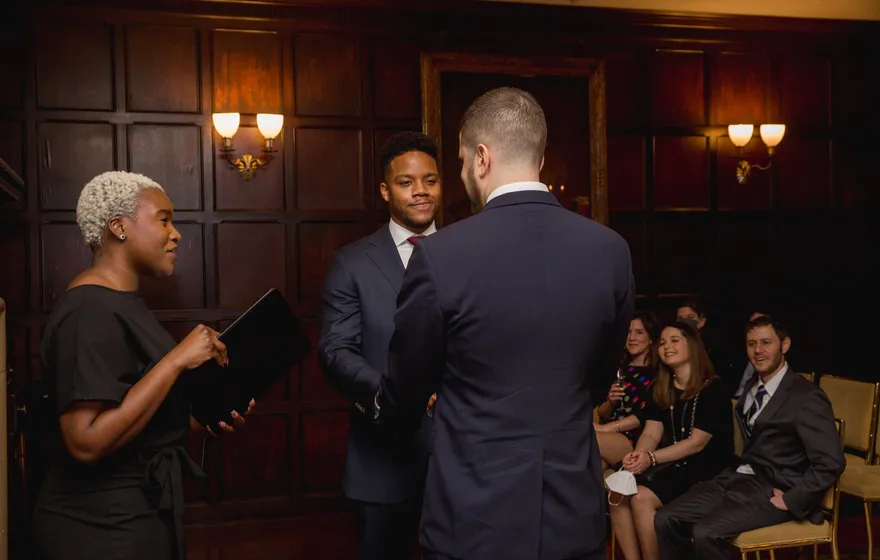
Here is what I tell couples taking the DIY path, whether that means self-uniting or a friend with a one-day license: the legal requirements are short, and everything else is yours to shape. In most places you only actually need the declaration of intent, the two of you saying you take each other as spouses. The rest is yours.
So you do not stare at a blank page, here is a complete, copy-ready ceremony you can use as-is or trim down to the legal bones.
Welcome:
“We are gathered, just as we are, to witness and celebrate the marriage of [Partner A] and [Partner B]. There is no crowd they would rather have than the one in front of them right now.”
(Pause. Let the room settle before going on.)
The Intention:
“[Partner A] and [Partner B], you have chosen each other freely, and you have chosen to make that choice permanent and public today. Marriage asks for honesty on the ordinary days and grace on the hard ones. You are saying yes to all of it.”
Declaration of Intent (the legally operative line):
(This is the part the law cares about. Each person answers clearly.)
“[Partner A], do you take [Partner B] to be your spouse, to have and to hold from this day forward?”
“I do.”
“[Partner B], do you take [Partner A] to be your spouse, to have and to hold from this day forward?”
“I do.”
The Vows (optional, personal):
“Speak your own words to each other now, or repeat after me: I give you my hands, my heart, and my honest days. I will keep choosing you.”
Ring Exchange (optional):
(Each partner places a ring while speaking.)
“I give you this ring as a sign of all I have promised.”
The Pronouncement:
“By the power vested in me, and with these witnesses present, it is my joy to declare you married. You may share your first kiss as spouses.”
(Officiant and couple sign the license here, in front of the witness. This signature, not the kiss, is the legal act.)
If you want a longer ceremony to adapt, I give a full one away, no charge, no catch. Grab a complete sample ceremony script here and make it yours.
When you want it to feel finished, not just legal
The legal minimum gets you married. It rarely gets you the ceremony you will want to remember.
When couples take the DIY route and then realize they want the words to actually sound like a real wedding, the wall they hit is structure: the order of things, the readings, the transitions that keep the moment from feeling like a form being read aloud. That is exactly what I built The Couple’s Ceremony Kit for. It hands you the full ceremony architecture, ready-to-use vow and reading options, and the wording for every section, so a self-uniting wedding or a friend-officiated one sounds like the two of you instead of a rushed signature, and it costs a fraction of hiring anyone.
Frequently asked questions
Do you legally need an officiant to get married?
In most US states, yes. A marriage is not legal until an authorized officiant solemnizes the ceremony and signs your marriage license. The exceptions are the handful of states that allow self-uniting or self-solemnizing marriages, with Colorado and Washington DC being the most permissive.
Can you marry yourself without an officiant?
Only in certain states. Colorado and DC let you marry with no officiant and no witnesses. Pennsylvania offers a self-uniting license open to everyone but requires two witnesses to sign. California, Wisconsin, Maine, Nevada, Kansas, and Illinois allow it only through a recognized religious society’s customs. Most states, including New York, do not permit secular self-solemnization.
Can a friend get ordained online and legally marry us?
Sometimes, but it depends on the county and state, and it carries real risk. Online ordination is not recognized everywhere, and the problem usually surfaces years later at a divorce, death, or immigration interview. Confirm with the county clerk where the wedding will happen, and in NYC consider the One-Day Marriage Officiant License, which avoids the gray area entirely.
What does a wedding officiant do that makes a marriage legal?
The legally operative parts are not the vows. The officiant has to be authorized in that jurisdiction, lead the couple in declaring they take each other as spouses in front of the required witnesses, then correctly complete and return the signed license to the issuing clerk on time. In several states the officiant also has to register with the county before the ceremony.
Is a marriage still valid if the officiant never returns the signed license?
In most states the marriage itself is usually still valid, and courts in California and Tennessee have held that a late return does not by itself void it. But “valid” and “officially recorded” are different. Until the license is filed, the state may have no record of your marriage, which causes problems for name changes and benefits. The exact outcome depends on your state.
The Couple’s Ceremony Kit
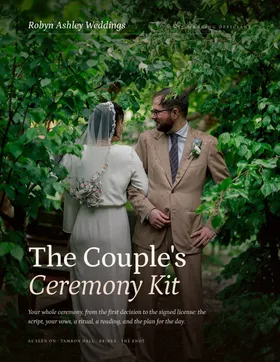
Walk in with a ceremony that sounds like the two of you
This post covers one part of the ceremony, and the Couple’s Ceremony Kit covers the rest, with five full scripts to start from and the prompts I use to help couples write their vows.
- Five full ceremony scripts in five different styles
- The Story Mine, thirty prompts for writing your vows
- Sixteen unity rituals, with the words and what to gather
- Thirty readings, each with my notes on when it fits
OFFICIANT
How to Officiate a Wedding: A First-Timer's Step-by-Step Guide (2026)
How to officiate a wedding when you've never done it before, from someone who's coached a lot of nervous first-timers through their first ceremony.
READ →
OFFICIANT
The One-Day Officiant License in NYC: How It Actually Works (2026)
NYC has two ways to legally officiate a wedding, and most articles confuse them. Here's the one-day license, the full registration, and which is yours.
READ →
OFFICIANT
Can a Friend Officiate Your Wedding? The Honest Guide (2026)
How to have a friend legally officiate your wedding, write the ceremony, and avoid the one mistake that actually matters, from an NYC officiant who's seen it go both ways.
READ →